HMRC to appeal VAT cut on public EV chargers to 5%
HMRC will appeal a tribunal ruling that public EV charging should attract 5% VAT. What it could mean for charging costs, operators and drivers.

Oliver Johansson
21 April 2026
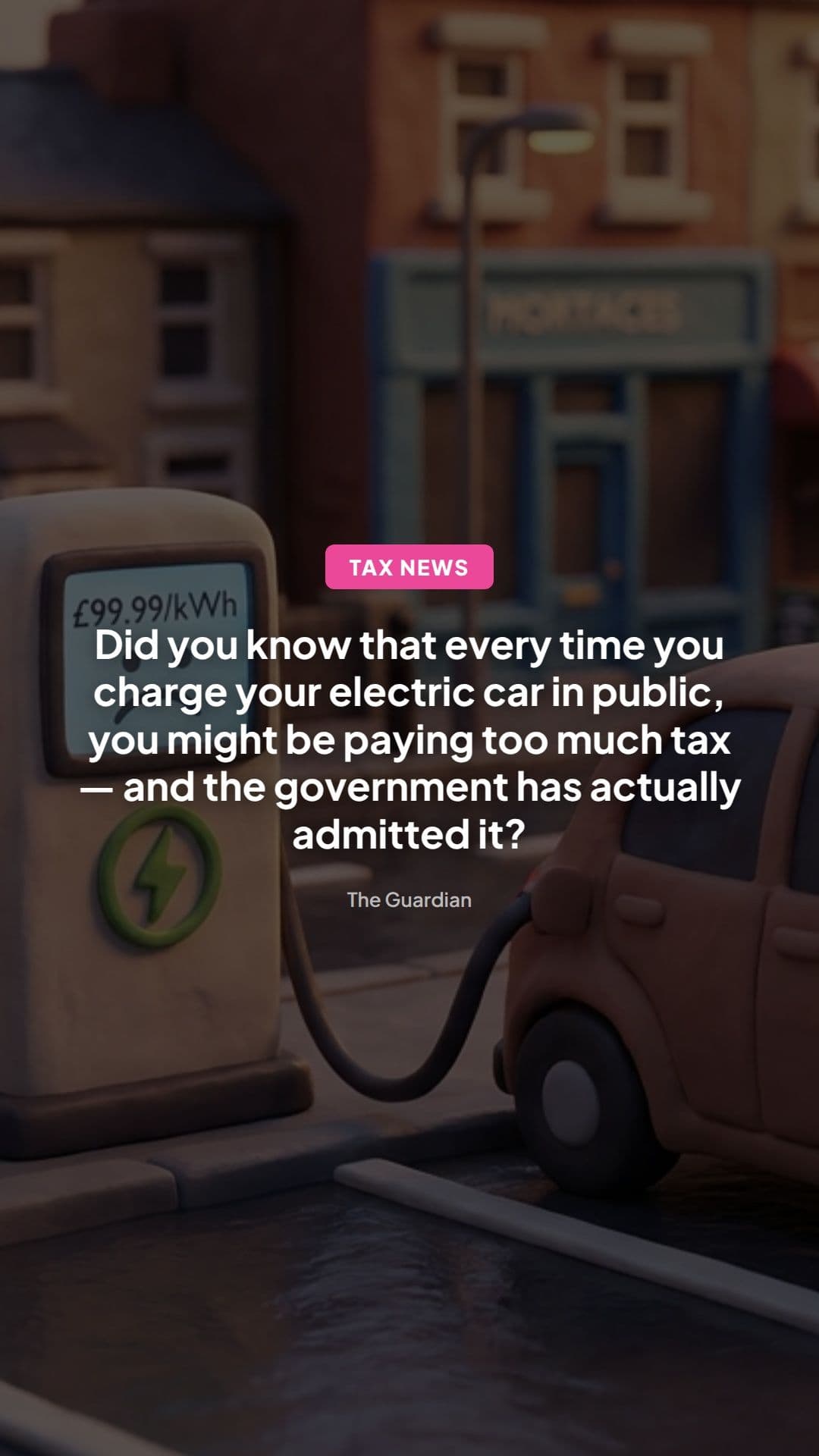
The VAT Battle Over Public EV Charging: What It Really Means for UK Drivers
A tax tribunal ruling could slash the cost of charging your electric car in public — but the government is fighting back. Here's everything you need to know.
Imagine filling up your petrol car and being charged a higher rate of VAT than your neighbour filling up at home. You'd rightly consider that unfair. Yet that's essentially what has been happening to electric vehicle drivers using public chargers across the UK for years — and a landmark tax tribunal ruling says the government has been getting it wrong all along.
The story broke via The Guardian in April 2026: HMRC has confirmed it will appeal a London tax tribunal decision that found the UK government has been overcharging VAT on public EV charging. If the original ruling stands, some public charging sessions could see VAT drop from 20% to 5% — a reduction that could meaningfully cut costs for millions of drivers. But with HMRC digging in for a legal fight, the outcome is far from certain. Let's unpack what's really going on.
What Actually Happened at the Tribunal
The case centres on a fundamental question of VAT classification: should electricity supplied through public EV chargers be treated as a standard-rated supply (attracting 20% VAT) or as a domestic energy supply (attracting the reduced 5% rate)?
Under the Value Added Tax Act 1994, Schedule 7A specifically provides for a reduced 5% VAT rate on the supply of electricity for domestic or residential use. The argument put before the First-tier Tax Tribunal in London was straightforward in principle: when a driver charges their electric vehicle, they are ultimately using that electricity for domestic purposes — to power their private car for personal transport — and therefore the lower rate should apply, at least in certain circumstances.
The tribunal agreed, at least in part. The ruling found that HMRC had been incorrectly applying the standard 20% rate to some categories of public EV charging, and that the reduced 5% rate was appropriate in those cases. This is not a trivial distinction. On a £30 charging session, the difference between 5% and 20% VAT amounts to roughly £3.75 — and across millions of charging sessions per year, the cumulative impact is enormous.
HMRC's response? To appeal the decision, meaning the ruling is currently stayed and does not immediately change what charger operators must charge or remit to the taxman.
Why This Matters: The Inequality at the Heart of EV Charging
To understand why this ruling is so significant, you need to appreciate the deeply uneven tax landscape that UK EV drivers have been navigating.
Electricity used at home to charge an EV already attracts the 5% reduced VAT rate, the same as all domestic energy. Electricity used at public chargers, however, has been taxed at the full 20% standard rate. This creates a glaring disparity: drivers who own their homes and can install a home charger enjoy a significant tax advantage over those who rely entirely on public infrastructure — typically renters, flat-dwellers, and people in older housing stock without off-street parking.
The RAC, AA, and various EV advocacy groups have been highlighting this inequity for years. According to data from Zap-Map and various energy analysts, public charging can already cost two to three times more per mile than home charging even before the VAT differential is factored in. The 20% VAT rate only widens that gap further.
This isn't just an abstract fairness argument. The UK government's own Zero Emission Vehicle (ZEV) mandate requires that 80% of new cars sold must be zero emission by 2030, rising to 100% by 2035. If public charging remains significantly more expensive than home charging — partly due to a tax quirk — it actively undermines the policy goals the government has set itself.
The Legal Angle: VAT Law, Precedent, and the Road Ahead
The legal framework here is worth examining closely, because it explains both why the tribunal ruled as it did and why HMRC is contesting it.
Schedule 7A of the VAT Act 1994 sets out "reduced rate supplies" — those eligible for the 5% rate. Group 1 of that schedule covers supplies of fuel and power for qualifying use, which includes domestic use. The crux of the argument is whether electricity supplied at a public charger constitutes a "supply for domestic use" within the meaning of the legislation.
HMRC's longstanding position has been that it does not — that the supply is made to a commercial entity (the charger operator) who then sells it on, and that the end use by a private individual does not automatically confer domestic status on the original supply. The tribunal, however, appears to have taken a more purposive approach, looking at the nature of the ultimate use rather than the commercial structure of the supply chain.
This distinction matters enormously in VAT law. UK courts and tribunals have historically grappled with the "economic reality" versus "legal form" debate in VAT cases — a tension that runs through EU VAT case law inherited into UK law post-Brexit via the Retained EU Law (Revocation and Reform) Act 2023. While the UK is no longer bound by new CJEU decisions, existing case law at the point of Brexit remains influential in domestic tribunals.
If HMRC's appeal goes to the Upper Tribunal and potentially beyond, it could take years to resolve. In the meantime, charger operators face genuine uncertainty about their VAT obligations — a situation that is unlikely to encourage the infrastructure investment the country desperately needs.
What Drivers Should Know Right Now
Given the legal uncertainty, here's what you need to understand as an EV driver using public infrastructure today:
1. Nothing changes immediately. HMRC's appeal means the tribunal ruling does not currently take effect. Charger operators will continue to apply 20% VAT on public charging sessions in the interim. Do not expect to see lower prices at the pump — or charger — just yet.
2. Keep your charging receipts. This sounds mundane, but it matters. If the ruling is ultimately upheld and applies retrospectively, there may be mechanisms for operators to pass on refunds or credits to customers. Having records of your charging sessions, costs, and the VAT paid could be relevant. Most charging apps — Osprey, Pod Point, BP Pulse, Gridserve — provide digital transaction histories. Download and save these regularly.
3. Compare your charging costs carefully. Even at 20% VAT, public charging rates vary enormously between networks. Some rapid chargers now charge upwards of 85p per kWh, while others remain closer to 50p. The VAT element is only one component of the price — network margins, grid connection costs, and location all play a role.
4. Lobby your MP. The VAT disparity between home and public charging is a political choice as much as a legal one. The government could legislate to apply the 5% rate to public charging without waiting for tribunal outcomes. Several MPs have already raised this in Parliament. Writing to your representative costs nothing and adds to the pressure.
5. Understand your rights if prices change. If the ruling is eventually upheld and operators reduce prices, any existing charging contracts or subscription plans (many networks offer monthly packages) may need to be reviewed. Check the terms of any EV charging subscription you hold regarding price variation clauses.
Looking Ahead: A Defining Moment for EV Infrastructure
The HMRC appeal is more than a technical tax dispute. It sits at the intersection of climate policy, social equity, and fiscal strategy — and the outcome will have consequences well beyond the immediate question of VAT rates.
For charger operators, the uncertainty is genuinely problematic. Companies like Gridserve, Osprey, and InstaVolt are making multi-million-pound investment decisions about where to build new hubs, what technology to deploy, and what pricing models are viable. A potential 15-percentage-point reduction in VAT on their revenue changes the economics of those decisions significantly. Some operators have quietly welcomed the tribunal ruling; none will say so loudly while the appeal is live.
For the government, the tension is obvious. Cutting VAT on public charging to 5% would cost the Treasury money in the short term — estimates suggest hundreds of millions of pounds annually as EV uptake grows. But maintaining the 20% rate risks being seen as a stealth tax on the EV transition, particularly hitting those least able to afford home charging infrastructure.
For drivers, the longer-term picture is potentially positive. If the 5% rate is confirmed — either through the courts or through a government policy change — it would represent the most significant reduction in public charging costs in years, without any technological breakthrough required. The savings would be most meaningful for the highest-mileage public charging users: taxi drivers, delivery workers, and those in urban flats who have no access to home charging.
One thing is clear: the UK cannot credibly mandate a near-total shift to electric vehicles by 2035 while simultaneously taxing the public charging infrastructure that underpins that transition at four times the rate applied to home energy. Whether the resolution comes through the courts, Parliament, or a future Budget statement, this anomaly cannot survive indefinitely.
The tribunal has opened a door. Whether HMRC can push it shut again — and whether the government would want to even if it could — is the question that will define public EV charging economics for the decade ahead.
Source: The Guardian, 21 April 2026. Analysis and commentary are original.
Written by
Oliver Johansson
Traffic Management Consultant
Ready to Challenge Your Ticket?
Let our AI analyse your PCN and generate a professional appeal letter in minutes.
Start Free Appeal