Havering PCN refused: parking without payment lesson
London Borough of Havering PCN appeal refused for “parked without payment”. What the tribunal looked for and how to avoid the same mistake.

Carlos Mendoza
15 May 2026
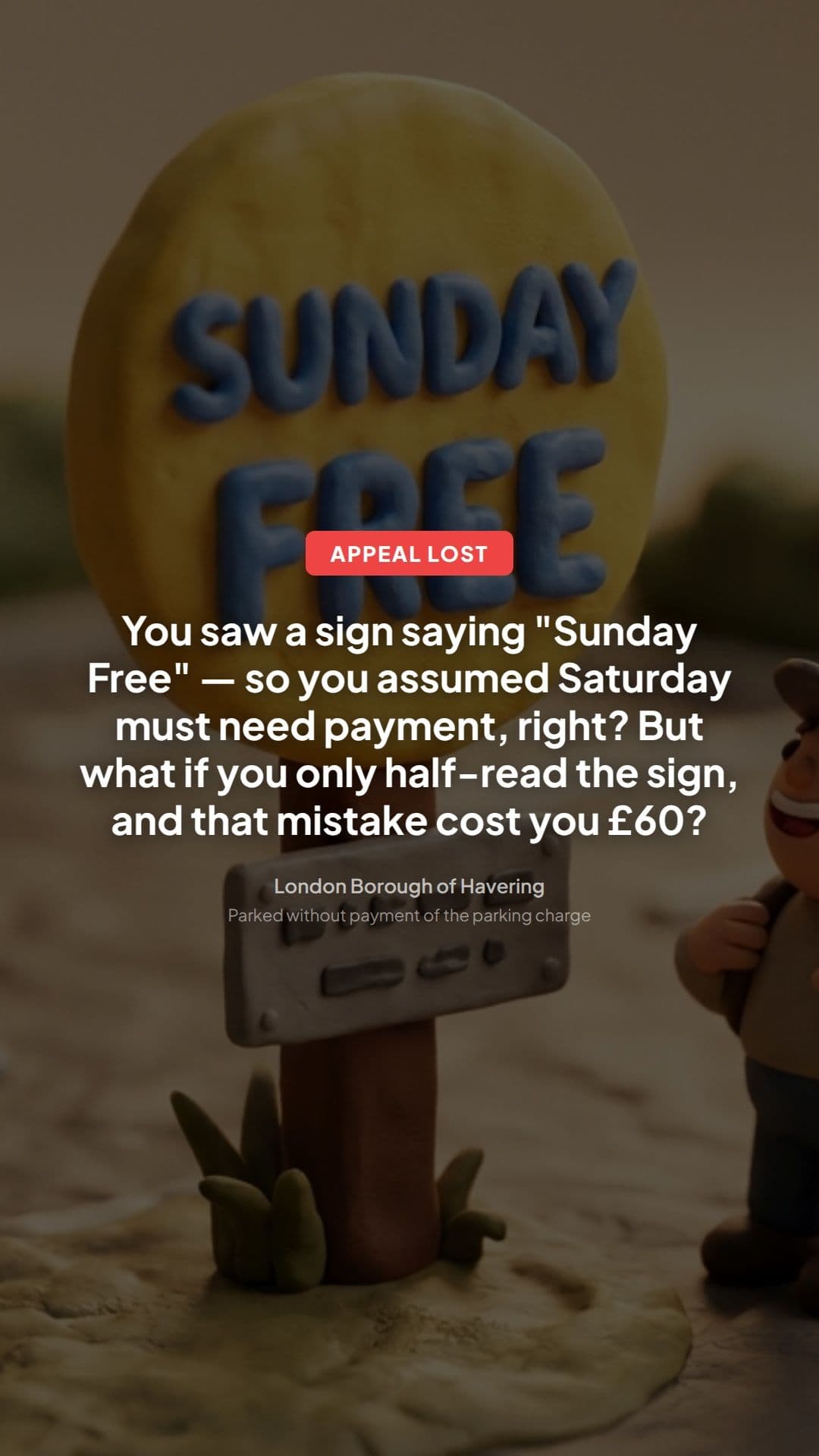
When "Sunday Free" Isn't Free on Saturday: The Havering Pay-by-Phone Case Every Driver Should Read
There is a particular kind of frustration that comes from receiving a parking fine when you genuinely believed you were doing nothing wrong. You saw a sign, you read it, you parked — and then a yellow envelope appeared under your wiper. This case from the London Borough of Havering captures that frustration perfectly. But it also reveals something important about how parking law actually works in Britain, and why good intentions count for very little at a tribunal.
What Happened
A driver parked in a Havering car park on a Saturday afternoon at 1:44pm. She did not pay for parking. When the Penalty Charge Notice (PCN) arrived, she appealed — not by denying she had failed to pay, but by arguing that the signage had misled her.
Her account was straightforward and, frankly, understandable. She had spotted a prominent sign indicating "Sunday Free" — meaning parking was free on Sundays. Seeing that, she appears to have assumed that either parking was also free on the day she visited, or that the free-parking arrangement extended more broadly than it actually did. It was only afterwards that she noticed a handwritten note attached to the conditions of use plate — a note added by a member of the public, not the council — which warned drivers about the payment requirement.
She submitted a photograph to support her account.
The council, meanwhile, provided photographs taken by the Civil Enforcement Officer at the time of issue. Those photographs showed the official conditions of use plate clearly stating that between 8am and 6pm on Saturdays, drivers could park for up to five hours — but only if they registered a session through the pay-by-phone provider. No session had been registered. No payment had been made.
The adjudicator refused the appeal.
What Each Side Argued
The driver's case rested on the quality and clarity of the signage. She argued that the large "Sunday Free" sign was the dominant visual message, and that the relevant payment conditions were not sufficiently clear. The handwritten warning, she suggested, indicated that even members of the public recognised that the signage was confusing enough to warrant an unofficial addition.
It is worth pausing on that point, because it is actually quite a clever argument. If the official signs were perfectly clear, why would a passer-by feel the need to scrawl a warning on them? That said, the adjudicator was not persuaded.
The council's case was simpler: the conditions of use plate was present, legible, and unambiguous. It stated the payment requirement clearly. The pay-by-phone session requirement was not hidden — it was on the official signage. The driver had not registered a session and had not paid.
The Decision
The adjudicator refused the appeal and found that the contravention had occurred. The PCN had been properly issued and properly served. No exemption applied.
The driver's genuine mistake was acknowledged — but treated as mitigation, not as a legal defence. Her financial hardship argument was also noted but dismissed, because adjudicators simply do not have the power to cancel a PCN on those grounds.
Breaking Down the Legal Reasoning
This decision turns on several distinct legal points, each of which is worth understanding clearly.
1. Not paying is the contravention — full stop
The legal basis for this PCN was simple: the vehicle was parked without payment of the parking charge. The driver did not dispute this. That admission, in legal terms, is significant. Once you concede the core fact — that you did not pay — the burden shifts entirely to you to show either that an exemption applies, or that the PCN was not properly issued. Neither applied here.
2. The "Sunday Free" sign did not create a general exemption
This is the crux of the case. The driver appears to have seen a sign about Sunday parking and drawn an inference that either did not follow logically, or that she did not fully verify. In UK parking law, signage must be read in its entirety. A sign saying parking is free on Sundays tells you something specific about Sundays — it tells you nothing about Saturdays.
The adjudicator applied a well-established principle: a motorist must not assume restrictions and must check all relevant signage. This is not a harsh or obscure rule. It is the foundation of how parking enforcement works. If drivers could rely on partial reading of signs, enforcement would become almost impossible.
3. The handwritten note cuts both ways
The driver argued that the handwritten public warning demonstrated the official signage was inadequate. The adjudicator disagreed, and here is why that reasoning holds up: the official conditions of use plate was present and readable. A member of the public adding an extra warning does not make the official sign deficient — if anything, it confirms that the payment requirement was known to people who had read the sign properly.
The adjudicator concluded that a motorist giving the signage appropriate attention would have understood they needed to register a pay-by-phone session.
4. Mitigation is not a defence
This is one of the most important distinctions in UK parking tribunal law, and one that catches many drivers out. An adjudicator's role is to determine whether a contravention occurred and whether the PCN was properly issued. They cannot cancel a PCN simply because the driver made an honest mistake, had a good reason, or is in financial difficulty.
The Traffic Management Act 2004, which governs civil parking enforcement in England and Wales, gives adjudicators specific powers — and cancelling a PCN on compassionate or mitigating grounds is not among them. That power rests with the enforcement authority alone, as a matter of discretion. Adjudicators are bound by the law as written, not by what seems fair in the circumstances.
5. The pay-by-phone system creates a specific obligation
Pay-by-phone parking is now commonplace across London and much of England. But it carries a specific legal requirement: you must actively register a session. Unlike a pay-and-display machine, where you might argue your ticket blew off the dashboard, a pay-by-phone system creates a digital record. Either a session was registered for your vehicle registration number at that location and time — or it was not. In this case, it was not.
Lessons for Drivers
1. Read every sign — not just the prominent one
A large, eye-catching sign is not necessarily the legally operative one. The conditions of use plate — often smaller and more detailed — is where the actual rules live. If you see a "Sunday Free" sign, that tells you about Sundays. It tells you nothing else until you have read everything else on display.
2. Pay-by-phone means you must actively register
Parking in a pay-by-phone bay without registering a session is not a grey area. There is no ambiguity, no partial compliance, no "I meant to do it." Either a session exists on the system for your vehicle, or you have not paid. Check your phone, check your confirmation, and keep the record.
3. A genuine mistake is not a legal defence
This is uncomfortable but true. UK parking tribunals are not courts of equity — they cannot simply do what seems fair. If you made an honest error, your best hope is to appeal directly to the council at the informal stage and ask them to exercise their discretion to cancel. Councils can and sometimes do cancel PCNs on goodwill grounds. Adjudicators cannot.
4. Photograph the signage before you appeal
The driver here did provide a photograph, which helped establish her account. If you are challenging signage, photograph all the signs in the vicinity — not just the one that supports your argument. Incomplete photographic evidence can undermine an otherwise reasonable case.
5. Financial hardship cannot be raised at tribunal
It is worth knowing this before you appeal. If your concern is primarily about the financial impact of the fine, raise it with the council directly and early — not at tribunal. Adjudicators have no power to act on it, and raising it at that stage will not help your case.
The Key Takeaway
Parking law rewards drivers who read all the signs, not the ones who read the most prominent sign. The moment you park without completing the required payment step — whether that is inserting coins, displaying a ticket, or registering a pay-by-phone session — the contravention is complete. Good intentions, confusing signage, and financial hardship may all be real and valid concerns, but none of them can substitute for the one thing that actually matters: paying correctly before you walk away from your car.
When in doubt, spend an extra two minutes reading every sign in the bay. It is considerably less time than an appeal takes — and considerably cheaper than the fine.
Written by
Carlos Mendoza
Parking Technology Analyst
Ready to Challenge Your Ticket?
Let our AI analyse your PCN and generate a professional appeal letter in minutes.
Start Free Appeal