
Havering Disc Parking PCN Appeal Allowed: Key Lesson
A Havering driver won a disc parking PCN appeal. Learn what evidence, signage checks and procedural points can help challenge a council penalty charge notice.

The Parking Ticket Pal Editorial Team
15 September 2026
When Your Car Gets a Parking Ticket While the Police Have Your Keys
Why This Case Matters
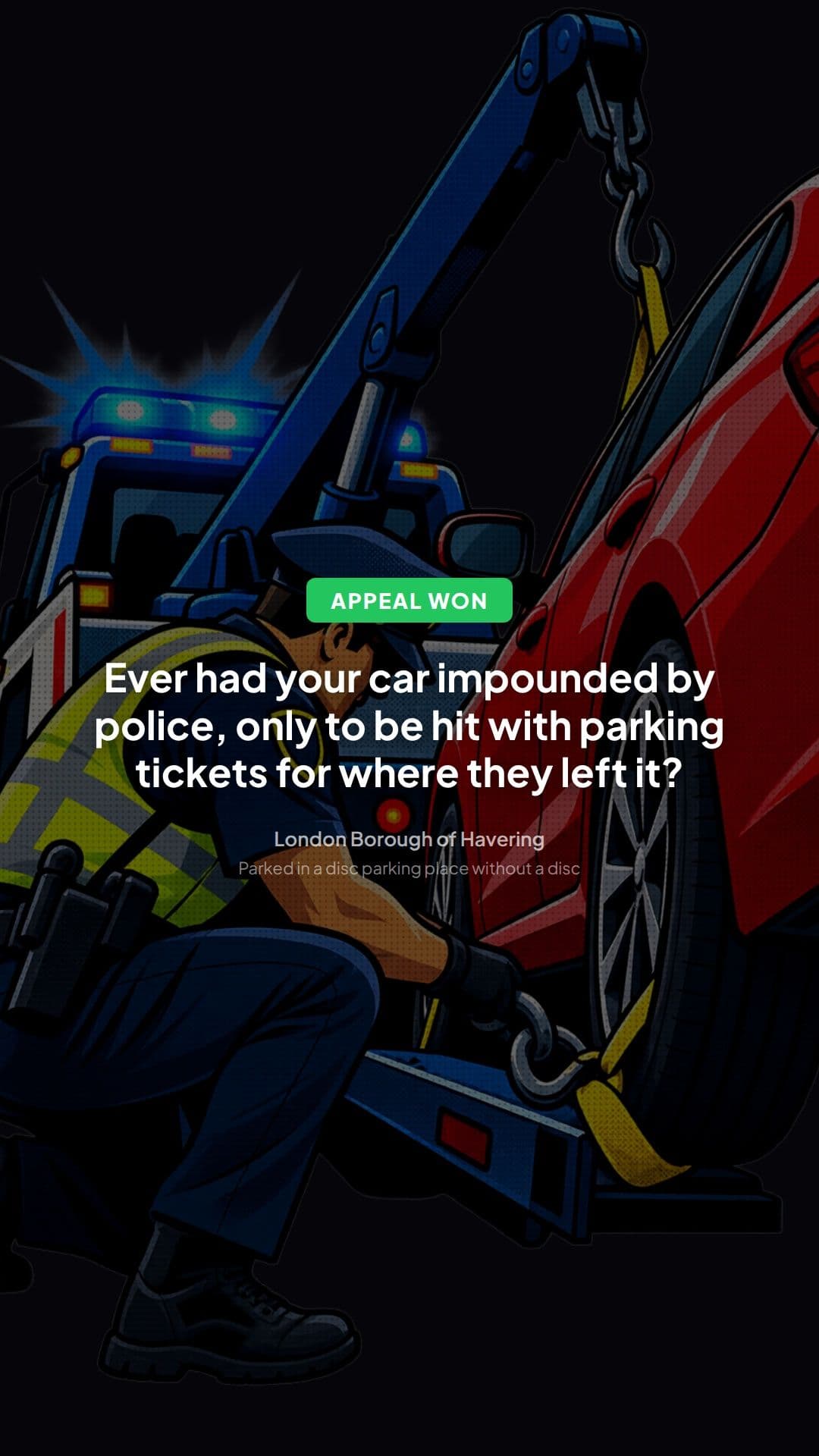
Picture this: you're arrested, your car is confiscated, and by the time you get it back it's covered in parking tickets for a spot you never chose to park in. It sounds like the setup for a bad joke, but for one Havering driver in early 2001, it was very real. This case is a brilliant reminder that parking law hinges on a simple but often overlooked question: were you actually in control of where your car ended up?
For drivers who've had their vehicle moved, towed, or repositioned by someone else entirely, whether that's the police, a garage, or even a thief, this case offers real reassurance that councils cannot simply assume you're responsible just because your name is on the vehicle registration.
The Case: A Car, A Confiscation, and a Street Called Southdown Road
The driver at the centre of this case, Miss Hallums, found herself facing a stack of Penalty Charge Notices (PCNs) issued by the London Borough of Havering between 2 January and 23 January 2001. Every single ticket was for the same contravention: parking in a disc parking place without clearly displaying a valid disc, on a street called Southdown Road.
Here's where it gets interesting. Miss Hallums hadn't parked the car there herself. Weeks earlier, on 18 December 2000, she'd been involved in a driving offence that led to the police confiscating both her vehicle and her keys. She was initially told the car had been taken to Hornchurch Police Station. When she eventually got her keys back several days later, she was informed the vehicle was actually in Southdown Road, but crucially, nobody told her it was parked somewhere with parking restrictions attached.
By the time she finally retrieved her car, it had accumulated a substantial pile of penalty notices, all racked up while sitting in a spot she had no say in choosing.
The Arguments: Who's Responsible When You're Not the One Parking?
Havering Council's position was straightforward, if a little unsympathetic to the circumstances: Miss Hallums should have moved her vehicle within a reasonable amount of time once she became aware of where it was. In other words, even if she didn't park it there, she had a duty to sort it out promptly once she knew its location.
Miss Hallums's response was equally simple. She didn't know the car was in a restricted parking area. She'd been told where it was, but not that it was somewhere she needed to worry about displaying a parking disc. As far as she was concerned, if the police had left it there, why would she assume it needed moving?
This is really a dispute about knowledge and reasonable assumptions. The council's argument only holds water if Miss Hallums knew, or should have known, that the parking spot came with strings attached.
The Decision: Appeal Allowed
The adjudicator sided with Miss Hallums and allowed every single one of the appeals. The reasoning was refreshingly logical.
The adjudicator noted that if there had been evidence showing Miss Hallums knew the vehicle was parked somewhere restricted, the council's argument that she should have moved it promptly would have carried weight. But there was no such evidence.
More importantly, the adjudicator made a key observation: if a vehicle has been parked by the police, it's entirely reasonable for the owner to assume it's been parked legally. Why would you think you needed to move a car that law enforcement themselves had positioned? There would be no obvious red flag prompting Miss Hallums to think, "I'd better shift this before it racks up fines."
Ultimately, the adjudicator concluded that the vehicle had been parked by someone without Miss Hallums's consent, and that finding was enough to unravel the entire batch of penalty notices.
The Legal Reasoning, Unpacked
At the heart of this decision is a principle that runs through much of UK parking law: liability generally follows control. If you didn't choose where the car was parked, and you had no reasonable way of knowing it was breaking the rules, it becomes very difficult for a council to pin the resulting penalty on you.
This isn't a free pass for anyone who says "I didn't park it there." The adjudicator was clear that the outcome would have been different if there had been evidence that Miss Hallums knew about the restrictions and simply failed to act. The burden was on the council to show that knowledge, or at least to show that she'd been given proper information and had time to respond. Havering couldn't produce that evidence, and their case collapsed as a result.
There's also an interesting assumption baked into the decision: that being told your car is "in police custody" or "at a police station" creates a reasonable expectation of lawful, careful handling. When that expectation turns out to be wrong (because the car ends up on a restricted street instead), it's not fair to transfer the consequences onto the driver who trusted the process.
This principle occasionally surfaces in other contexts too, such as cases involving stolen vehicles or cars sold to new owners where the paperwork hasn't caught up. If you're dealing with a similar situation, our guide on handling parking fines on a stolen vehicle covers related territory in more depth.
Lessons for Drivers
This case, unusual as it is, offers several genuinely useful takeaways:
Keep a paper trail of communications. Miss Hallums's case succeeded partly because there was no evidence she'd been told about the restrictions. If you ever find yourself in a situation where a third party (police, a garage, a recovery firm) moves your vehicle, try to get written confirmation of where it's been left and any conditions attached. Even a text message or email exchange could prove invaluable later.
Don't assume all is fine, but don't panic either. If you discover your car has been moved without your input, it's worth checking the location yourself as soon as practically possible, even if you've been told it's fine. This case succeeded because there was no evidence of prior knowledge, but a quick check could have avoided weeks of accumulating tickets altogether.
Knowledge is central to your defence. If you're appealing a PCN on the grounds that you weren't the one who parked the vehicle unlawfully, focus your evidence on demonstrating what you knew and when. Adjudicators want to see whether a reasonable person in your position would have realised there was a problem.
Consent matters as much as parking itself. This case reinforces that the person who owns a vehicle isn't automatically liable for every contravention if they didn't consent to how or where it was parked. That principle can apply in other unusual situations too, such as when a vehicle is parked by a stranger, a family member without permission, or during a dispute over ownership.
Formal representations can succeed even against seemingly stacked odds. Facing a huge pile of PCNs can feel overwhelming, but if the underlying facts are on your side, it's worth pursuing a formal challenge. For anyone unsure how to structure this kind of argument, our guide to formal representations for PCNs walks through the general process.
If you're dealing with something similar today, whether that's a vehicle moved without your consent or confusion over responsibility for a parking contravention, it's always worth checking official guidance from the Traffic Penalty Tribunal or seeking professional advice, since every case turns on its own specific facts and evidence.
Key Takeaway
If someone else, particularly an authority like the police, moves your car without your consent or full knowledge, you are not automatically on the hook for every parking ticket that follows. Responsibility follows knowledge and control, and if you genuinely didn't know your vehicle was breaking the rules, that's a defence worth pursuing rather than quietly paying up.
Written by
The Parking Ticket Pal Editorial Team
Source-checked parking guidance
Ready to Challenge Your Ticket?
Let our AI analyse your PCN and generate a professional appeal letter in minutes.
Start Free Appeal