Hammersmith PCN Appeal Allowed: Loading Ban Lesson
A Hammersmith and Fulham PCN appeal was allowed after a loading-ban allegation. Learn what evidence drivers need to challenge prohibited parking claims.

Lisa Rodriguez
17 August 2026
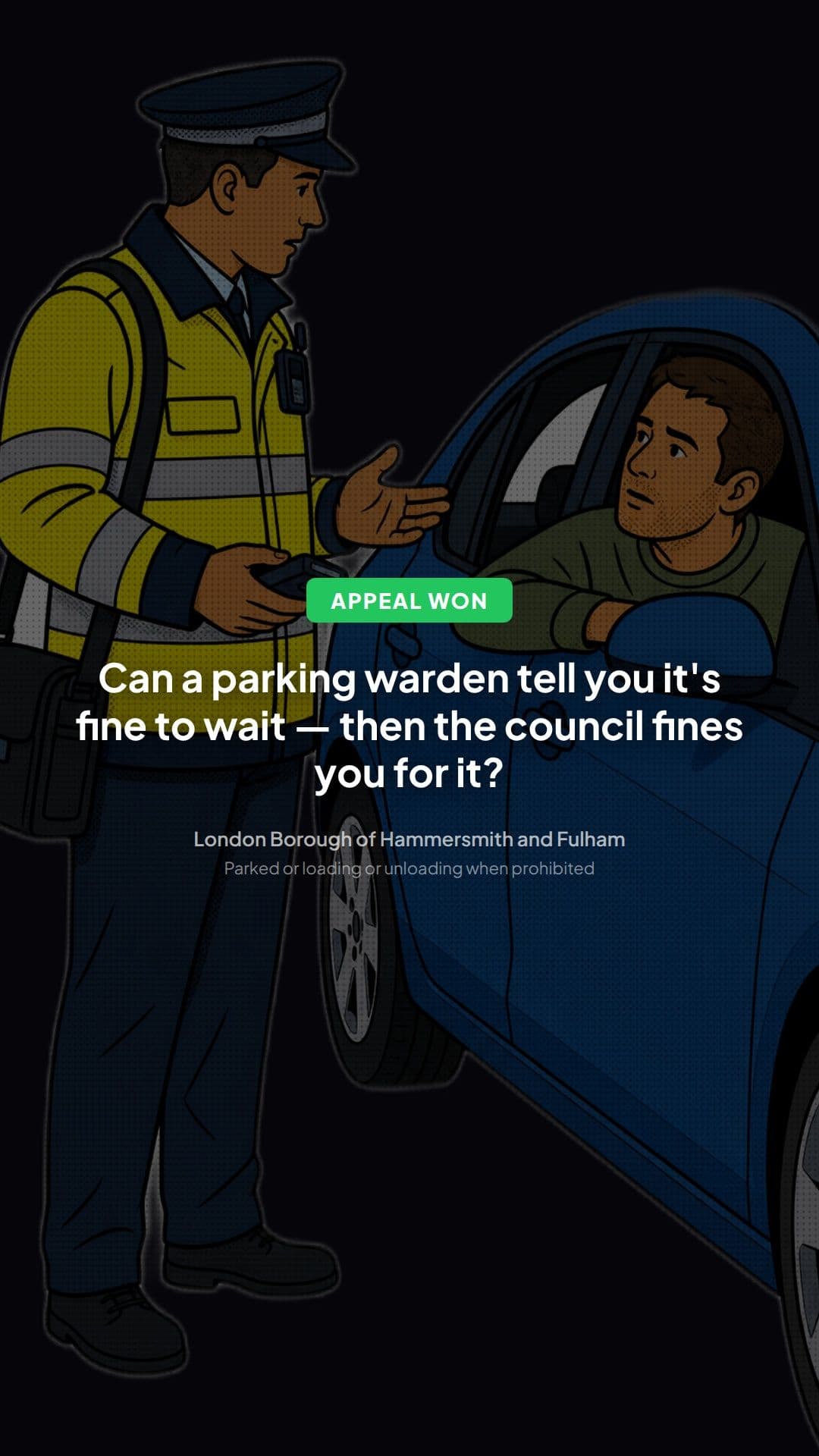
When a Council's Own Staff Tell You to Wait, Can They Then Fine You? One Driver's Win Says No
Picture the scene: you're outside a Tube station, waiting to collect someone who uses a wheelchair. A parking attendant walks over, not to hand you a ticket, but to give you instructions on how to wait there without breaking the rules. You follow those instructions to the letter. Weeks later, a Penalty Charge Notice lands on your doormat anyway.
That's exactly what happened to the Appellant's husband in a recent case against the London Borough of Hammersmith and Fulham, and it's a case that every driver who's ever been given verbal guidance by a warden should know about.
The Case
Mr Arnold, driving his wife's car, headed to Hammersmith to pick up a disabled passenger from the underground station. While he waited outside, two parking attendants approached him. Rather than warning him off, they gave him a workaround: he couldn't simply sit there indefinitely, but he could drive around the block, come back, pause briefly to check whether his passenger had arrived, and repeat the loop if she hadn't.
He did exactly that. At some point during one of these brief pauses, the council's enforcement camera caught his vehicle and issued a PCN for "parked or loading or unloading when prohibited."
Mr Arnold appealed, and the case went to a tribunal adjudicator.
The Arguments
Mr Arnold's case was straightforward. He said two council parking attendants had personally told him how to wait for his passenger without falling foul of the restrictions, and he had simply done what they told him. When the camera caught him, he was mid-loop, waiting briefly exactly as instructed.
Crucially, the council didn't turn up with a witness or evidence to contradict this account. There was no statement from the attendants in question, no CCTV showing a different conversation, nothing to challenge Mr Arnold's version of events. The Authority appears to have relied on the camera evidence alone, treating the contravention as a simple, technical breach of the parking restriction.
The Decision
The adjudicator allowed the appeal. Having watched Mr Arnold give evidence, the adjudicator found him "an honest and credible witness" and accepted his account in full. That mattered enormously, because with no evidence from the council to contradict him, his story stood unchallenged.
The adjudicator made a specific finding of fact: the two parking attendants were acting as agents of the council at the time, and they had given Mr Arnold permission to wait where he did, in the manner they described. Because of that, the adjudicator ruled that Mr Arnold had a "legitimate expectation" that following those instructions would not result in a ticket. The council, having effectively authorised the very behaviour it was now trying to penalise, was not entitled to enforce the charge.
The Legal Reasoning, Explained
This case turns on a concept called legitimate expectation, which sounds like classic legalese but is actually a fairly intuitive idea once you break it down.
In plain terms, legitimate expectation means this: if a public body (or someone acting on its behalf) makes a clear promise or gives clear assurance about how it will treat you, and you reasonably rely on that assurance, the public body generally can't then turn around and act against that promise. It's a fairness principle. Public authorities, including councils, are expected to behave consistently and not pull the rug out from under people who've relied in good faith on what they were told.
Here, the key building blocks were:
1. The attendants were treated as "agents of the Authority." This is important. A parking attendant on the street isn't just a random person; they're acting on behalf of the council when carrying out enforcement duties. So when they gave Mr Arnold instructions, the adjudicator treated that as the council itself effectively speaking, not some unofficial bystander whose word carried no weight.
2. Uncontradicted evidence carries real weight. Tribunals decide cases on the evidence in front of them. Mr Arnold gave a clear, detailed account, and the council didn't produce anything to challenge it. Adjudicators aren't obliged to accept everything a driver says just because the council stays silent, but where a witness is found credible and nothing rebuts their account, that account is very likely to be accepted as fact.
3. Permission plus reliance equals legitimate expectation. It wasn't enough that Mr Arnold merely believed he wouldn't be fined. He was specifically told what to do by the people enforcing the rules, and he acted on that instruction. That combination, specific assurance and genuine reliance, is what tipped this into a legally recognised legitimate expectation, rather than just a driver's optimistic assumption.
4. The result: the council couldn't enforce the charge. Because the situation the camera captured was the direct result of following the attendants' own advice, enforcing the PCN would have been fundamentally unfair. The adjudicator's ruling effectively said the council can't have it both ways: it can't instruct a driver on how to behave and then penalise them for behaving exactly that way.
Lessons for Drivers
This case is unusual because most disputes over PCNs revolve around signage, road markings, or technical timing issues. Here, the entire outcome hinged on a conversation. That creates some genuinely practical lessons.
- If a parking attendant gives you specific verbal instructions, note down exactly what was said, when, and by whom. Details matter. Mr Arnold could clearly recall being told to drive around the block and return briefly. Vague recollections are far weaker at tribunal than a specific, consistent account.
- Try to get something in writing or some form of corroboration where possible. This case succeeded partly because the council failed to produce any contradicting evidence. That won't always happen. If you can note a warden's badge number, ask for their name, or even ask a bystander to witness the conversation, you strengthen your position considerably.
- Being a credible, consistent witness matters enormously at tribunal. Adjudicators assess honesty and credibility directly. Turning up, explaining your situation clearly and calmly, and not overstating your case all help.
- Don't assume a verbal instruction from council staff is worthless just because it isn't in writing. As this case shows, tribunals can and do accept oral assurances from officials as binding, provided the driver reasonably relied on them.
- This is a narrow, fact-specific route to success, not a general licence to ignore restrictions because "someone probably said it was fine." Legitimate expectation requires a genuine, specific assurance from someone acting for the authority, not a guess or hope. If you find yourself in a similar situation, it's worth looking at how to structure a formal representation so you present the evidence clearly, and seeking advice if the stakes are high.
Key Takeaway
If a council's own parking attendant tells you how to behave to stay within the rules, and you follow that advice precisely, the council cannot then penalise you for doing exactly what its own staff told you to do. Fairness cuts both ways, and this case is a reminder that councils are bound by the assurances their own agents give on the street, not just the rules printed on the signs.
Written by
Lisa Rodriguez
Automotive Journalist
Ready to Challenge Your Ticket?
Let our AI analyse your PCN and generate a professional appeal letter in minutes.
Start Free Appeal