Greenwich PCN Appeal Refused: Parking Time Lessons
Royal Borough of Greenwich PCN appeal refused for overstaying. Learn how parking time limits, evidence and signs can shape a council parking challenge.

The Parking Ticket Pal Editorial Team
30 August 2026
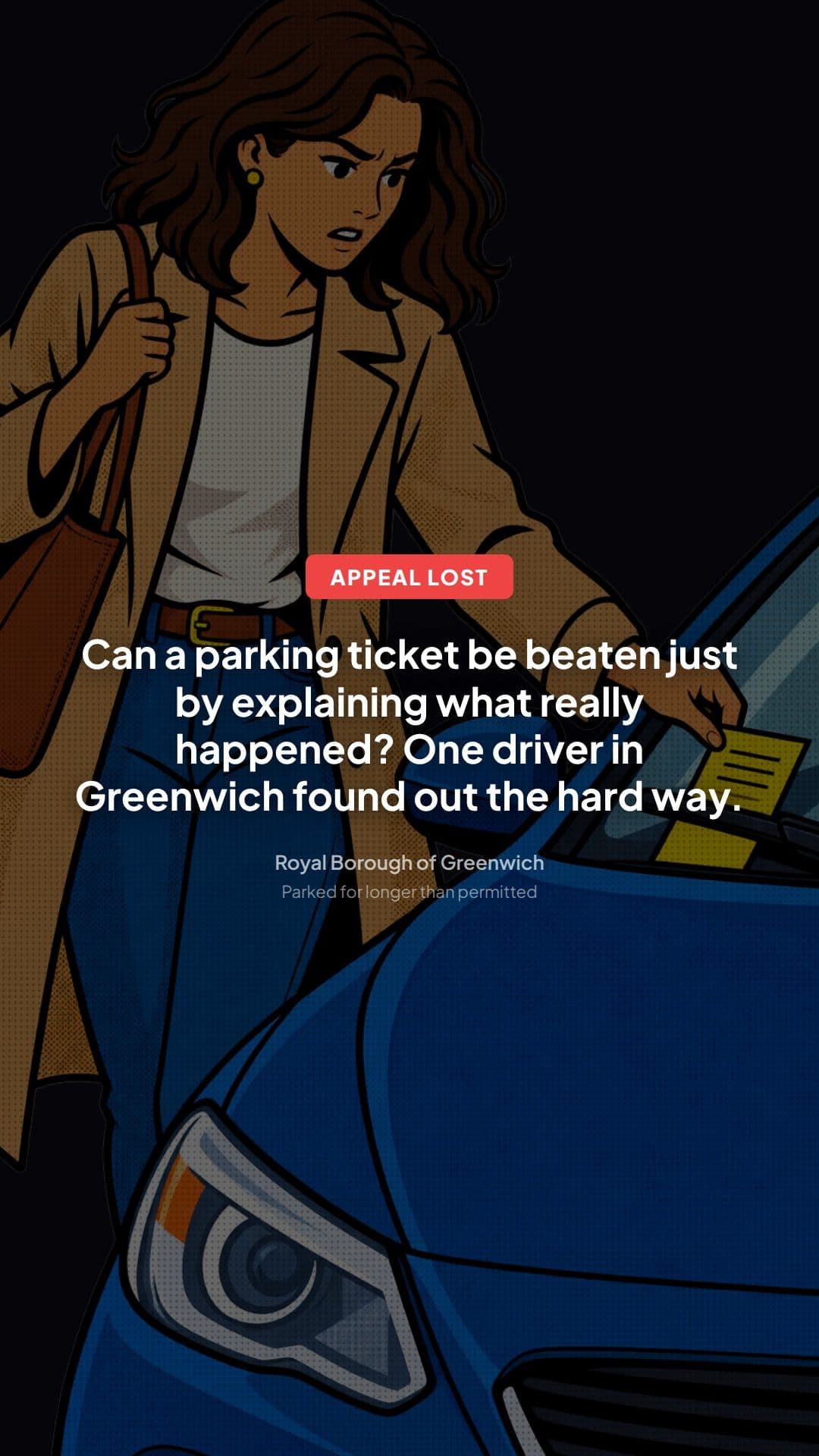
Wheel Marks, Not Watches: Why a Greenwich Driver Lost Her Overstay Appeal
Why This Case Matters
Picture this: you nip out for a couple of hours, come back to a parking ticket, and you're convinced you moved your car at some point during that window, even if it was just to shuffle it a few feet and back. Surely that means you weren't "parked" the whole time?
It's a common assumption, and it's exactly the argument that failed in this Royal Borough of Greenwich case. The decision is a useful reminder that parking enforcement doesn't rely on guesswork or good faith. It relies on evidence, and one particular piece of evidence, the humble tyre valve, has quietly become one of the most powerful tools in a parking attendant's kit.
The Case
The contravention here was "parked for longer than permitted", a common issue in bays that allow free or paid parking up to a certain time limit, in this instance two hours.
A civil enforcement officer (still often called a "parking attendant" in tribunal paperwork, even though the terminology has moved on) observed the vehicle at 10:17. They returned at 12:31, over two hours later, and observed it again. Crucially, the officer recorded the position of the vehicle's wheel valves on both occasions. They hadn't changed.
Because the bay only permits parking for up to two hours, and because the car appeared not to have moved in that time, Greenwich issued a Penalty Charge Notice (PCN) for overstaying.
The driver appealed to the independent tribunal, disputing the contravention.
The Arguments
The driver's position: The Appellant put forward an account of events to explain what had happened during those two-plus hours. Unfortunately for her, the adjudicator's decision doesn't dwell on the detail of that account, because it turned out not to matter (more on that below).
The council's position: Greenwich relied squarely on the enforcement officer's notes. Those notes recorded specific timestamps and, critically, the wheel valve positions at each observation. The council's case summary also raised a separate point, referenced only as "paragraph 7 of page 1", which argued that even the driver's version of events wouldn't amount to a valid defence.
The Decision
The adjudicator refused the appeal, and did so on two independent grounds:
- The evidence was reliable. The officer's contemporaneous notes, timestamps and wheel valve observations were found to be "a clear and detailed contemporaneous account" and therefore accurate.
- Even if the driver's account were true, it wouldn't help her. The adjudicator explicitly said that even accepting her version of events, the council's argument at paragraph 7 meant she still had no valid defence.
That second point is significant. It means the driver didn't just lose because the tribunal disbelieved her. She lost because, on the facts as she described them, the law still didn't favour her.
The Legal Reasoning, Unpacked
1. Wheel valve checks are treated as strong evidence
This is the heart of the case. When a car is parked, its wheel valves (the little valve stems poking out of each wheel where you'd attach a tyre pump) sit in a fixed rotational position. If the car moves, even a short distance, the wheels rotate and the valve positions change.
Enforcement officers routinely note the valve positions (sometimes described using a clock-face reference, such as "nearside front at 3 o'clock") when they first observe a vehicle, then check again later. If the positions match, it's strong circumstantial evidence the car hasn't moved between those two visits.
This technique has become a tribunal staple precisely because it's hard to argue with. It doesn't rely on the officer's memory or subjective impression, it's a physical, recorded observation, taken twice, compared directly.
2. "Contemporaneous" records carry real weight
The adjudicator specifically praised the notes for being "clear and detailed" and "contemporaneous", meaning written at the time, not reconstructed afterwards. Tribunals consistently give more credibility to notes made in the moment than to recollections offered weeks or months later during an appeal. This is a pattern that comes up again and again in parking tribunal decisions.
3. An "inference" is enough to establish a contravention
The adjudicator didn't need direct proof, such as CCTV footage, of the car staying put for two hours. Instead, they drew a logical inference from the valve evidence: unchanged valve positions plus more than two hours elapsed equals no movement equals overstay. Tribunals are entitled to draw reasonable inferences from solid circumstantial evidence, they don't need a smoking gun.
4. Even accepting the driver's account, there was no defence
This is the trickier part for drivers to get their heads around. Sometimes an appellant's explanation, even if entirely truthful, simply doesn't amount to a legal defence to the contravention as defined. Without the full text of "paragraph 7" we can't know the precise technical point Greenwich raised, but the structure of the reasoning tells us something important: not every innocent-sounding explanation cancels out a PCN. If the bay's own rules define the contravention in a way that doesn't leave room for the driver's excuse, the tribunal has no discretion to invent one.
Lessons for Drivers
1. If you move your car, be ready to prove it. A vague memory of "nipping off and coming back" won't outweigh a documented valve check. If you genuinely relocate your vehicle within a limited-stay bay, useful evidence includes timestamped fuel receipts, dashcam footage, or witness confirmation.
2. Understand what the time limit actually restricts. Many drivers assume that moving the car briefly "resets the clock". Depending on the local rules, that's often not true, particularly if the same vehicle returns to the same bay, or if the restriction is based on total time within a zone rather than a single unbroken stay. Always check the specific wording on the signage.
3. Contemporaneous evidence beats a good story. This case is a clear illustration that tribunals favour records made at the time over accounts given later, however honest those accounts might be. If you think you'll need to dispute an overstay, gather your own time-stamped evidence as early as possible, ideally on the day.
4. Not every explanation is a legal defence. It's worth pausing before assuming that "I did X" will automatically get a PCN cancelled. The wording of the contravention and any relevant regulations matter enormously. If you're facing a genuine, high-stakes dispute, it's worth reading the specific contravention code on your PCN and, if needed, seeking independent advice on whether your circumstances fit a recognised defence.
5. Read the council's case summary carefully before appealing. Councils often address anticipated driver arguments in advance, as Greenwich did here. If you're appealing a PCN, it helps to see whether the authority has already pre-empted your explanation, and think about how you'd respond to that argument specifically.
Key Takeaway
Enforcement officers don't need to watch your car for two hours straight, they just need two snapshots and an unmoved wheel valve to build a case that's very hard to shift. If you're relying on "I did move it, honestly" as your defence, you'll need more than your word: you'll need evidence that stands up as well as the council's does.
This article discusses a single tribunal decision for illustrative purposes and is not legal advice. If you're appealing a PCN, check the specific contravention code and consider the official guidance available through the relevant tribunal service before submitting your case.
Written by
The Parking Ticket Pal Editorial Team
Source-checked parking guidance
Ready to Challenge Your Ticket?
Let our AI analyse your PCN and generate a professional appeal letter in minutes.
Start Free Appeal