Gatwick Parking Fire: 140 Cars Damaged at Holiday Site
Fire at a Gatwick holiday parking site damaged about 140 cars. We examine what affected drivers should do, insurance steps and airport parking consumer rights.

The Parking Ticket Pal Editorial Team
24 August 2026
When Your Holiday Ends in Ashes: The Gatwick Car Park Fire and What It Means for Drivers
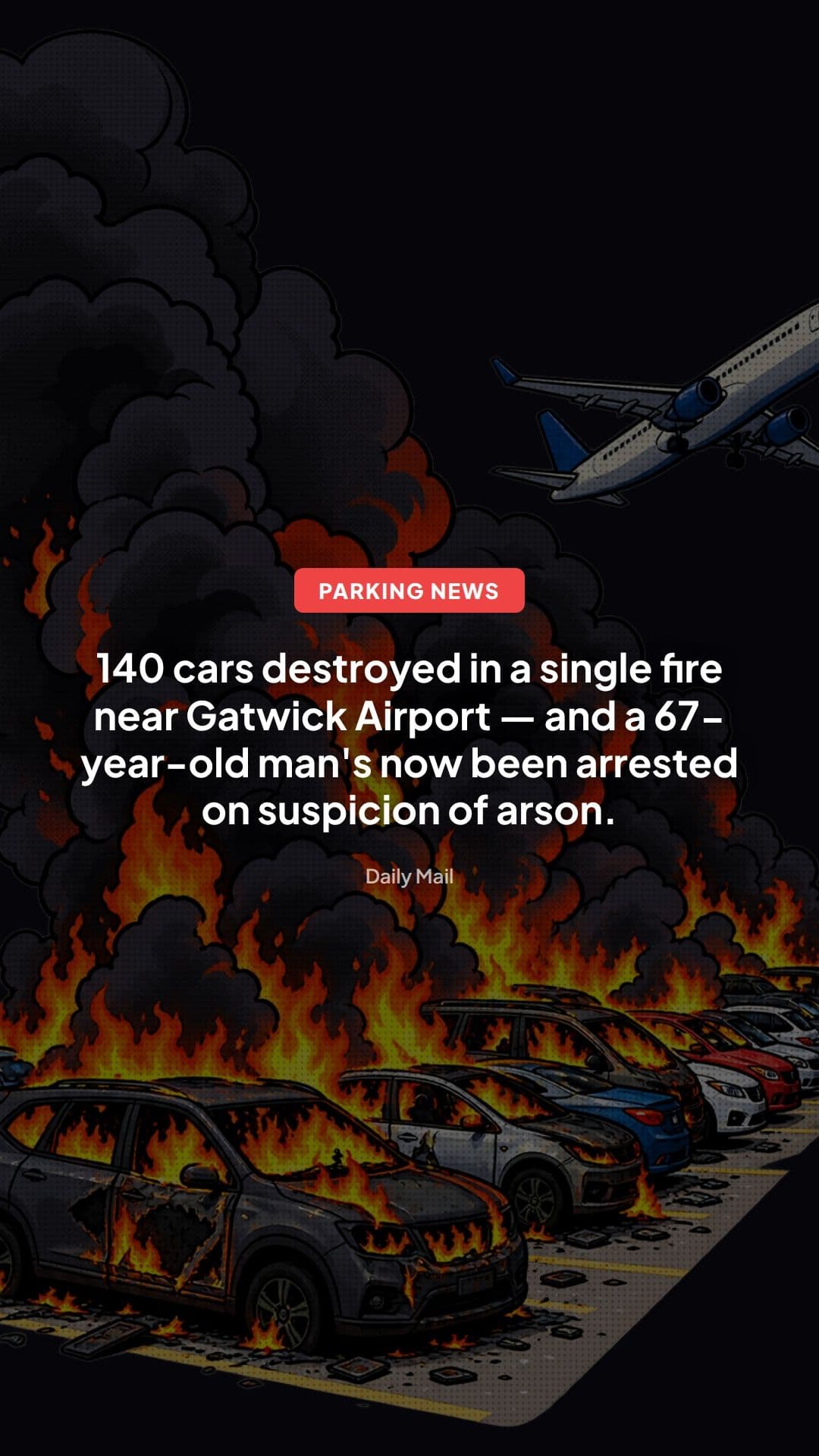
Imagine landing back in the UK after a fortnight abroad, tired and ready to get home, only to discover your car is a burnt-out shell in a field near the airport. For roughly 140 people who used a holiday parking site near Gatwick Airport, that nightmare became reality when a huge fire tore through the car park, drawing eight fire engines and ending with a 67-year-old man arrested on suspicion of arson.
It's a dramatic story on its own. But scratch beneath the surface and it raises serious questions about how off-airport parking works, who is liable when things go catastrophically wrong, and what drivers can actually do to protect themselves before they hand over their car keys and head off on holiday.
What Happened
According to reports, a major blaze broke out at a holiday parking site close to Gatwick Airport, one of the many privately run car parks that offer cheaper alternatives to official airport parking for travellers heading off on their holidays. The fire spread rapidly enough to damage around 140 vehicles and required a significant emergency response, with eight fire engines sent to bring it under control.
Police have arrested a 67-year-old man on suspicion of arson, which suggests investigators believe the fire may not have been accidental. As with any live criminal investigation, the full picture will only emerge over time, but the scale of the damage, well over a hundred cars, makes this one of the more serious incidents to hit the UK's off-airport parking industry in recent memory.
For anyone whose car was among those damaged, the immediate practical nightmare is obvious. Many of those drivers were almost certainly still away on holiday when the fire happened, meaning they came home to find their transport from the airport gone, along with potentially thousands of pounds worth of vehicle sitting in a car park hundreds of miles from a repair garage.
Why It Matters
Off-airport parking is a huge and largely unregulated market. Millions of UK holidaymakers each year choose meet-and-greet or park-and-ride style sites near airports like Gatwick because they're cheaper than the airport's own official car parks. Some of these sites are excellent, professionally run and properly insured. Others operate with far less oversight than travellers might assume, and previous stories, including the discovery of abandoned vehicles at a scrapyard after a rogue airport parking operation collapsed, have shown just how badly things can go wrong.
This fire adds a new dimension to those concerns. It's not just about whether your car will still be where you left it, or whether the company handling it is legitimate. It's about whether the site itself is safe, secure, and properly managed to reduce risks like fire, vandalism or arson in the first place. A car park holding well over a hundred vehicles is, in effect, a huge concentration of value and flammable material sitting largely unattended for days or weeks at a time. When something goes wrong at that scale, the consequences multiply fast.
It also matters because it exposes a gap in public awareness. Most people booking holiday parking focus on price and proximity to the terminal. Very few think to check whether a site is accredited, insured against catastrophic loss, or covered by an industry code of practice.
The Legal Angle
There are several strands of law that come into play here, and they're worth understanding even if you never experience anything this dramatic yourself.
Criminal law. If the fire is confirmed as arson, it falls under the Criminal Damage Act 1971. Setting fire to property intentionally or recklessly is treated as an aggravated form of criminal damage, and where lives are endangered, sentences can be severe, up to life imprisonment in the most serious cases. An arrest on suspicion of arson doesn't mean guilt has been established, and the case will need to go through the usual criminal justice process, but it does confirm police are treating this as a potential criminal act rather than a simple accident.
Bailment and liability. When you leave your car at a holiday parking site, you're generally entering into a contract of bailment. In simple terms, you (the bailor) hand over possession of your goods, in this case a vehicle, to someone else (the bailee) for safekeeping. English law has long held that a bailee for reward owes a duty to take reasonable care of the goods, and if something is lost or damaged while in their custody, the burden can fall on the bailee to show the loss wasn't caused by their negligence. This principle has been tested in cases involving cleaners, warehouses and storage firms, and the same logic can apply to car parks.
However, most parking operators include exclusion clauses in their terms and conditions attempting to limit or exclude liability for events like fire, theft or vandalism, particularly where they can argue the cause was outside their control, such as a criminal act by a third party. Whether those clauses hold up depends heavily on the wording, on the Consumer Rights Act 2015 requirement that services be carried out with reasonable care and skill, and on whether the operator failed to take reasonable steps, like adequate fire safety measures, security patrols or CCTV, to prevent foreseeable harm.
Insurance. For the drivers affected, the practical route to compensation will almost certainly run through their own motor insurance rather than a drawn-out legal battle with the parking operator. Fire damage is typically covered under comprehensive policies, and often under third-party, fire and theft policies too, but not under basic third-party-only cover. If an insurer pays out, it may then seek to recover its costs from the parking operator or its insurer through a process called subrogation, particularly if negligence can be shown.
What Drivers Should Know
If you're booking off-airport parking for an upcoming trip, or if you've already got a holiday booked, there are some sensible precautions worth taking.
- Check for accreditation. Look for membership of a recognised industry body such as the British Parking Association or the Independent Parking Committee, and check whether the site holds a Park Mark award, which is specifically focused on safety and security standards.
- Read the terms and conditions before you book. Pay particular attention to any clauses excluding liability for fire, theft or damage, and understand what compensation, if any, is offered.
- Photograph your car before handover. A timestamped set of photos showing the condition of your vehicle when you drop it off can be invaluable if you need to make a claim later, whether against your insurer or the parking operator.
- Confirm your own insurance covers you properly. If you only have third-party cover, fire damage while your car is parked won't be covered. It's worth checking your policy documents, especially before a long trip where your car will be left unattended for an extended period.
- Keep your booking confirmation and any correspondence. If the worst happens, you'll need clear evidence of exactly where and when you left your vehicle.
- Consider reviews and reputation, not just price. The cheapest option isn't always the most secure, and a quick search for past complaints or incidents at a particular site can be revealing.
For drivers who suspect they've booked with an unauthorised or poorly regulated site, it's also worth understanding your options if things go wrong before you even get to the airport, since problems with rogue or informal parking arrangements have become a recurring theme in the industry.
Looking Ahead
Incidents like this tend to prompt renewed scrutiny of an industry that has grown quickly but without much formal regulation. It wouldn't be surprising to see calls for tighter safety standards at off-airport car parks, more consistent accreditation requirements, or clearer rules on what compensation drivers are entitled to when a site fails to keep their vehicle safe.
In the meantime, the criminal investigation into the suspected arson will play out, and the affected drivers face the immediate task of dealing with insurers, arranging alternative transport, and in some cases replacing a car entirely. It's a stark reminder that while most airport parking trips end without incident, the sector still carries real risks that are easy to overlook when you're focused on getting a good deal and catching your flight on time.
Written by
The Parking Ticket Pal Editorial Team
Source-checked parking guidance
Ready to Challenge Your Ticket?
Let our AI analyse your PCN and generate a professional appeal letter in minutes.
Start Free Appeal