Fuel duty freeze extended to 2026: what it means
UK fuel duty will stay frozen until at least 2026. Here’s what that means for pump prices, motoring costs, and the political impact for drivers.

Sarah Mitchell
20 May 2026
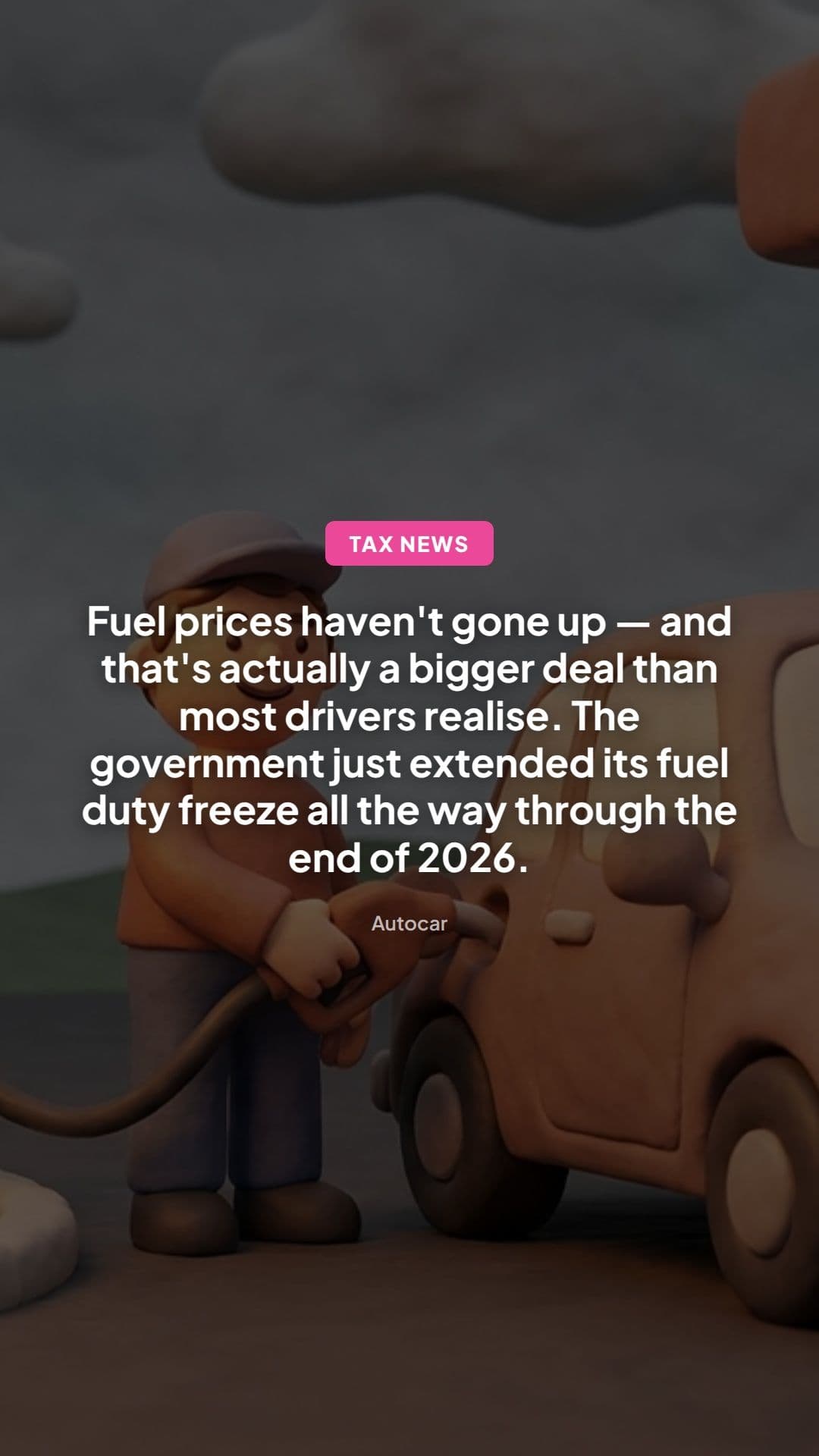
Fuel Duty Frozen Until 2026: What It Really Means for UK Drivers — and What Comes Next
The Pump Price You're Not Paying (Yet)
Picture this: you pull into a forecourt, fill your tank with 50 litres of unleaded, and drive away without a second thought about the tax embedded in every drop. But here's the thing — roughly 53p of every litre you buy goes straight to the Treasury as fuel duty. Not profit. Not the cost of oil. Tax. And for the third consecutive year, the Chancellor has decided not to raise it.
That might sound like good news — and in many respects it is — but the story behind the freeze is considerably more complex than a simple headline about pump prices. It touches on government finances, road investment, the transition to electric vehicles, and the long-term question of how Britain will pay for its roads when petrol and diesel are eventually phased out. Let's unpack it properly.
What Actually Happened
In the Spring Statement, Chancellor Rachel Reeves confirmed that the freeze on fuel duty — originally introduced by Rishi Sunak's government in 2022 — will remain in place until at least the end of 2026. This means the main rate of fuel duty stays at 52.95p per litre for petrol and diesel, a level it has been held at since March 2022 when the government also introduced a temporary 5p-per-litre cut.
That 5p cut, which was always described as a temporary measure, has now effectively become permanent for the foreseeable future. Had the government allowed duty to revert to its pre-cut level and then applied the standard inflationary increase that had previously been routine, drivers could have been looking at pump prices roughly 7–10p per litre higher than they currently are.
According to Autocar's reporting of the announcement, the government cited the ongoing cost-of-living pressures on motorists and the broader economic context as justification for extending the freeze. The move was broadly welcomed by motoring groups, though with predictable caveats about what happens when the freeze eventually ends.
Why This Matters More Than You Might Think
To understand the significance of this decision, you need to appreciate just how much fuel duty contributes to the public purse. In a typical year, fuel duty raises approximately £25 billion for the Treasury — making it one of the largest single revenue streams in the entire tax system, dwarfing many other taxes that receive far more political attention.
When the freeze was first introduced in 2022, it was against a backdrop of fuel prices spiking dramatically following the Russian invasion of Ukraine. Unleaded briefly touched 190p per litre at some forecourts. The freeze, combined with the 5p cut, was a political lifeline — and it worked. Pump prices eventually stabilised, and the policy became politically difficult to reverse.
But here's the awkward truth: the freeze hasn't actually saved drivers as much as the headline figures suggest. VAT, which is charged at 20% on top of the pump price including duty, rises automatically as pump prices rise. So when oil prices increased globally, VAT receipts went up even as duty was frozen. The Treasury wasn't exactly suffering in silence.
For the average UK driver covering around 7,400 miles per year in a car achieving roughly 40 miles per gallon, the freeze is worth approximately £100–£130 per year compared to what they might have paid had duty risen with inflation. That's meaningful — it's a tank of fuel — but it's not transformative.
The Legal and Regulatory Framework
Fuel duty is governed primarily by the Hydrocarbon Oil Duties Act 1979, which provides the legislative basis for taxing petrol, diesel, and other hydrocarbon oils. The rates themselves are set annually through the Finance Act, which means each freeze requires an active parliamentary decision — it doesn't happen automatically.
This is an important distinction. Unlike, say, income tax thresholds that can be quietly frozen in real terms, fuel duty requires the Chancellor to stand up and explicitly choose not to raise it. That creates a political dynamic where raising duty becomes a visible, headline-grabbing act, while freezing it can be presented as a "giveaway" even when it simply maintains the status quo.
The Road Fuel Testing Regulations 2002 and associated legislation govern the quality and composition of fuel sold at UK forecourts, but the pricing mechanism — and specifically the duty element — sits entirely within Treasury control. There is no independent regulator setting a cap on fuel duty, and the Competition and Markets Authority (CMA), while it has investigated forecourt pricing practices, has no remit over the tax component.
It's also worth noting that fuel duty applies differently across fuel types. Red diesel (used in agricultural and off-road vehicles) attracts a much lower rate of 11.14p per litre, while aviation fuel used in commercial flights is exempt from duty entirely — a longstanding anomaly that environmental campaigners have repeatedly highlighted.
What Drivers Should Actually Do With This Information
The freeze is confirmed, but that doesn't mean you should be complacent about fuel costs. Here's what savvy drivers can do right now:
1. Use price comparison tools consistently Apps such as PetrolPrices.com and Confused.com's fuel finder allow you to identify the cheapest forecourt within a given radius. Supermarket fuel stations consistently undercut branded forecourts by 3–5p per litre. On a 50-litre fill, that's £1.50–£2.50 saved every single time.
2. Understand when to fill up Fuel prices tend to be higher on motorways and in rural areas where competition is limited. If you know you're heading into a remote area or onto a major toll road, fill up beforehand at a supermarket forecourt.
3. Don't assume the freeze means prices are stable Fuel duty is only one component of the pump price. Crude oil costs, refinery margins, distribution costs, and VAT all fluctuate independently. A frozen duty rate does not guarantee stable prices at the pump — as anyone who watched prices spike in early 2022 will know.
4. Consider your vehicle's efficiency With duty frozen, the relative cost advantage of a more fuel-efficient vehicle hasn't changed — but it remains significant. A driver switching from a car achieving 30mpg to one achieving 50mpg saves roughly £500–£600 per year at current prices, entirely independent of any duty changes.
5. Keep records of fuel expenditure if you're self-employed HMRC's approved mileage rates for the 2025/26 tax year are 45p per mile for the first 10,000 miles and 25p thereafter for cars. If you're using your own vehicle for business purposes, you can claim these rates regardless of actual fuel costs — meaning the freeze doesn't directly affect your tax position, but tracking your mileage carefully remains important.
Looking Ahead: The Freeze Can't Last Forever
Here's the uncomfortable question that nobody in Westminster wants to answer publicly: what happens when the freeze ends?
The government is committed to phasing out the sale of new petrol and diesel cars by 2035. As EV uptake increases, fuel duty receipts will inevitably decline. The Office for Budget Responsibility has already flagged this as a structural threat to public finances, projecting that fuel duty revenues could fall by tens of billions of pounds over the coming decades as the fleet electrifies.
This creates a fiscal time bomb. Either the government raises fuel duty sharply in the short term — potentially accelerating the shift to EVs but hammering drivers who can't yet afford to switch — or it begins developing an alternative road-funding mechanism. The most frequently discussed option is pay-per-mile road pricing, which would charge drivers based on distance travelled rather than fuel consumed.
For now, the freeze buys political breathing room. But every year it continues, the eventual adjustment becomes steeper. If duty had risen with inflation since 2010, it would now be closer to 70–75p per litre rather than the current 52.95p. That gap has to be bridged somehow, whether through duty increases, road pricing, or higher Vehicle Excise Duty on internal combustion engine vehicles.
The 2026 deadline is also significant. A General Election is not due until 2029, but by the end of 2026, the government will need to make a decision about whether to extend the freeze again, allow it to lapse, or announce a longer-term road-funding strategy. Given the political sensitivity of fuel prices, the temptation to keep kicking the can down the road will be enormous.
The Bottom Line
The fuel duty freeze is genuinely good news for drivers in the short term — it represents a real saving compared to what prices might otherwise have been, and in a period of ongoing financial pressure for many households, that matters. But it is not a solution to the long-term challenge of funding Britain's roads in a post-petrol era.
For now, fill up at your local supermarket, drive efficiently, and keep an eye on the Autumn Budget. The freeze is confirmed until the end of 2026 — but beyond that, the road ahead is considerably less certain.
Written by
Sarah Mitchell
Parking Rights Advocate
Ready to Challenge Your Ticket?
Let our AI analyse your PCN and generate a professional appeal letter in minutes.
Start Free Appeal