Freelander 8 revealed: what UK drivers should know
New images show the production-ready Freelander 8 ahead of launch. We look at what it could mean for UK motorists, EV charging and parking rules.

Sarah Mitchell
12 May 2026
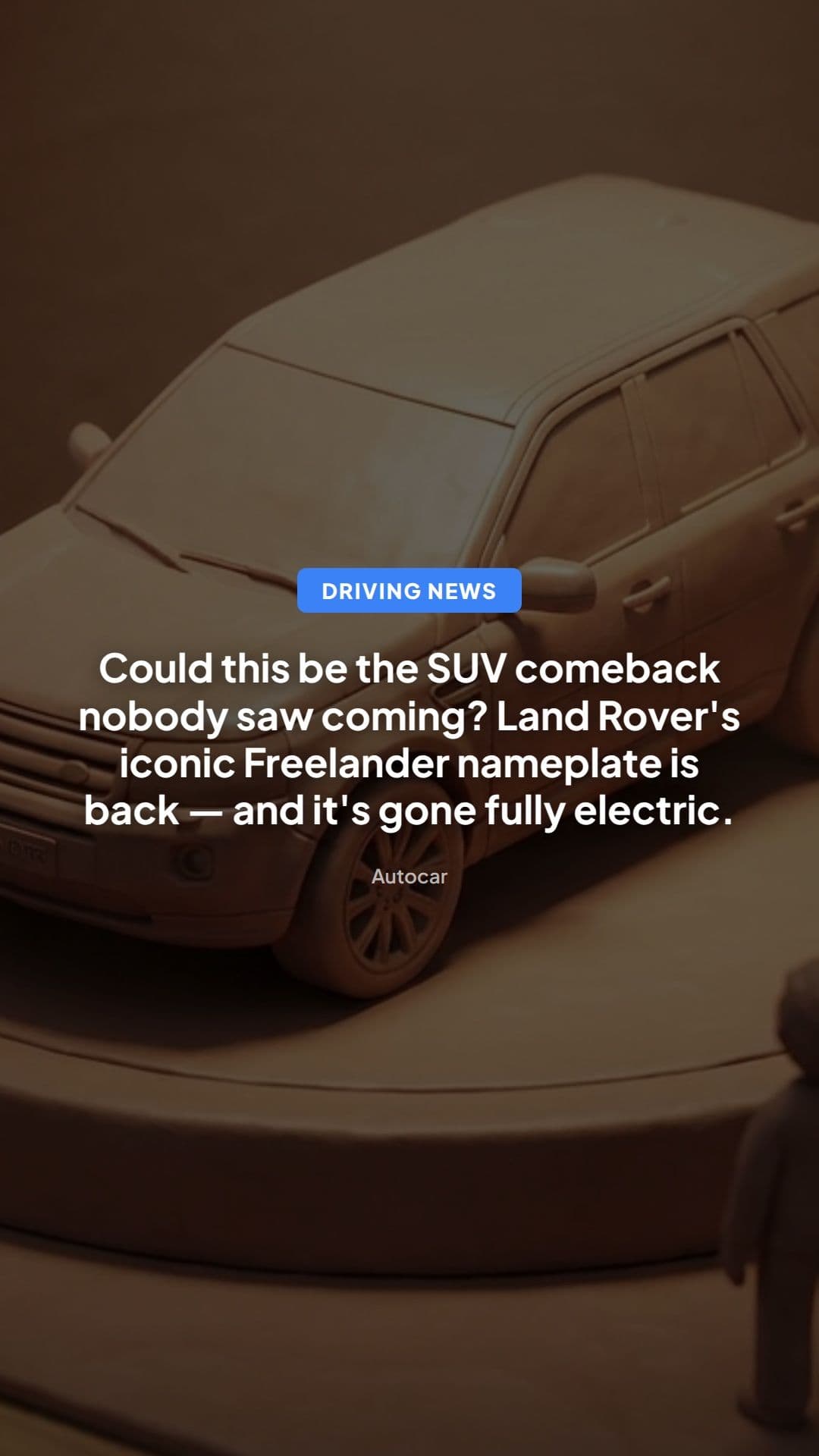
Land Rover's Freelander Returns: What the New Electric SUV Means for UK Drivers
The Badge That Never Really Left Our Hearts
Cast your mind back to the early 2000s and there's a decent chance someone on your street had a Freelander. It was the approachable face of Land Rover — not quite as imposing as a Discovery, not as wallet-draining as a Range Rover, but rugged enough to feel like a proper 4x4. It sold in enormous numbers across the UK, became a fixture of school runs and weekend escapes alike, and then — quietly, almost apologetically — it was discontinued in 2014, replaced by the Discovery Sport.
Now it's back. And this time, it's electric.
New images published by Autocar have revealed the production-ready Freelander 8, offering the clearest look yet at what Land Rover's parent company, Jaguar Land Rover (JLR), has been developing. The pictures confirm this isn't a concept or a design exercise — this is a real car heading for real roads, and the details they reveal tell us quite a lot about where the premium SUV market is heading, and what it means for drivers navigating Britain's rapidly changing motoring landscape.
What the New Images Actually Show Us
The production-ready Freelander 8 — the "8" referencing the car's position in a new model naming convention — appears in images that confirm a clean, contemporary SUV silhouette. Gone is the slightly boxy, utilitarian aesthetic of the original. In its place is something more sculpted, more aerodynamically considered, and clearly designed with the electric powertrain's requirements in mind.
The design language draws on JLR's broader refresh across its brands, with flush door handles, a closed-off front end (a tell-tale sign of an EV, where there's no need for a traditional grille to feed a combustion engine), and a raised roofline that hints at generous interior headroom.
Critically, the car is understood to be built on a platform developed in partnership with Chery, the Chinese automotive giant — a significant detail that reflects the increasingly global nature of EV development and supply chains. This collaboration allows JLR to bring the Freelander to market at a price point that could genuinely compete in the volume end of the premium SUV sector, rather than sitting exclusively in the rarefied air of the Defender or Range Rover.
A full launch is expected in the coming months, with UK sales anticipated to follow in 2025 or 2026.
Why This Matters: The Bigger Picture
The return of the Freelander name isn't just a nostalgia play. It signals something strategically important about where JLR believes the market is heading — and where the regulatory landscape is pushing it.
The Zero Emission Vehicle (ZEV) Mandate came into force in the UK at the start of 2024. Under this legislation, manufacturers must ensure a rising percentage of their UK new car sales are zero-emission vehicles each year, reaching 80% by 2030 and 100% by 2035. For 2024, the target was 22%, rising to 28% in 2025. Failure to hit these targets results in fines of £15,000 per non-compliant vehicle sold above the permitted threshold.
For a manufacturer like JLR, which has historically leaned heavily on premium petrol and diesel models, the ZEV Mandate creates enormous pressure to expand its electric lineup — and fast. The Freelander 8 is, in part, a direct response to that regulatory reality.
But it's also a response to genuine market demand. UK EV sales have been climbing steadily, and the sub-£50,000 premium SUV segment — think Volkswagen ID.4, Hyundai Ioniq 5, Kia EV6 — has become fiercely competitive. Land Rover currently has no product in that space. The Freelander 8 is designed to fill precisely that gap.
The Legal and Regulatory Angle Every Driver Should Understand
The arrival of a new electric Land Rover isn't just a car story — it intersects with a web of UK laws and policies that directly affect drivers' costs, rights, and choices.
The ZEV Mandate and What It Means for Buyers
Because manufacturers face significant financial penalties for missing ZEV targets, there is a genuine incentive for them to offer competitive pricing and attractive financing on electric models to drive volume. In practical terms, this has already led to some manufacturers offering below-market lease deals on EVs to shift units and stay compliant. Buyers who time their purchase well — particularly towards the end of a calendar quarter when manufacturers are watching their numbers closely — can sometimes negotiate more aggressively.
Benefit in Kind (BIK) Tax Advantages
For company car drivers, the Freelander 8's electric powertrain carries significant tax implications. Under current HMRC rules, battery electric vehicles attract a Benefit in Kind rate of just 2% for the 2024/25 and 2025/26 tax years, rising to 3% in 2026/27 and 4% in 2027/28. Compare this to a petrol SUV of equivalent value, which might attract BIK rates of 30% or more, and the savings for a higher-rate taxpayer can run to thousands of pounds annually. If you're choosing a company car and the Freelander 8 falls within your employer's approved list, the numbers are likely to be compelling.
The Consumer Rights Act 2015 and New EV Purchases
UK buyers of new electric vehicles are protected by the Consumer Rights Act 2015, which requires goods to be of satisfactory quality, fit for purpose, and as described. This is particularly relevant for EVs, where real-world range can differ from manufacturer claims. If a car consistently fails to achieve the range advertised under normal driving conditions, buyers have grounds to raise a formal complaint and, within the first 30 days, the right to a full refund. Between 30 days and six months, the burden of proof shifts to the manufacturer to demonstrate the fault didn't exist at point of sale.
What Drivers Should Know Before They Buy
If you're considering the Freelander 8 — or any electric SUV in this class — here's what to keep front of mind:
- Check your home charging situation first. The convenience of an EV is dramatically diminished without home charging. A standard 7kW wallbox installation typically costs between £800 and £1,200 after the EV chargepoint grant (worth up to £350 for eligible homeowners and renters). Confirm your property qualifies before committing to a purchase.
- Understand the real-world range. Manufacturer range figures are based on WLTP testing, which tends to be optimistic. In cold weather, with the heater running and motorway speeds sustained, expect to see 15–25% less range than the headline figure. For a car likely to claim 250–300 miles, that means planning long journeys with a buffer.
- Factor in public charging costs. Rapid charging on the public network — at providers like Gridserve, Pod Point, or BP Pulse — currently costs between 60p and 85p per kWh at many locations. At those rates, filling a 75–80kWh battery from near-empty can cost £45–£65, significantly eroding the fuel cost advantage over petrol unless you charge predominantly at home.
- Scrutinise the warranty. Most manufacturers offer an 8-year/100,000-mile battery warranty on EVs. Check the small print: some warranties cover battery failure but not gradual capacity degradation. Understand what threshold triggers a replacement — typically 70% of original capacity.
- Consider the Chery partnership carefully. This isn't a criticism — Chery is a well-established manufacturer — but buyers should be aware that some insurance companies are still calibrating their pricing for vehicles built on newer, less familiar platforms. Get insurance quotes before you commit.
Looking Ahead: What the Freelander 8 Tells Us About UK Motoring
The Freelander 8's emergence is a microcosm of the broader transformation underway in British motoring. The pressures are converging from multiple directions simultaneously: regulatory mandates, tax incentives, fuel price volatility, and genuine consumer appetite for change.
What's particularly interesting about the Freelander story is the manufacturing dimension. Building in partnership with a Chinese firm, potentially producing in China for global markets, reflects the reality that European and British manufacturers cannot develop competitive EV platforms at scale without international collaboration. Whether that sits comfortably with buyers who associate Land Rover with British engineering heritage remains to be seen — and JLR will need to manage that narrative carefully.
For UK drivers, the practical upshot is straightforward: more choice, at more accessible price points, is coming to the electric SUV market. Competition between established names like Land Rover and the wave of newer entrants will push prices down and quality up. The ZEV Mandate ensures manufacturers cannot afford to sit still.
The Freelander was once the car that made Land Rover accessible to ordinary British families. If the Freelander 8 can do the same for electric motoring — bringing the practicality, the brand reassurance, and the genuine capability that drivers need — then its return could matter far beyond the showroom floor.
Watch this space. The school run is about to get a lot quieter.
Written by
Sarah Mitchell
Parking Rights Advocate
Ready to Challenge Your Ticket?
Let our AI analyse your PCN and generate a professional appeal letter in minutes.
Start Free Appeal