Ford’s new car park tech could stop trolley dents
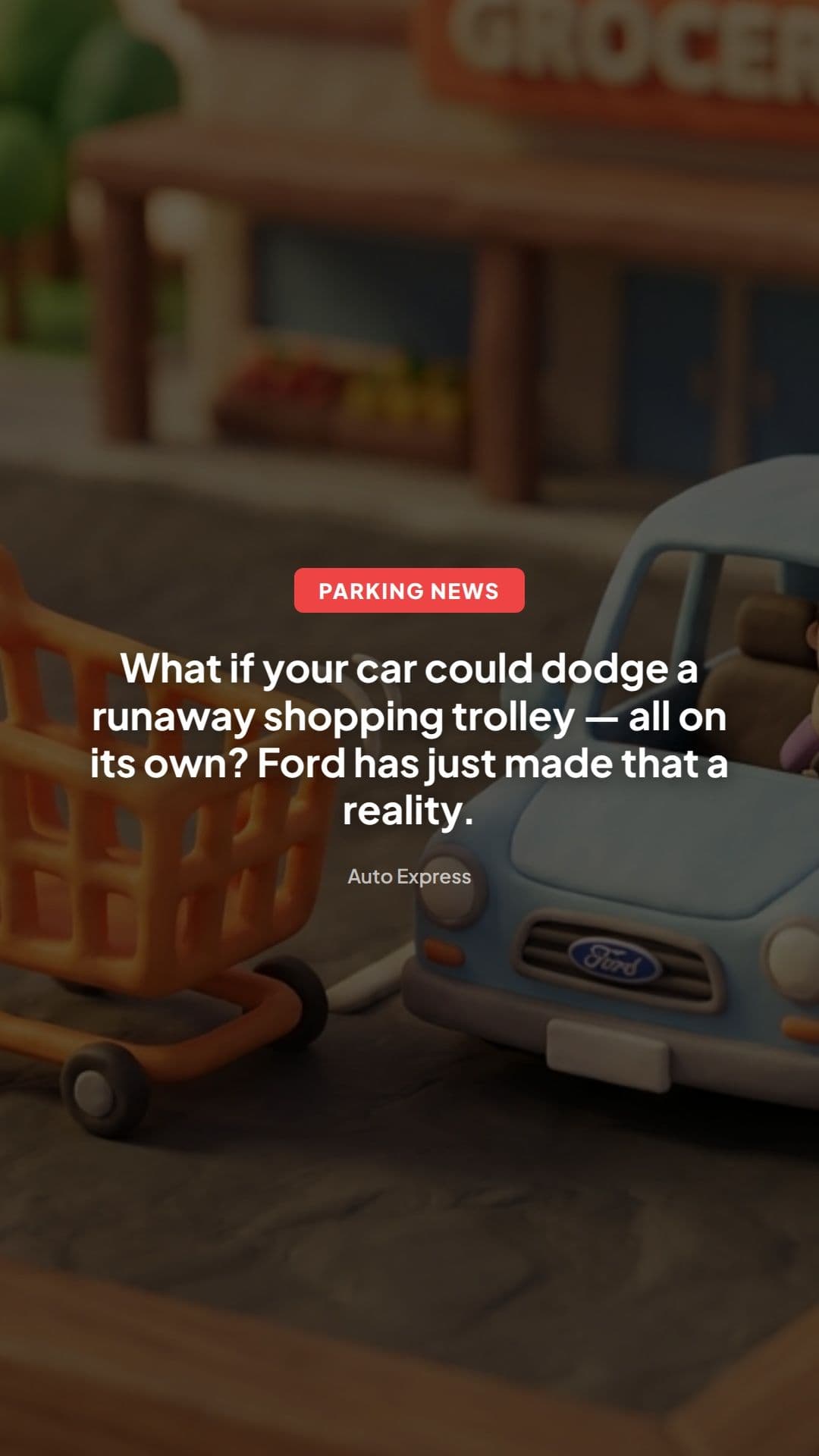
Ford has patented car park tech to detect stray shopping trolleys, predict their path and brake or steer to avoid bumps—cutting low-speed damage and claims.

Grace O'Sullivan
11 May 2026
Ford's Shopping Trolley Tech Could Save Your No-Claims Bonus — But Who's Liable When It Fails?
Picture this: you've navigated the weekend chaos of a packed supermarket car park, squeezed into a space between two oversized SUVs, and returned with a full trolley to find a rogue shopping cart has rolled into the side of your car, leaving a satisfying crease along the door panel. No CCTV angle that helps, no note on the windscreen, and a repair bill heading north of £500. Sound familiar? For millions of British drivers, it's an all-too-common nightmare.
Ford thinks it has an answer — and it's considerably more sophisticated than a better trolley bay.
What Ford Has Actually Built
According to Auto Express, Ford has developed an intelligent car park assistance system capable of detecting moving objects in the immediate vicinity of a vehicle — including errant shopping trolleys — predicting where those objects are heading, and automatically intervening to avoid a collision.
This isn't simply a more sensitive parking sensor. The system uses a combination of cameras, radar, and predictive algorithms to track the trajectory of moving hazards in real time. If the system calculates that a trolley (or any other moving object) is on a collision course with the vehicle, it can apply braking or steering corrections automatically, even at the very low speeds typical of car park manoeuvring.
Ford is positioning this as a meaningful step forward in reducing what the industry calls "car park damage" — the minor but infuriating scrapes, dents, and scratches that account for a disproportionate share of motor insurance claims in the UK. The technology builds on existing driver assistance systems already found in Ford's newer models, extending their usefulness beyond motorway cruising and into the unglamorous but damage-heavy world of retail car parks.
Why This Matters More Than You Might Think
Car park incidents are far from trivial in financial terms. Industry data has consistently shown that low-speed car park damage is one of the most common causes of insurance claims in the UK, with estimates suggesting that around one in three motor insurance claims involves a car park incident of some kind. The Association of British Insurers has flagged car park damage as a persistent cost driver — and those costs feed directly into the premiums every driver pays.
Shopping trolleys, specifically, are a notorious culprit. Unlike a collision with another vehicle, a trolley impact typically leaves no responsible party to pursue. Supermarkets have long argued — often successfully — that they bear no legal responsibility for trolleys that escape their bays and cause damage in their car parks. This leaves drivers to absorb the cost themselves or make a claim on their own comprehensive insurance, with all the excess payments and potential no-claims bonus implications that entails.
There's also a broader context here. British car parks are, by international standards, increasingly cramped. As the average vehicle has grown wider and longer over the past two decades — driven largely by the SUV boom — the bays painted in most UK car parks have not kept pace. The standard bay width recommended by most local authorities is 2.4 metres, a figure that dates back to an era when a Ford Cortina was considered a reasonably sized family car. A modern Ford Kuga is 1.93 metres wide before you factor in door mirrors. The margin for error is shrinking, and trolley impacts are one consequence.
The Legal Angle: Who Actually Pays When a Trolley Hits Your Car?
This is where things get genuinely complicated — and where Ford's technology has implications that go well beyond engineering.
Under UK law, the position on supermarket liability for trolley damage is frustratingly murky. Occupiers' Liability Act 1957 places a duty of care on premises owners (including supermarket operators) towards visitors using their land. In principle, a supermarket that fails to maintain adequate trolley management — insufficient bays, no retrieval system, no staff monitoring — could be found negligent if a trolley causes foreseeable damage.
In practice, however, successfully pursuing a supermarket for trolley damage is extraordinarily difficult. Courts have generally required claimants to demonstrate that the supermarket knew or ought to have known about a specific risk and failed to act. Proving that a particular trolley was left in a hazardous position due to the supermarket's negligence, rather than another customer's carelessness, is a high bar. Most solicitors will advise that the cost of pursuing such a claim far outweighs the likely recovery.
The Occupiers' Liability Act 1984 extends some duty to trespassers, but that's of limited relevance here. More pertinent is the question of whether a supermarket's terms and conditions — often displayed on signs at car park entrances — effectively disclaim liability for vehicle damage. Such disclaimers are subject to the Unfair Contract Terms Act 1977 and the Consumer Rights Act 2015, which prevent businesses from excluding liability for negligence causing personal injury, but the position on property damage is less clear-cut.
What this means in practice is that most drivers who suffer trolley damage in supermarket car parks end up bearing the cost themselves. Ford's technology, if it works as advertised, could prevent that damage from occurring in the first place — which is arguably a more reliable solution than any legal remedy currently available.
What Drivers Should Know Right Now
While Ford's system won't be retrofitted to the car you're driving today, there are practical steps every driver can take to protect themselves in the interim.
Document everything when damage occurs:
- Photograph the damage immediately, including the position of any nearby trolleys
- Note the time, date, and location within the car park
- Ask the supermarket for CCTV footage as soon as possible — under UK GDPR, you have the right to request footage in which you or your vehicle appear, and retailers must respond within one month
Before making an insurance claim, consider the maths:
- Check your excess against the repair estimate — if the damage is £400 and your excess is £350, a claim may not be worthwhile
- Understand that even a successful claim can affect your no-claims bonus and future premiums
- Get two or three independent repair quotes before deciding
Check whether the supermarket has a formal complaints process:
- Some larger chains do consider goodwill payments for car park damage, particularly if you can demonstrate inadequate trolley management
- A formal letter citing the Occupiers' Liability Act 1957 and requesting CCTV review sometimes prompts a response that an informal complaint does not
When parking, think defensively:
- Avoid spaces adjacent to trolley bays where possible — trolleys are most likely to escape from overfull or poorly positioned bays
- Park facing downhill where you can, as trolleys tend to roll with gravity
- Consider whether end-of-row spaces, though sometimes narrower, reduce your exposure to trolley drift
Looking Ahead: Automation, Liability, and the Unanswered Questions
Ford's trolley-detection system raises questions that will become increasingly pressing as driver assistance technology matures. If a vehicle equipped with an automatic intervention system fails to prevent a collision that it was specifically designed to prevent, who bears responsibility — the driver, the manufacturer, or both?
This is not a hypothetical concern. The Automated and Electric Vehicles Act 2018 began the process of establishing a legal framework for automated vehicle liability in the UK, and the Automated Vehicles Act 2024 has taken that further, placing greater responsibility on manufacturers for the behaviour of automated systems when they are active. As systems like Ford's become more sophisticated, the line between "driver assistance" and "automation" will become harder to draw — and the legal consequences of that distinction will matter enormously.
For now, Ford's technology sits firmly in the assistance category: it supports the driver rather than replacing them. But as these systems become standard features rather than premium options, insurers will need to grapple with how they affect risk pricing. A vehicle that can demonstrably prevent a category of low-speed damage should, in theory, attract lower premiums — and there are early signs that some insurers are beginning to factor advanced driver assistance systems into their underwriting models.
The broader implication is this: the humble car park, long regarded as a low-tech, low-priority environment, is becoming a frontier for some of the most consequential questions in motoring law and technology. Ford's trolley-dodging system is, on one level, a neat engineering solution to an everyday frustration. On another level, it's a preview of a future in which the boundaries between driver responsibility, manufacturer liability, and automated decision-making are being redrawn — one car park at a time.
In the meantime, park away from the trolley bay, keep your dashcam running, and know your rights.
Written by
Grace O'Sullivan
Municipal Enforcement Expert
Ready to Challenge Your Ticket?
Let our AI analyse your PCN and generate a professional appeal letter in minutes.
Start Free Appeal