Ford’s Europe comeback: Fiesta return, new Puma & Bronco
Ford plans a European comeback with a possible Fiesta return plus new Puma and Bronco variants. What it means for UK drivers, running costs and choice.

Yuki Tanaka
4 June 2026
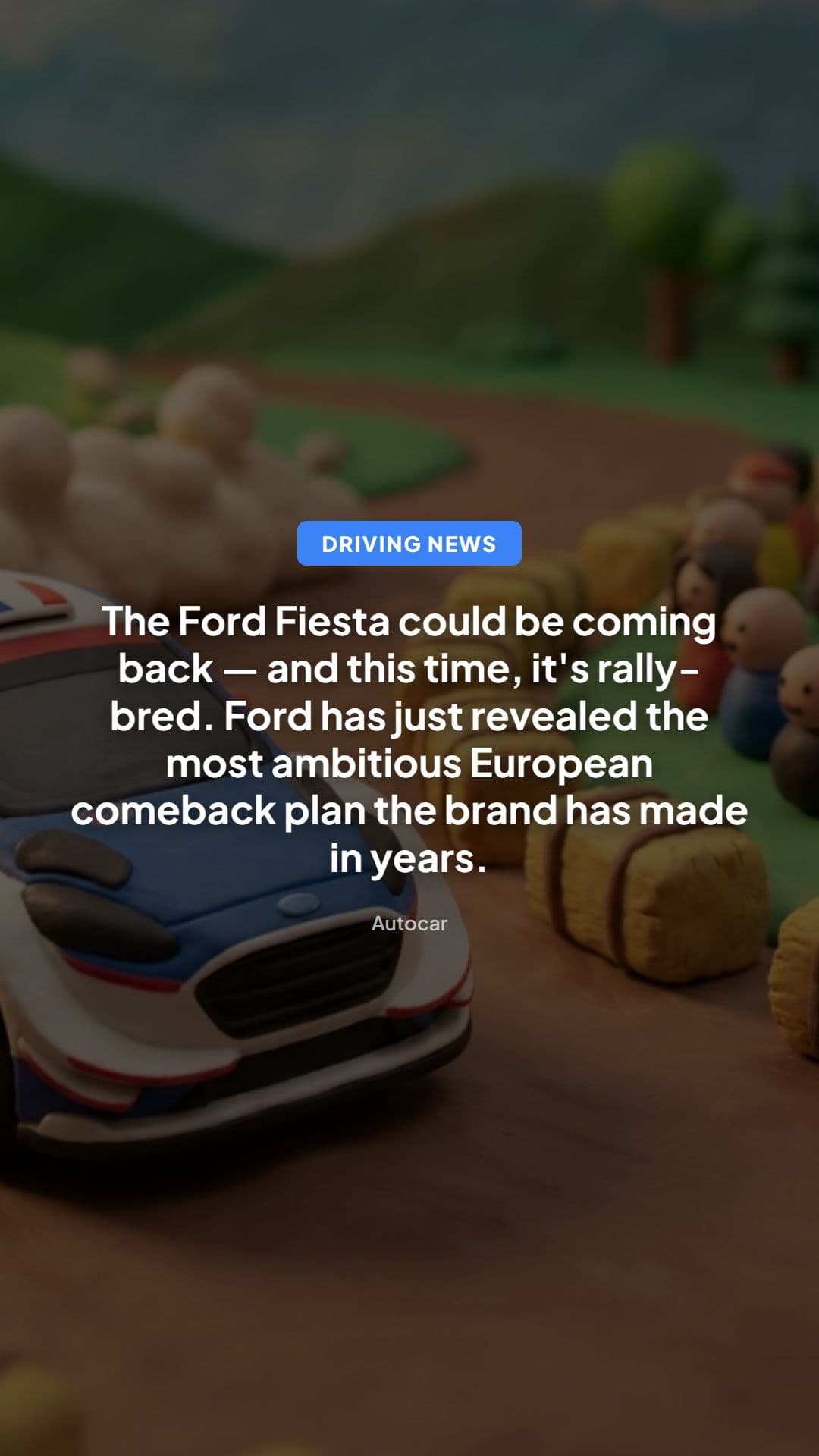
Ford's European Comeback: What the Fiesta Revival and New Models Mean for UK Drivers
There's a particular kind of grief that comes with losing a car you love. Ask any Fiesta owner who handed back their keys for the last time in 2023, and you'll likely get a wistful pause before they answer. Ford's decision to axe its best-selling European supermini felt, to many, like the end of an era — a cold commercial calculation that left millions of loyal drivers without a natural successor. But now, according to a detailed Autocar report on Ford's European strategy, the Blue Oval is plotting a comeback that could reshape the UK new car market significantly. The Fiesta name is apparently back on the table, joined by a right-hand drive Bronco and fresh Puma variants. So what's actually happening, and what does it mean for drivers navigating an increasingly complex, expensive, and electrified road landscape?
What's Actually Happening at Ford Europe
Autocar's report outlines a multi-pronged product strategy from Ford aimed at rebuilding its presence in Europe after a turbulent few years. The headline grabber is the potential revival of the Fiesta nameplate, which was discontinued in June 2023 after more than 4.7 million examples were sold in the UK alone since its 1976 debut. That makes it, statistically, one of the most successful cars ever sold on British roads.
Beyond the Fiesta, Ford is reportedly planning to introduce the Bronco to European and right-hand drive markets — a rugged, American-flavoured SUV that has been a runaway success in North America but has never officially reached UK showrooms. The Puma, already one of Ford's better-performing European models, is set to receive new variants to extend its appeal.
The broader context here is Ford's acknowledgement that abandoning the affordable small car segment was, commercially, a mistake. While the company pivoted aggressively towards electrification and higher-margin vehicles, rivals including Volkswagen, Renault, and a wave of Chinese manufacturers have continued to offer competitive, affordable options to European buyers. Ford is now attempting to reclaim lost ground.
Why This Matters: The Bigger Picture
Ford's retreat from the European small car market didn't happen in isolation. It was part of an industry-wide squeeze driven by increasingly stringent EU and UK emissions regulations, the enormous capital costs of developing electric platforms, and a post-pandemic shift in consumer demand towards larger vehicles. The logic seemed sound at the time: margins on superminis are notoriously thin, and electrifying them profitably is genuinely difficult.
But the strategy backfired. Ford's European market share declined noticeably following the Fiesta's discontinuation. The company had underestimated how many buyers simply wouldn't trade up to a Puma or Explorer — they'd go elsewhere. Renault's Clio and Volkswagen's Polo continued to sell strongly, and newer entrants like the BYD Dolphin and MG3 demonstrated that affordable small cars, including electric ones, absolutely have a market.
The Fiesta's potential return also reflects a broader industry rethink about the ZEV Mandate — the UK government's requirement that 22% of each manufacturer's new car sales must be zero-emission vehicles in 2024, rising to 28% in 2025 and eventually 100% by 2035. For Ford to meet those targets while remaining competitive in volume terms, it needs affordable electric models. A new Fiesta, almost certainly electric or hybrid in its next iteration, would serve that purpose directly.
The Legal and Regulatory Angle
For UK buyers, the regulatory backdrop to any new Ford model launch is significant and worth understanding properly.
The Zero Emission Vehicle (ZEV) Mandate, introduced under the Automotive Zero Emission Vehicles Act and subsequent regulations, places legal obligations on manufacturers, not consumers. However, it has a direct knock-on effect on the cars available to buy and their pricing. Manufacturers who miss their ZEV targets face fines of £15,000 per non-compliant vehicle — a penalty that creates strong commercial pressure to either discount electric models or restrict the supply of popular petrol vehicles.
This matters for Fiesta buyers specifically. If the revived model arrives as a pure electric vehicle, it will likely qualify for the UK's Electric Vehicle Grant — currently available on cars priced under £35,000 for eligible buyers including charities and small businesses. A new Fiesta EV priced competitively could bring those grants back into play for private buyers if government policy evolves, as has been discussed in Parliament.
Regarding the Bronco, bringing a right-hand drive version to the UK involves navigating DVSA type approval requirements, which have become more complex post-Brexit. Vehicles must meet UK WVTA (Whole Vehicle Type Approval) standards rather than the EU's equivalent, meaning Ford would need separate certification for UK-specification cars. This is a genuine engineering and regulatory undertaking, not merely a marketing exercise.
The Consumer Rights Act 2015 is also relevant here for early adopters. When manufacturers announce models in advance — sometimes years before delivery — buyers who place deposits are protected. Any deposit paid is subject to contract law, and if a vehicle fails to arrive or arrives materially different from what was described, consumers have rights to a full refund. Given Ford's history of cancelling or significantly altering models, this is worth keeping in mind.
What Drivers Should Know: Practical Takeaways
If you're tempted by any of the returning or new Ford models, here's what to bear in mind before you commit:
- Don't rush a deposit. Early reservation deposits on unconfirmed models carry risk. Ensure any deposit is fully refundable and get that in writing before you pay.
- Check the ZEV Mandate implications. If the new Fiesta arrives as an EV, manufacturers may offer attractive finance deals or discounts to hit their ZEV quota targets — particularly towards the end of each calendar year. Timing your purchase accordingly could save you thousands.
- Verify type approval for the Bronco. Before placing any order, confirm the vehicle has full UK WVTA certification. This affects insurance, financing, and — critically — whether the car can be legally registered and driven on UK roads.
- Understand running costs before switching. If you're a current Fiesta owner on a tight budget, a new electric version will involve different running cost calculations. Home charging (if you have a driveway) remains significantly cheaper than public charging, which can now rival petrol costs at some rapid charge points.
- Check insurance group ratings early. New models, particularly those with unfamiliar powertrains or imported platforms like the Bronco, can attract unexpectedly high insurance premiums initially. Get quotes before committing.
- Leasing versus buying. Given the pace of EV technology development, personal contract hire (PCH) or PCP deals may offer better value than outright purchase on new electric Fords, particularly in the first model year. Battery technology and range are improving rapidly, and a three-year lease keeps your options open.
Looking Ahead: What Ford's Comeback Means for the UK Market
Ford's renewed European ambition is genuinely significant for British drivers, and not just for sentimental reasons. The UK new car market has been quietly bifurcating: premium and luxury vehicles continue to sell well, while the affordable end has been increasingly dominated by used cars, Chinese imports, and a shrinking pool of mainstream European options.
A credible, affordable electric Fiesta — if it arrives at a competitive price point — could do for EV adoption what the original Fiesta did for car ownership in the 1970s: make it genuinely accessible to ordinary working families. That would have real implications for urban air quality, fuel costs, and the UK's progress towards its net zero transport commitments under the Climate Change Act 2008.
The Bronco's potential UK arrival, meanwhile, opens up a different conversation about road suitability and emissions. Large American SUVs face growing scrutiny in urban areas, and any Bronco variant sold here would need to meet Euro 6d or UK-equivalent emissions standards. Buyers in areas covered by Clean Air Zones — including Birmingham, Bristol, and Bath — should check whether a petrol or diesel Bronco would incur daily charges before purchasing.
Ford's comeback is, ultimately, a story about a company recalibrating after a strategic misjudgement. Whether it succeeds depends on pricing, timing, and whether the emotional connection drivers feel towards the Fiesta name can be transferred to an entirely new electric vehicle. The history of automotive revivals is mixed — some work brilliantly, others disappoint.
But if Ford gets this right, it could mark a genuine turning point: not just for the brand, but for making electric motoring affordable for the millions of UK drivers who currently feel priced out of the transition entirely. Watch this space — and keep your deposit cheque in your pocket until the order books officially open.
Written by
Yuki Tanaka
Urban Planning Researcher
Ready to Challenge Your Ticket?
Let our AI analyse your PCN and generate a professional appeal letter in minutes.
Start Free Appeal