Ferrari Luce EV: 1,036bhp, 329-mile range & UK price
Ferrari’s Luce super-EV promises 1,036bhp, a 329-mile range and a £440k UK price. We unpack the specs, charging implications and what it means for UK drivers.

Yuki Tanaka
28 May 2026
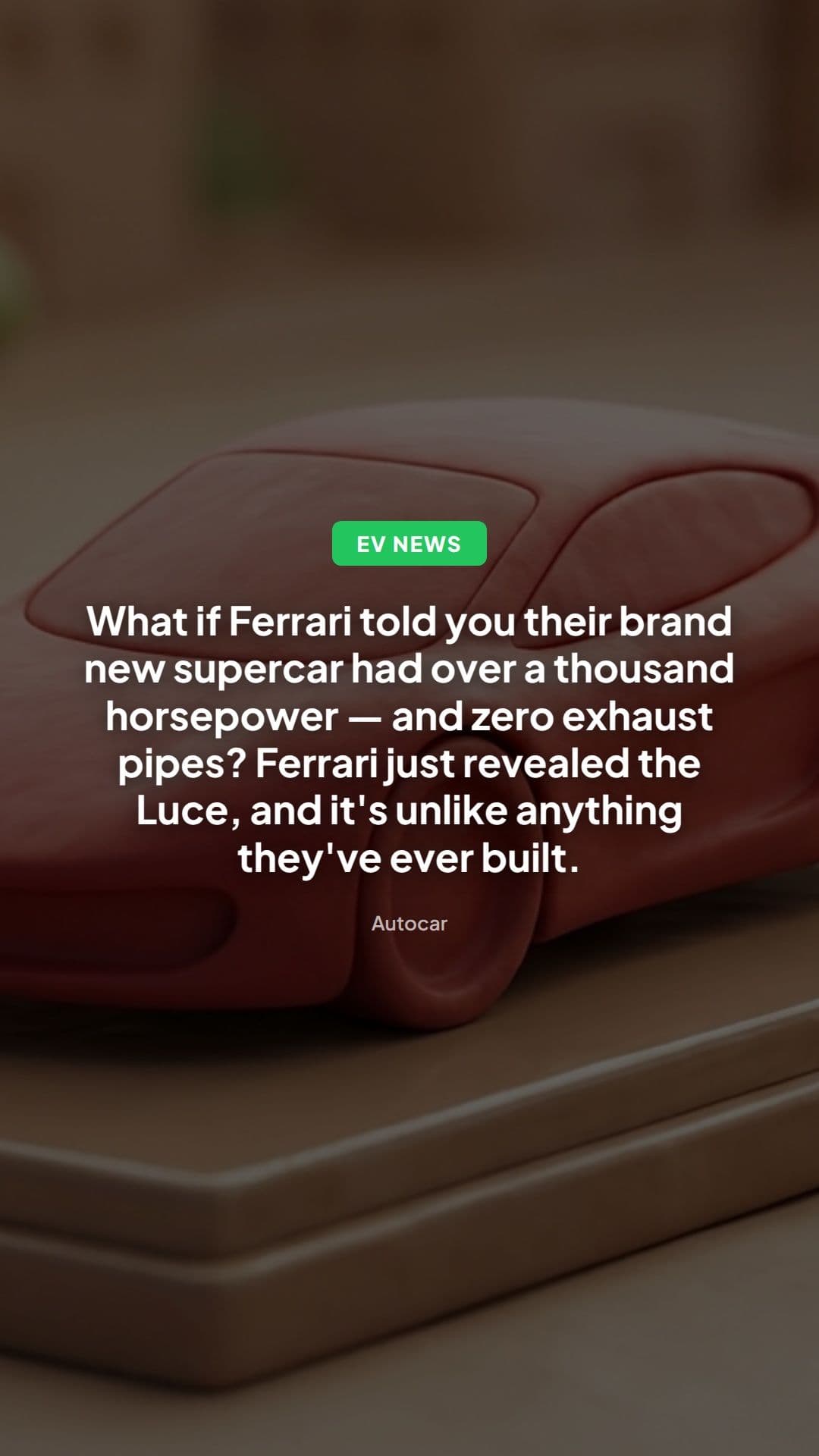
Ferrari Luce: What a £440,000 Electric Supercar Tells Us About the Future of Driving in Britain
There's a moment in every technological revolution when the old guard stops resisting and starts leading. For Ferrari, that moment appears to have arrived — and it's arrived at 1,036 brake horsepower, a claimed 329-mile range, and a price tag that would comfortably buy you a four-bedroom house in most parts of England. The Ferrari Luce isn't just a new car. It's a statement of intent that carries implications far beyond the rarefied world of supercar ownership.
What Is the Ferrari Luce, and Why Is Everyone Talking About It?
Reported by Autocar, the Ferrari Luce is the Maranello manufacturer's first fully electric production supercar, and it is — by any measure — an extraordinary machine. The headline figures are staggering: over 1,000bhp from an all-electric drivetrain, a claimed range of 329 miles on a single charge, and a UK price in the region of £440,000.
To put that in perspective, the current Ferrari Roma — considered a relatively accessible entry point into the brand — starts at around £200,000. The Luce costs more than twice that. Yet it is almost certain to sell out almost immediately, as Ferrari's production volumes are deliberately constrained and its waiting lists perpetually lengthy.
But beyond the jaw-dropping numbers, the Luce matters because of who is making it. Ferrari has historically been among the most vocal sceptics of full electrification, with former chairman John Elkann publicly stating that the brand would not rush into battery power simply to follow a trend. The Luce suggests that position has fundamentally shifted — and when Ferrari moves, the rest of the industry pays close attention.
Why This Matters Far Beyond the Supercar Market
You might reasonably ask: what does a £440,000 Ferrari have to do with the average British driver? Rather more than you'd think.
Technology trickles down. The engineering breakthroughs required to deliver 1,036bhp from an electric powertrain whilst maintaining a 329-mile range will eventually filter into mainstream vehicles. Ferrari's investment in battery management, thermal regulation, and power delivery will contribute to the broader knowledge base from which brands like Volkswagen, Hyundai, and Renault draw. The same was true of carbon fibre, paddle-shift gearboxes, and regenerative braking — all technologies that debuted in motorsport or supercars before becoming commonplace.
Range anxiety is being dismantled at the top end. One of the persistent objections to electric vehicles in Britain has been range. The Luce's claimed 329 miles represents a significant psychological threshold — enough to drive from London to Edinburgh on a single charge, with a margin to spare. When even a supercar can achieve this, the argument that EVs are fundamentally limited becomes increasingly difficult to sustain.
The luxury EV market is reshaping charging infrastructure expectations. As ultra-premium brands electrify, pressure grows on charging networks to deliver the speed, reliability, and accessibility that wealthy early adopters demand. This pressure benefits all EV drivers. Porsche's investment in high-speed charging infrastructure, partly driven by the Taycan's success, is a clear precedent.
The Legal and Regulatory Landscape Surrounding High-Performance EVs
The arrival of a 1,000bhp electric vehicle in Britain raises several genuinely interesting legal questions that deserve examination.
Type Approval and Road Legality
All vehicles sold in the UK must comply with GB Type Approval regulations, which replaced EU type approval following Brexit. These rules, administered under the Road Vehicles (Construction and Use) Regulations 1986 and updated frameworks, govern everything from braking performance to pedestrian safety systems. A car producing 1,036bhp must demonstrate that its braking, stability control, and safety systems are commensurate with its performance. The Luce will almost certainly deploy sophisticated torque vectoring, multi-mode stability control, and carbon-ceramic brakes to satisfy these requirements.
Speed Limiters and Intelligent Speed Assistance
Under EU Regulation 2019/2144, which the UK has partially mirrored in post-Brexit legislation, new vehicles sold in Great Britain are increasingly expected to feature Intelligent Speed Assistance (ISA) — technology that can detect speed limits and alert or restrict the driver. The practical question for a car capable of extraordinary speeds is how ISA interacts with track-day modes. UK regulations do permit manufacturers to offer driver-deactivatable ISA systems, but the system must default to active at each engine start.
Insurance Implications
Insuring a £440,000 electric supercar in the UK presents unique challenges. Under the Road Traffic Act 1988, third-party insurance is the legal minimum, but comprehensive cover for a vehicle of this value will be extraordinarily expensive — and some mainstream insurers will simply decline to quote. Specialist brokers such as those operating under Lloyd's of London syndicates handle such vehicles, but premiums can run to tens of thousands of pounds annually.
There is also the question of agreed value versus market value policies. Given Ferrari's tendency to appreciate rather than depreciate — many modern Ferraris are worth significantly more than their original list price within years of delivery — owners must ensure their policy reflects current market value, not purchase price.
EV-Specific Regulations on Public Roads
The Luce, like all EVs, must comply with UNECE Regulation 138, which requires electric vehicles to emit a minimum level of acoustic warning sound at low speeds — the so-called Acoustic Vehicle Alerting System (AVAS). This regulation, retained in UK law post-Brexit, mandates that EVs produce a sound between 56 and 75 decibels when travelling below 20km/h (approximately 12mph). For a Ferrari, the acoustic design of this system will be considered a significant engineering and brand challenge.
What Drivers Should Know: Practical Takeaways
Even if a £440,000 Ferrari is somewhat beyond your immediate purchasing plans, the Luce's arrival carries practical lessons for any UK driver considering an electric vehicle.
1. Range claims require scrutiny. The 329-mile figure is almost certainly a WLTP (Worldwide Harmonised Light Vehicle Test Procedure) figure — the standard used in European and UK homologation. Real-world range, particularly in winter or at motorway speeds, will be lower. As a rule of thumb, expect 15–25% less than the WLTP figure in typical British driving conditions.
2. Home charging infrastructure matters more than you think. For any EV — Ferrari or Ford — the majority of charging happens at home. If you live in a property without off-street parking, this presents a genuine challenge. The UK government's EV Infrastructure Strategy includes provisions for on-street charging, but rollout remains patchy. Check your local council's provision before committing to any electric vehicle purchase.
3. Understand your charging rights. The Public Charge Point Regulations 2023 require publicly funded charge points to be operational, contactless payment-enabled, and accessible. If you encounter a broken or inaccessible public charger, you have the right to report it to the charge point operator and, where applicable, to the relevant local authority. Ofgem also has an oversight role in the public charging market.
4. Consider depreciation differently for EVs. Battery technology is advancing rapidly. A premium EV purchased today may face steeper depreciation than a petrol equivalent as newer, longer-range models arrive. This is less likely to apply to a limited-production Ferrari — but it is a genuine consideration for mainstream EV buyers.
5. Check your lease or finance agreement. Many EV drivers in the UK acquire their vehicles through PCP or lease arrangements. Ensure your agreement accounts for battery health guarantees, and understand what happens if battery capacity degrades below a threshold during the finance term.
Looking Ahead: What the Luce Signals for British Motoring
The Ferrari Luce is not merely a car. It is a cultural artefact that marks a decisive turning point in the story of the internal combustion engine.
Ferrari's electrification sends a clear message to the remaining holdouts — both manufacturers and drivers — that the transition is no longer a question of if, but how. If the brand most synonymous with the roar of a naturally aspirated V12 can find meaning and excitement in electric power, the philosophical objections to EVs become harder to sustain.
For British drivers, the practical timeline is shaped by the Zero Emission Vehicle (ZEV) Mandate, which requires 22% of new cars sold by manufacturers to be zero-emission in 2024, rising to 80% by 2030 and 100% by 2035. The infrastructure, the technology, and now the cultural credibility are aligning.
The Ferrari Luce will be bought by a handful of extraordinarily wealthy enthusiasts. But its legacy will be felt by every driver who fills up — or plugs in — in Britain over the coming decade. That, ultimately, is why a £440,000 supercar is everybody's business.
Source: Autocar — "1036bhp, 329 miles, £440k: Ferrari Luce revealed as wild super-EV"
Written by
Yuki Tanaka
Urban Planning Researcher
Ready to Challenge Your Ticket?
Let our AI analyse your PCN and generate a professional appeal letter in minutes.
Start Free Appeal