EV Charging VAT Cut: Why Public Users Could Lose Out
From October 2026, zero VAT on domestic electricity could cut home EV charging costs—but motorists relying on public chargers may miss out in the tax shake-up.

Grace O'Sullivan
21 July 2026
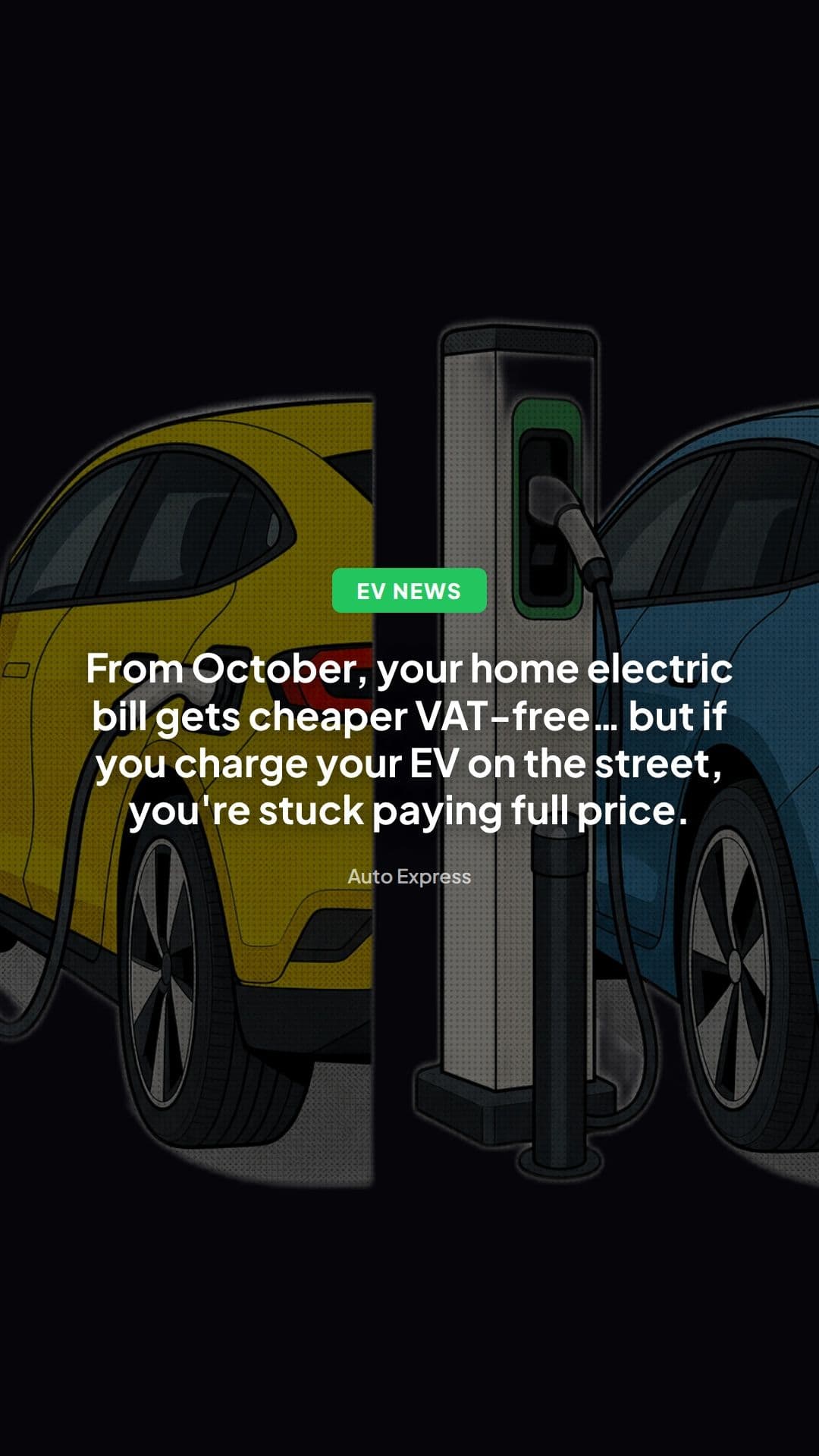
The VAT Cut That Could Leave Millions of EV Drivers Paying More
Here's an uncomfortable truth about the government's plan to scrap VAT on domestic electricity from October 2026: it's brilliant news, unless you're one of the estimated third of UK households without off-street parking. For them, this policy could quietly widen an already yawning cost gap between charging an electric car at home and doing it on the street.
If you've been eyeing an EV purchase, or you already own one and rely on public chargers because you park on the road, this is a story you need to understand properly, not just skim the headline on.
What's Actually Happening
According to Auto Express, the government is planning to remove VAT from domestic electricity bills starting October 2026. On the surface, this looks like straightforward good news for anyone with an electric vehicle. Charge your car overnight from your home supply, and that electricity should become cheaper the moment the VAT charge disappears.
The problem, as the report highlights, is that this saving is tied specifically to domestic electricity, the kind that comes through your household meter. Public charging networks, the rapid chargers at motorway services, the lamppost units on residential streets, the bay chargers in supermarket car parks, run on commercial electricity tariffs and are subject to different VAT treatment entirely.
Domestic electricity already benefits from a reduced 5% VAT rate, a policy that's been in place for years. Public charging, by contrast, has historically been charged at the standard 20% VAT rate, a disparity that's been a long-running sore point for EV campaigners and drivers without driveways. There have been previous government moves to address this gap, but the core inequality has persisted.
If domestic electricity VAT drops to zero while public charging VAT stays where it is (or even if it's reduced but not eliminated), the pence-per-mile cost of running an EV becomes even more dependent on whether you have a driveway.
Why This Matters More Than It First Appears
Let's put some real-world logic around this. Home charging is already dramatically cheaper than public charging, often costing a fraction of the price per mile, particularly if you're on a specialist EV energy tariff that offers cheap overnight rates. Public rapid charging, especially at motorway services, can cost several times more per kilowatt-hour.
Removing VAT from home electricity widens that gap further. It's not a small tweak, it's a structural change that rewards drivers who can plug in at home and does nothing for those who can't.
This matters because the drivers who rely on public charging aren't a niche group. Millions of UK households, particularly in cities, in terraced housing, in flats, or without a garage or driveway, have no realistic way to charge at home. They're not choosing to use public infrastructure out of preference, they're doing it because it's their only option.
There's also a fairness dimension that goes beyond convenience. Lower-income households are statistically more likely to live in properties without off-street parking. If the tax system increasingly favours home charging, it risks becoming a policy that inadvertently subsidises EV ownership for wealthier, homeowning drivers while leaving less affluent drivers facing higher running costs, precisely the opposite of what you'd want if the goal is genuinely inclusive EV adoption ahead of the 2030 phase-out of new petrol and diesel car sales.
This isn't a hypothetical concern either. The government has previously acknowledged the public charging VAT disparity as a problem worth solving, yet solutions have been slow to materialise. If the domestic VAT cut goes ahead without a parallel move on public charging rates, it risks entrenching exactly the divide campaigners have been warning about for years.
The Legal and Regulatory Picture
VAT policy in the UK is set by HMRC and confirmed through the Chancellor's fiscal statements, typically the Budget or a fiscal event. The reduced 5% rate on domestic fuel and power, including electricity, has applied since the 1990s under specific VAT legislation covering household energy supplies. Any move to remove VAT entirely on domestic electricity would need to be confirmed through official Treasury announcements and subsequent legislation, so drivers should treat the October 2026 date as a planned policy direction rather than a locked-in certainty until it's formally legislated.
Public EV charging, by contrast, has generally attracted the standard 20% VAT rate because commercial electricity supply falls outside the reduced domestic rate categories. This has been a point of contention, and there have been calls, including from within government circles, to align public charging VAT more closely with domestic rates to avoid penalising drivers without home charging access. Whether this VAT change actually happens alongside the domestic cut, or lags behind it, will significantly shape how big the cost gap becomes.
It's also worth noting that VAT is just one part of the wider public charging cost picture. Site host fees, network operating costs, and the price networks pay for wholesale electricity all feed into what you're charged per kilowatt-hour at a public unit. Even if VAT rates were fully aligned tomorrow, other cost pressures would remain.
There's no current indication of a legal challenge or judicial review connected to this specific policy, but the broader issue of unequal treatment for drivers without home charging access has featured in policy discussions around fairness in the EV transition, and it's the kind of disparity that consumer groups and motoring organisations are likely to keep pushing back on publicly.
What Drivers Should Actually Do
If you're relying on public charging, either because you don't have a driveway or you're a high-mileage driver who needs rapid top-ups, there are practical steps worth taking now rather than waiting to see how policy shakes out.
Shop around on charging networks. Costs vary significantly between providers, and some networks offer membership schemes or subscription tariffs that reduce the per-kWh rate if you charge regularly. It's worth comparing several networks rather than defaulting to whichever charger happens to be nearest.
Check for overnight or off-peak public tariffs. Some public charging providers, particularly those operating on-street or destination chargers, offer cheaper rates during quieter hours. If your routine allows it, timing your charging sessions can make a real difference.
Investigate whether a home charging solution is possible even without a traditional driveway. Some councils have started trialling on-street charging solutions, including cable gullies that let residents run a charging cable safely across a pavement from their property to a parked car. Availability is patchy and depends heavily on your local authority, but it's worth checking what your council currently offers or has planned.
Keep an eye on further government announcements. If there's a genuine gap opening up between domestic and public charging costs, there will likely be pressure on the Treasury to address public charging VAT separately. Following official updates from HMRC and the Department for Transport will help you stay ahead of any additional relief that might apply to public charging specifically.
Factor total cost of ownership into any EV purchase decision. If you don't have home charging and are considering an EV, run the numbers properly using realistic public charging rates rather than assuming you'll get home-charging economics. The savings on fuel and maintenance can still make an EV worthwhile, but the sums look different depending on where you'll be plugging in.
Looking Ahead
The direction of travel on EV policy has been anything but smooth over the past couple of years, with shifting timelines on the 2030 sales target, wavering support for charging infrastructure rollout, and ongoing debate about how EV drivers should be taxed as fuel duty revenue declines. This VAT change adds another layer of complexity to that picture.
Whether the government moves to close the gap between domestic and public charging VAT, or lets it widen, will say a lot about how seriously ministers are taking the fairness dimension of the EV transition. For drivers without driveways, this isn't an abstract tax debate, it's the difference between an EV that's genuinely cheaper to run than a petrol car and one that barely breaks even.
Until there's further clarity from the Treasury, the sensible approach is to treat October 2026 as a date to watch rather than a guaranteed saving, particularly if public charging is your only realistic option.
Written by
Grace O'Sullivan
Municipal Enforcement Expert
Ready to Challenge Your Ticket?
Let our AI analyse your PCN and generate a professional appeal letter in minutes.
Start Free Appeal