EV Charging Parking Fine: Why a Driver Faced a £270 Bill
A Kia EV driver was hit with a near-£270 private parking charge after charging 11 minutes over the limit at a Weymouth KFC. Learn what drivers can challenge.

The Parking Ticket Pal Editorial Team
27 August 2026
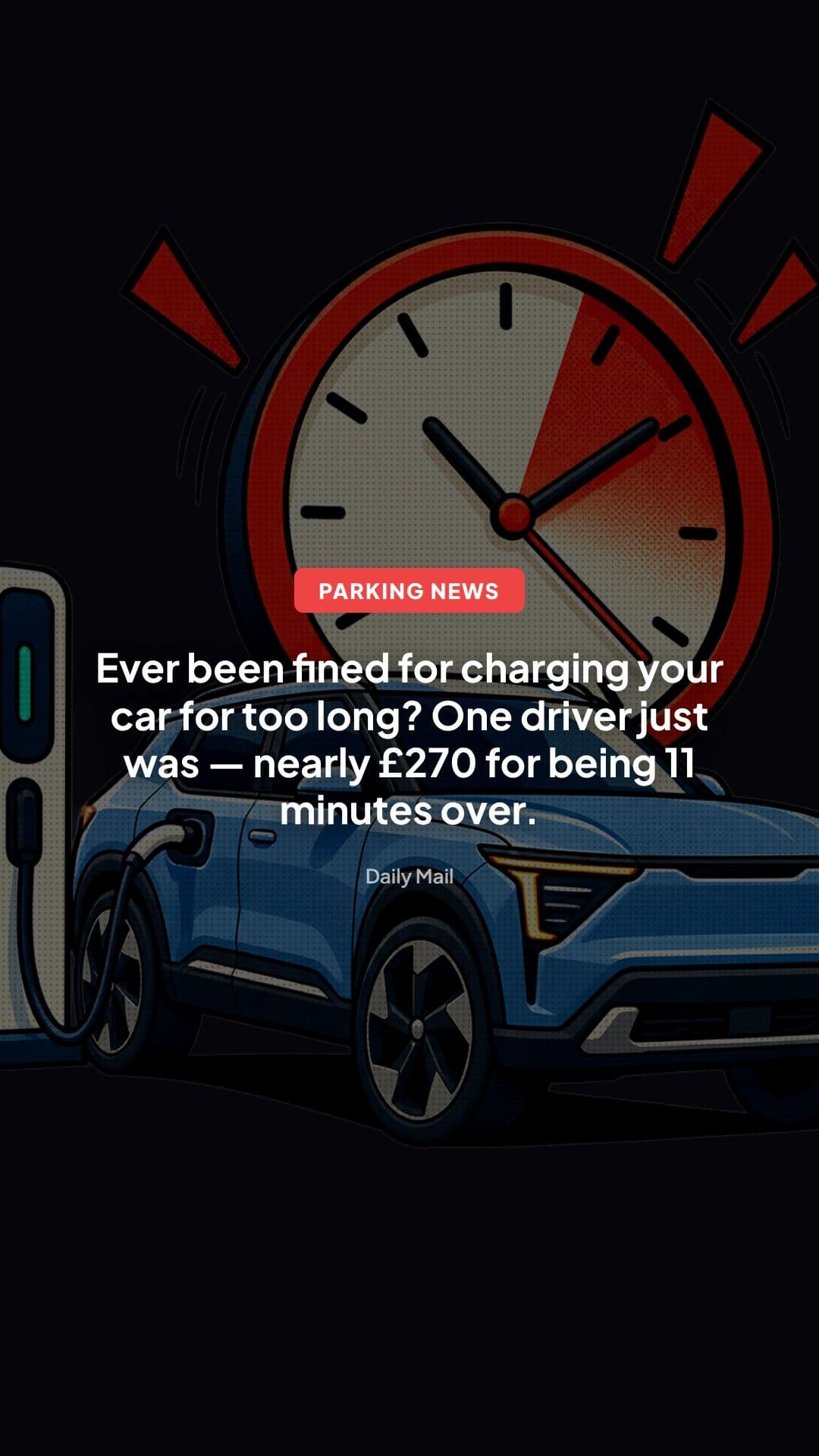
Fined Nearly £270 Because His Car Charged For 11 Minutes Too Long: What This EV Driver's Ordeal Tells Us About Parking Rules in 2025
Imagine doing everything right. You plug in, you order your dinner, you wait for your battery to top up, and you still walk back to a parking charge notice on your windscreen. That is precisely what happened to a Kia driver at a KFC car park in Weymouth, who was pursued for nearly £270 after his electric car overstayed the site's maximum parking limit by just 11 minutes while it was still charging.
It sounds like a punchline. It is not. It is a genuine warning sign for the growing number of drivers who rely on destination chargers bolted onto retail and fast food car parks, and it exposes a gap between how EV charging actually works and how private parking operators enforce their rules.
What Happened
According to the Daily Mail's report, the driver parked at the fast food restaurant's car park in Weymouth to use an on-site EV charger. The car park, like thousands of others attached to supermarkets, drive-throughs and retail parks across the UK, imposes a maximum stay limit designed to keep spaces turning over for paying customers. In this case, the driver's charging session ran 11 minutes past that limit.
That overrun was enough to trigger a parking charge notice, which, once escalated, left him facing a bill of close to £270. The frustration is obvious: charging an electric car is not like refuelling with petrol. You cannot simply squeeze the trigger for another thirty seconds and be done. Charging speed depends on the battery's state, the ambient temperature, how many other vehicles are drawing power from the same unit, and the charger's own throughput, which can slow dramatically as the battery approaches full. An 11-minute miscalculation is entirely plausible, and arguably almost unavoidable, when you are not in full control of the variables.
Why It Matters
This story lands at an interesting moment for UK motoring. EV ownership is rising fast, and many drivers without a driveway or home charger depend on destination charging at supermarkets, retail parks and fast food outlets to keep their cars moving. These bays are typically run by private parking companies operating under contract to the landowner, not by the council, which means enforcement is governed by contract law and the terms displayed on signage rather than by traffic regulation orders.
The tension is structural. Car parks attached to fast food restaurants and retail units are designed around a business model that wants customers in and out quickly, often with stay limits of 60 to 90 minutes. EV charging, on the other hand, is not always quick. A driver plugging into a slower AC charger, or arriving with a nearly empty battery, may simply need longer than the site's time limit allows, regardless of how efficiently they eat their meal.
This is not an isolated design flaw. It is the same pattern behind many of the "shock" EV charging bay fines that have been reported at retail sites up and down the country, where drivers who believed they were doing the environmentally responsible thing found themselves facing charges that dwarfed the cost of the electricity they used. It also echoes the wider surge in private parking enforcement generally, with private firms issuing tens of thousands of tickets every day across the UK.
The Legal Angle
It's worth understanding the framework that allows a private car park to issue a charge like this in the first place.
Parking charge notices (PCNs) issued in car parks like the one at this KFC are not fines in the legal sense that a council-issued penalty is. They are, technically, an invoice for an alleged breach of contract, based on the idea that by parking on the land, the driver accepted the terms displayed on signage, including the maximum stay. This is why wording and visibility of signage matters so much in any dispute; if the terms were not clearly and prominently displayed, that can form the basis of a legitimate appeal.
The keeper liability provisions in Schedule 4 of the Protection of Freedoms Act 2012 allow a parking operator to pursue the registered keeper of a vehicle for an unpaid charge if they cannot identify the driver, provided the operator follows a strict notice process. If that process is not followed to the letter, keeper liability may not apply, which is one of the most common grounds for a successful challenge.
Drivers who receive a charge like this from a British Parking Association (BPA) or International Parking Community (IPC) member firm also have the right to appeal, first informally to the operator, and then formally through an independent appeals service, POPLA for BPA members or the Independent Appeals Service for IPC members, if the operator rejects the initial challenge. These appeal routes are free to use and do not require legal representation, though the evidence you submit matters enormously.
There is also a wider regulatory backdrop worth knowing about. The government has been working towards a new Private Parking Code of Practice, which at various points has proposed capping unavoidable extra charges and building in grace periods for genuine circumstances. Reforms of this kind are aimed squarely at situations like this one, where a driver overstays through no real fault of their own.
What Drivers Should Know
If you are charging an EV in a car park with a posted maximum stay, there are some practical steps that can reduce your risk of ending up in the same position as this Weymouth driver.
Check the maximum stay before you plug in, not after. Signage at the entrance and near the charger should state the limit clearly. If it does not, note that down, because unclear or missing signage is one of the strongest grounds for challenging a charge.
Be realistic about charging times. Charging speed slows as a battery fills, particularly past 80 percent, so do not assume a linear rate. If your session is running close to the time limit, consider stopping the charge early rather than risking an overstay, even if the battery is not completely full.
Keep your charging session receipt or app data. Most charge point operators log start and end times electronically. This evidence can be invaluable if you later need to demonstrate exactly how long you were parked and why.
Photograph the signage and the charger on arrival and departure. Time-stamped photos showing the car plugged in, the charge point's payment screen, and any relevant signs can support an appeal far more persuasively than a written explanation alone.
Appeal promptly, in writing, and stick to the facts. If you do receive a charge, do not ignore it. Escalating charges and debt collection referrals only add pressure. A clear, evidence-based appeal, submitted within the deadline stated on the notice, gives you the best chance of a swift resolution. Our guide to writing an effective informal PCN appeal sets out a structure that works well for exactly this kind of dispute.
Understand who you are dealing with. Not every car park operator is well known. Some smaller operators or single sites have inconsistent enforcement practices, and it is worth checking whether the firm is a member of the BPA or IPC, since this affects which appeals body you can use.
Looking Ahead
Cases like this one are likely to become more common before they become rarer. The number of electric vehicles on UK roads continues to climb, and destination charging at fast food outlets, supermarkets and retail parks remains a crucial part of the charging network, especially for drivers without off-street parking at home. Yet the maximum stay limits at many of these sites were designed years before EV charging bays became commonplace, built around the turnover expectations of a quick coffee or a drive-through meal, not the unpredictable rhythms of battery charging.
Pressure is building on several fronts to close that gap. Regulatory reform of private parking enforcement continues to move, however slowly, towards clearer protections for drivers, and charge point operators and landowners are under growing scrutiny to align their car park rules with the realities of EV charging rather than against them.
Until that catches up properly, the responsibility largely sits with drivers to plan carefully, document everything, and know their rights the moment a parking charge notice appears. An 11-minute overstay costing nearly £270 might sound absurd, and in many ways it is, but it is also a preventable outcome for anyone willing to keep half an eye on the clock while their car quietly tops up.
Written by
The Parking Ticket Pal Editorial Team
Source-checked parking guidance
Ready to Challenge Your Ticket?
Let our AI analyse your PCN and generate a professional appeal letter in minutes.
Start Free Appeal