EV charging gullies: UK plans for drivers without driveways
UK ministers back faster rollout of pavement EV charging gullies and kerbside solutions, helping flat-dwellers and motorists without driveways charge at home.

David Chen
22 April 2026
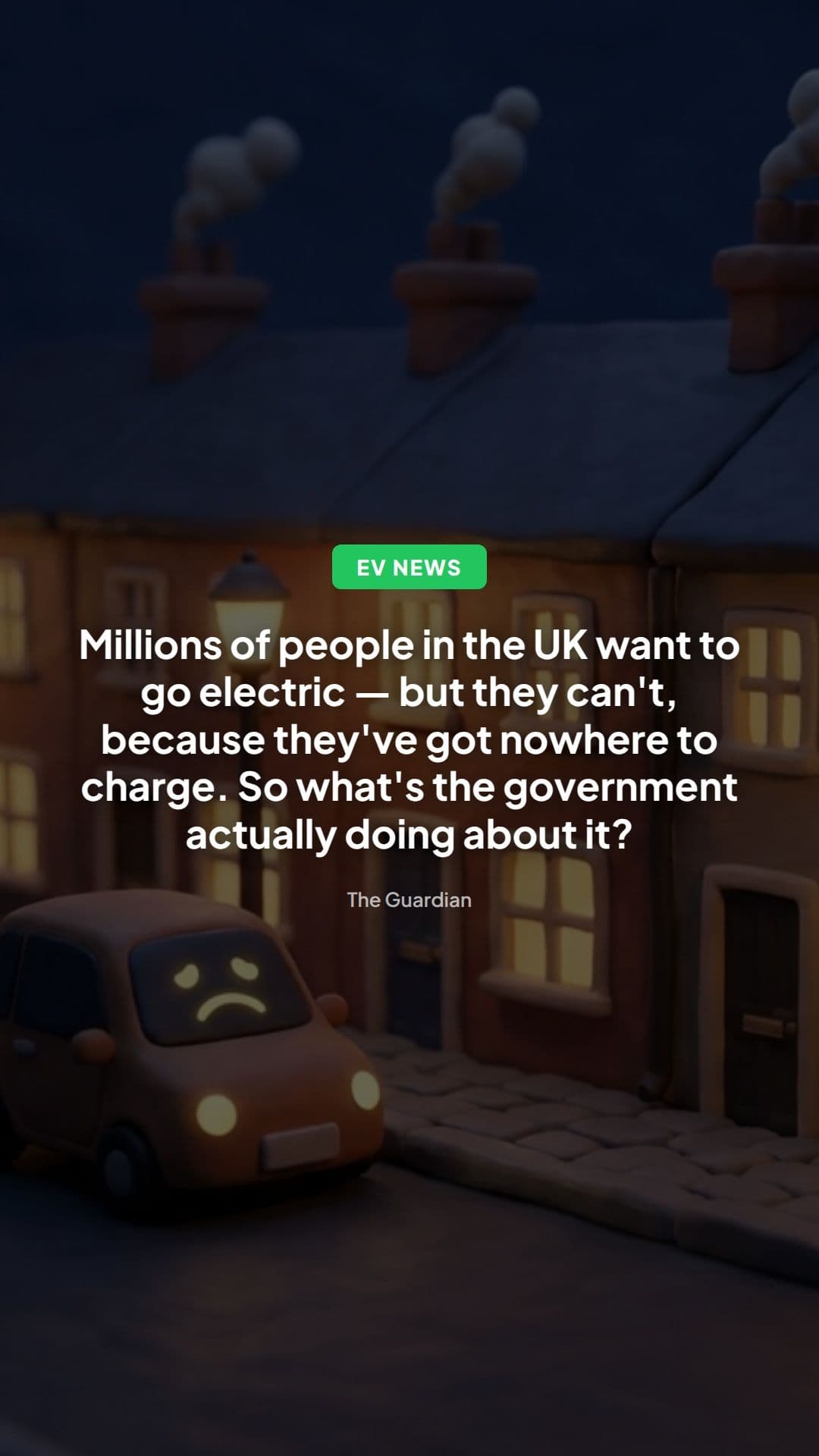
No Driveway, No Problem? Why the Government's EV Charging Shake-Up Could Be a Game-Changer for Millions
Picture this: you've just bought a shiny new electric vehicle, motivated by rising fuel costs, the looming 2035 petrol and diesel ban, and the promise of cheaper running costs. You arrive home, pull up outside your terraced house or your block of flats, and then the reality hits. There's nowhere to plug in. Your car sits on the street, its battery slowly draining, while your neighbours with driveways charge overnight for pennies. Welcome to the EV charging divide — one of the most stubborn barriers to electric vehicle adoption in the UK, and one that the government is finally taking seriously.
According to reporting by The Guardian, ministers are set to back measures designed to accelerate the installation of pavement charging gullies and other innovative solutions specifically aimed at households without off-street parking. It's a significant policy signal, and for the estimated 40% of UK households that lack a driveway or garage, it could genuinely change everything.
What's Actually Being Proposed?
The core of the announcement centres on so-called charging gullies — channels cut into pavements that allow a charging cable to run from a property's electricity supply to a car parked at the kerb, without creating a trip hazard. Think of them as a tidy, semi-permanent solution that sits somewhere between a full public charger and a home charge point.
But the proposals reportedly go further than just gullies. Ministers are said to be looking at a broader package of measures to tackle what the industry has long called the "last mile" charging problem: the infrastructure gap that exists not on motorways or in city centres, but right outside people's front doors. This includes streamlining planning permissions for kerbside chargers, reducing the bureaucratic burden on local councils, and potentially fast-tracking approvals for lamp-post charging units — a technology that has been trialled in several London boroughs and other cities but has struggled to scale nationally.
The timing is deliberate. With the 2035 ban on new petrol and diesel car sales approaching and EV uptake figures still lagging behind government targets, ministers are under real pressure to demonstrate that switching to electric is genuinely viable for everyone — not just homeowners with a garage and a spare socket.
Why This Matters More Than You Might Think
The charging inequality problem in the UK is stark, and it doesn't get discussed nearly enough. Research consistently shows that EV ownership is heavily skewed towards wealthier, suburban households — precisely because those households tend to have driveways. If you can charge at home overnight on a cheap electricity tariff, an EV makes brilliant financial sense. If you can't, you're reliant on public chargers, which are often slower, pricier, and — outside major cities — frustratingly sparse.
This isn't just an inconvenience. It's a structural barrier that risks turning the EV transition into yet another inequality story, where the environmental and financial benefits of electric driving accrue to those who already have advantages, while renters, flat-dwellers, and those in older terraced housing are left behind.
Flat-dwellers face a particularly acute challenge. Even where a resident might theoretically be willing to fund a charger installation, the legal and practical complications of shared buildings — managing agents, freeholders, the Landlord and Tenant Act 1985, building regulations — can make it enormously difficult. The government has previously introduced legislation giving leaseholders in England and Wales the right to request EV charge point installation under the Electric Vehicles (Smart Charge Points) Regulations 2021, but "the right to request" is a long way from "the right to have one installed", and many leaseholders report hitting brick walls.
The Legal Landscape: What Rights Do You Actually Have?
This is where things get genuinely complicated, and it's worth understanding the legal framework before you assume the government's new measures will immediately solve your problem.
Pavement Charging Cables
Currently, trailing a cable across a public pavement to charge your car is a legal grey area at best, and an offence under the Highways Act 1980 at worst. Section 161 of that Act makes it an offence to deposit anything on a highway that causes danger or obstruction. A cable running across a pavement — even a tidy one — could technically fall foul of this, and some councils have issued warnings accordingly. The proposed charging gullies are specifically designed to address this, creating a legal, safe, and standardised method for kerbside home charging.
Planning Permission
Installing a home charge point on private property generally falls under permitted development rights, meaning you don't need planning permission in most cases. However, the moment you're talking about infrastructure that touches or crosses the public highway — which a kerbside gully inevitably does — you enter the realm of highway authority consent under the Highways Act. This is where projects have historically stalled, with councils citing liability concerns, inconsistent standards, and resourcing issues. Streamlining this consent process is reportedly a key part of what ministers are planning.
Leasehold and Rental Properties
For renters, the position is weaker still. The Tenant Fees Act 2019 limits what landlords can charge tenants, but it doesn't compel landlords to facilitate EV charging. Renters have no automatic right to install a charge point, and while the government has consulted on extending permitted development rights to rental properties, progress has been slow. If you're a private tenant hoping to benefit from the new measures, the honest answer is that kerbside infrastructure is probably your most realistic near-term option.
What Drivers Without Driveways Should Know Right Now
While the policy wheels turn, here's what you can practically do today:
- Check your local council's kerbside charging programme. Many councils — particularly in London, Bristol, and Manchester — already have active rollouts of lamp-post chargers and kerbside units. Use your postcode on the Zap-Map platform to find the nearest public chargers and see what's coming to your area.
- If you're a leaseholder, write to your managing agent. Under the Electric Vehicles (Smart Charge Points) Regulations 2021, you have the right to formally request a charge point installation. Your managing agent or freeholder cannot unreasonably refuse. Put your request in writing, keep copies, and if they stall, consider escalating to the First-tier Tribunal (Property Chamber).
- Look into OZEV grants. The Office for Zero Emission Vehicles still offers the EV chargepoint grant for flat owners and renters, covering up to £350 (or 75% of installation costs) for eligible properties. The eligibility criteria were updated in 2023, so check the current rules on GOV.UK rather than relying on older information.
- Talk to your energy supplier. Several suppliers — including Octopus Energy and OVO — offer dedicated EV tariffs with very cheap overnight rates. Even if you're currently using public chargers, switching to a specialist EV tariff can reduce costs significantly.
- Join a local residents' association or community group. Councils are more likely to prioritise kerbside charging infrastructure on streets where there's demonstrated demand. Organised community requests carry far more weight than individual ones.
Looking Ahead: Will This Actually Work?
The honest answer is: it depends on the detail, the funding, and the speed of implementation.
The UK has a long history of announcing EV-related policy intentions that then take years to materialise in any meaningful way on the ground. The Electric Vehicle Infrastructure Strategy, published in 2022, set ambitious targets for public charging — 300,000 public charge points by 2030 — but progress has been uneven, with rural areas and deprived urban communities consistently lagging behind.
What's different about this announcement, potentially, is the focus on the pavement itself as infrastructure — not just installing chargers in car parks or on high streets, but fundamentally rethinking how residential streets can support EV ownership. That's a more ambitious and more difficult challenge, because it requires coordination between central government, local highway authorities, energy networks, and individual property owners.
The involvement of energy network operators is particularly crucial and often underappreciated. Even if every pavement gully in the country were approved tomorrow, the local electricity distribution networks would need to handle the additional load. In some older residential areas, the grid capacity simply isn't there yet, and upgrading it is expensive and slow.
Nevertheless, the direction of travel is clear, and for the millions of UK drivers currently locked out of the home charging revolution, it represents genuine cause for optimism. The EV transition was always going to require more than just better cars — it requires better infrastructure, smarter legislation, and a serious commitment to ensuring that the benefits of electric driving aren't reserved for those lucky enough to have a driveway.
The government appears, at last, to be taking that seriously. Now the hard work of delivery begins.
Written by
David Chen
Consumer Rights Expert
Ready to Challenge Your Ticket?
Let our AI analyse your PCN and generate a professional appeal letter in minutes.
Start Free Appeal