EV battery repair ‘black hole’: what UK drivers must know
Experts warn EV battery packs are being replaced, not repaired—raising used EV costs in the UK. What it means for warranties, repairs and rights.

Isabella Romano
13 May 2026
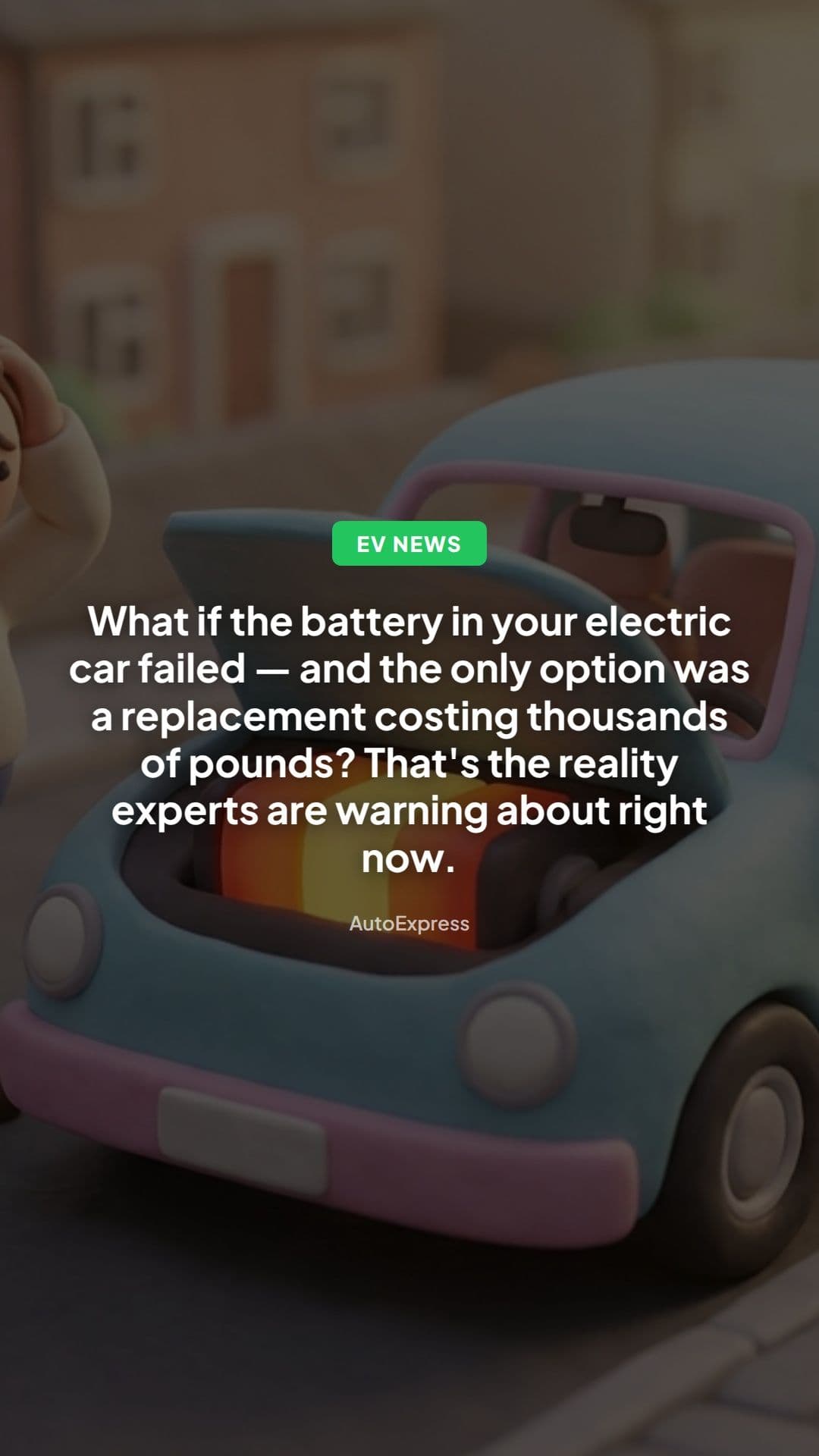
The EV Battery Repair Black Hole: Why It Could Derail Britain's Electric Revolution
Imagine buying a second-hand electric car, only to discover the battery needs replacing — and being quoted more than the vehicle is worth. It sounds like a nightmare scenario, but for a growing number of UK drivers, it's becoming an uncomfortable reality. A stark warning from industry experts, highlighted by Auto Express, has thrown a spotlight on what specialists are calling a "repair black hole" at the heart of the electric vehicle market. The consequences stretch far beyond individual motorists and threaten to undermine the entire second-hand EV ecosystem — and with it, the UK's wider ambitions for a cleaner, greener transport future.
What's Actually Happening?
The core problem is deceptively simple: when an EV battery pack develops a fault, the default response from manufacturers and dealerships is almost always to replace the entire unit rather than repair it. Battery packs are complex, expensive assemblies — often the single most costly component in an electric vehicle, frequently representing 30–50% of the car's total value.
Rather than diagnosing and fixing the specific cells or modules that have failed, technicians are routinely swapping out the whole pack. The result? Repair bills that can run to £10,000, £15,000 or even more — figures that make economic nonsense when the car itself might be worth considerably less on the open market.
The problem is compounded by a lack of transparency. Many manufacturers do not publish detailed battery diagnostics data or repair procedures for independent garages. Specialist tools and software are often proprietary, locked behind manufacturer access agreements that exclude the independent sector. In short, the skills, tools, and information needed to carry out module-level battery repairs simply aren't available to most of the market.
Why This Matters More Than You Might Think
The UK has committed to ending the sale of new petrol and diesel cars by 2035 under the Zero Emission Vehicle (ZEV) Mandate. For that transition to work equitably — for EVs to become genuinely accessible to all income groups, not just early adopters — a healthy second-hand market is essential. That market depends entirely on buyer confidence.
Right now, that confidence is fragile. Battery health anxiety is already one of the most commonly cited reasons why consumers hesitate to buy a used EV. The repair black hole makes that anxiety entirely rational. If a battery fault can render a £12,000 used car economically worthless overnight, the second-hand EV market risks becoming toxic — a space where buyers fear to tread and values collapse unpredictably.
There's also a glaring sustainability contradiction at play here. The entire premise of electrification rests on reducing environmental impact. Yet replacing a whole battery pack — with all the mining, manufacturing, and logistics that entails — when only a handful of cells have failed is deeply wasteful. The carbon embedded in that replacement pack is enormous. Throwing away a largely functional battery because the industry hasn't built the infrastructure to fix it is, frankly, an environmental scandal hiding in plain sight.
The Legal Angle: What Rights Do UK Drivers Actually Have?
This is where things get genuinely interesting — and where drivers may be better protected than they realise.
Under the Consumer Rights Act 2015, goods must be of satisfactory quality, fit for purpose, and as described. If a battery fails within the first six years of ownership and the fault is deemed inherent (i.e., present from manufacture), the consumer may have a claim against the seller. Crucially, in the first six months after purchase, the burden of proof lies with the seller to demonstrate the fault wasn't present at the time of sale. After six months, it shifts to the consumer — but the right to pursue a remedy doesn't simply vanish.
The Sale of Goods Act 1979 (still relevant for older transactions) and its successor, the Consumer Rights Act, both support the principle of repair, replacement, or refund — in that order of preference. If a seller opts for replacement of the entire battery rather than a more proportionate repair, and that replacement cost is disproportionate to the vehicle's value, there is a reasonable argument that this falls short of the consumer's statutory entitlement to a proportionate remedy.
Beyond consumer law, the Right to Repair movement is gaining traction at a regulatory level. The EU introduced Right to Repair regulations in 2024, and while the UK is no longer bound by EU law post-Brexit, there is growing political pressure on Westminster to introduce equivalent legislation. The Product Security and Telecommunications Infrastructure Act 2022 touched on repairability for electronics, and campaigners argue that EV batteries should be subject to similar mandatory repairability standards.
There's also the matter of manufacturer warranties. Most EV manufacturers offer separate battery warranties — typically 8 years or 100,000 miles, though terms vary. Drivers should scrutinise these carefully. Some warranties cover replacement only when capacity drops below a specified threshold (often 70%), but may not cover premature cell failure in all circumstances. The devil is very much in the detail.
What Drivers Should Know: Practical Takeaways
If you own or are considering buying a used EV, here's what you need to keep front of mind:
- Get a battery health report before buying. Services such as those offered by specialist EV inspectors can provide a State of Health (SoH) reading. Anything below 80% warrants serious negotiation on price or a decision to walk away.
- Check the remaining manufacturer warranty. Ask the seller to confirm in writing how much battery warranty is left and what it specifically covers. Read the small print on capacity thresholds.
- Use a specialist independent EV garage. A growing number of independent workshops — many of them members of the Independent Garage Association (IGA) — are developing battery diagnostic and repair capabilities. They may be able to offer module-level repairs at a fraction of dealership replacement costs.
- Keep all service records. If you need to make a warranty or consumer rights claim, a clear paper trail is essential.
- Know your Consumer Rights Act protections. If a battery fault emerges within six years of purchase and you believe it's an inherent defect, you have grounds to pursue the seller — not just the manufacturer.
- Consider specialist EV insurance. Some policies now include battery cover as a specific add-on. Given the potential costs involved, this is worth investigating.
- Don't ignore battery management. Avoid regularly charging to 100% or letting the battery drop to near-zero. Most manufacturers recommend keeping charge between 20% and 80% for day-to-day use to prolong cell life.
Looking Ahead: What Needs to Change
The repair black hole isn't an immovable obstacle — it's a market failure that policy and industry action could address relatively quickly, if the will exists.
Standardisation is the most urgent need. Battery packs designed with modular, repairable architecture — rather than sealed, glued units optimised purely for manufacturing efficiency — would transform the repair landscape overnight. Some manufacturers, notably Nissan with its Leaf and more recently certain Chinese brands entering the UK market, have moved in this direction. Others need to follow.
Open diagnostic data is equally critical. Independent garages cannot repair what they cannot diagnose. Requiring manufacturers to share battery diagnostic protocols — as is already required for other vehicle systems under Block Exemption Regulations — would open the market to genuine competition and drive down repair costs.
Government intervention looks increasingly likely. The Department for Transport and the Competition and Markets Authority (CMA) have both shown a willingness to scrutinise automotive market practices in recent years. A Right to Repair framework specifically covering EV batteries — modelled on but going further than the EU's 2024 regulations — would be a logical next step.
The stakes could not be higher. The UK's net zero transport ambitions depend on EVs becoming genuinely affordable for ordinary drivers. That means a used EV market people can trust. And that market cannot function while a single battery fault has the power to write off a car entirely.
The battery repair black hole is a solvable problem. But solving it requires manufacturers to prioritise repairability over convenience, regulators to act with urgency, and drivers to know their rights. The electric revolution is still very much worth having — but only if we build it on foundations that last.
Written by
Isabella Romano
Civil Enforcement Officer
Ready to Challenge Your Ticket?
Let our AI analyse your PCN and generate a professional appeal letter in minutes.
Start Free Appeal