EU Entry System Chaos Could Snarl Port of Dover Traffic
MPs warn a struggling EU entry system could trigger Port of Dover chaos, with long queues for freight and holiday traffic—what it means for UK drivers.

David Chen
9 July 2026
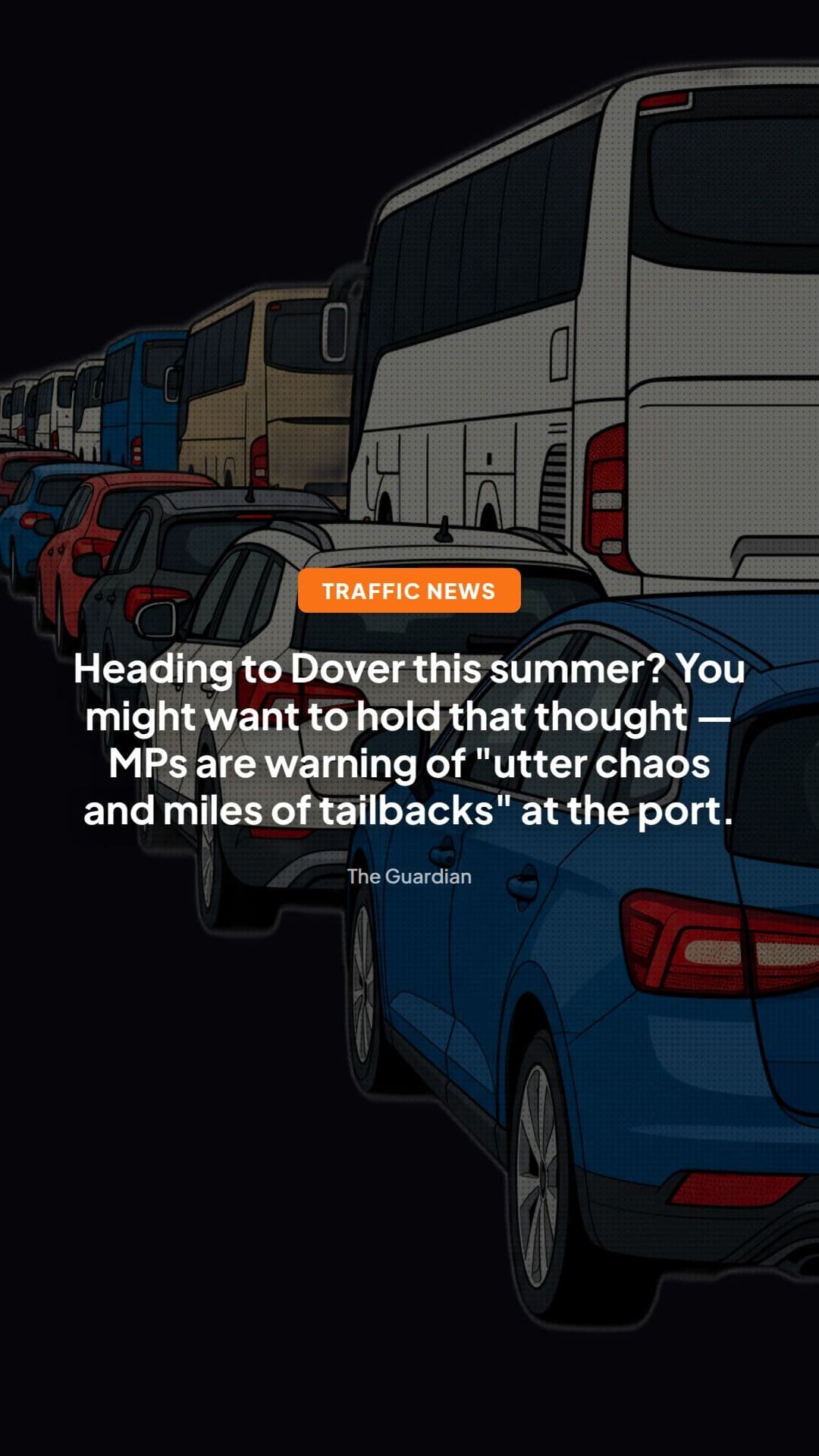
Dover's Looming Chaos: What the EU Entry System Crisis Means for Every UK Driver
Imagine pulling up to the Port of Dover on a summer Friday, bags packed, kids in the back, ferry booked for months. You've left early, you've planned well — and then you sit. And sit. And sit. Not because of a breakdown or bad weather, but because a digital border system is struggling to cope with the sheer volume of people trying to use it.
That's not a hypothetical. According to a stark warning from MPs reported by The Guardian, it could soon be the reality at Britain's busiest passenger port — and the consequences stretch far beyond frustrated holiday-makers.
What's Happening at Dover?
MPs have raised the alarm over the EU's Entry/Exit System (EES), warning that the Port of Dover faces "utter chaos" if the scheme is rolled out without significant improvements to its infrastructure and processing capacity.
The EES is the European Union's new automated border control system, designed to replace the old passport stamp with biometric data collection — fingerprints and facial scans — for all non-EU nationals crossing into the Schengen Area. That includes British citizens, who lost their right to free movement after Brexit. Every UK driver or passenger crossing into France, Belgium, or any other Schengen country will need to be processed through this system.
On paper, it's a security upgrade. In practice, at a port like Dover — which handles around 10,000 lorries and 50,000 passengers on a busy day — the processing time required for each individual could cause catastrophic bottlenecks.
MPs have called on the UK government to urgently press France to either fix the system's operational problems or suspend the checks altogether while solutions are found. The concern isn't theoretical: trial runs and early implementations elsewhere in Europe have already exposed serious delays and technical difficulties.
Why This Matters Far Beyond the Holiday Queue
Dover isn't just a holiday gateway. It is the single most important freight artery between the United Kingdom and the European continent. Around 17% of the UK's entire trade in goods passes through Dover — food, pharmaceuticals, manufacturing components, retail stock. The port operates on a "rolling motorway" model, where the turnaround of lorries must be near-continuous to prevent gridlock cascading back onto the M20 and A20.
We've seen what happens when that system breaks down. During the peak of post-Brexit checks and the COVID-era disruptions, tailbacks stretched for miles through Kent, triggering Operation Stack — the emergency protocol that effectively turns sections of the M20 into a lorry park.
If EES introduces even a modest per-person delay at passport control, the cumulative effect across thousands of daily crossings could be severe. Freight delays don't just inconvenience hauliers — they affect supermarket shelves, hospital supply chains, and manufacturing just-in-time delivery schedules across the country.
For ordinary drivers planning a trip to France or beyond, the implications are equally direct: longer queues, missed ferries, potential knock-on costs, and considerable uncertainty about journey times.
The Legal and Regulatory Landscape
It's worth understanding exactly what legal framework underpins all of this — because it matters for how drivers and hauliers can respond.
The EES is an EU regulation, specifically Regulation (EU) 2017/2226, and it applies to the external borders of the Schengen Area. The UK, having left the EU, has no formal mechanism to block or delay its implementation. What the UK government can do is negotiate bilaterally with France — which controls the French side of the Dover-Calais crossing — and lobby through diplomatic channels.
Under UK domestic law, the situation at the border is governed by a patchwork of legislation including the Immigration Act 1971, the Customs and Excise Management Act 1979, and more recently the Nationality and Borders Act 2022. None of these give individual drivers any right to bypass EES checks, nor do they provide compensation rights if delays cause financial loss.
For hauliers, the picture is slightly more complex. Under CMR (Convention on the Contract for the Carriage of Goods by Road), which the UK remains party to, carriers have certain liability protections — but delays caused by border controls generally fall under force majeure clauses, meaning haulage companies are unlikely to recover losses caused by EES-related delays from their clients or insurers without specific contractual provisions.
Travellers who miss ferries due to unexpected border delays face a similarly unhelpful legal position. Most ferry operators' terms and conditions — including those of DFDS, P&O Ferries, and Eurotunnel — treat missed departures as the passenger's responsibility unless the delay is caused by the operator itself. A government-mandated border check, however chaotic, is unlikely to trigger any refund obligation.
Travel insurance is therefore crucial — but even here, standard policies may not cover delays caused by border processing backlogs unless specifically listed as a covered event. Drivers should check their policy wording carefully before travel.
What Drivers and Hauliers Should Know Right Now
Whether you're planning a summer driving holiday across the Channel or you're a professional driver making regular freight runs, here's what you need to be doing:
For Leisure Drivers and Families
- Book flexible fares where possible. If EES causes widespread delays, having a flex ticket on your ferry or Eurotunnel booking could save you significant rebooking costs. The price premium is worth it during uncertain periods.
- Arrive significantly earlier than usual. Until EES processing times are properly understood, build in at least an extra 60–90 minutes beyond your normal check-in time. Dover and Folkestone check-in lanes can back up quickly even without additional biometric processing.
- Check your travel insurance policy now. Look specifically for coverage related to "border delays," "missed departures," or "travel disruption." If your current policy doesn't cover these, consider upgrading before you travel.
- Register for EES pre-enrolment if available. The EU is developing a pre-registration option that would allow travellers to submit biometric data in advance, potentially speeding up border crossing. Check the official EU EES portal for the latest on this.
- Monitor the Kent Resilience Forum and National Highways updates. If Operation Stack is activated, the M20 will be subject to contraflow and lane closures. Sign up for traffic alerts or use apps like Waze or Google Maps set to avoid motorway disruptions.
For Hauliers and Freight Operators
- Review your CMR paperwork and contractual terms. If you have time-critical deliveries scheduled for summer crossings, speak to your legal team or transport solicitor about force majeure clauses and liability exposure.
- Engage with your trade association. Bodies like the Road Haulage Association (RHA) and Logistics UK are actively lobbying on this issue and can provide the most current guidance on expected delays and any government mitigations.
- Consider alternative routing now, not later. Ports like Harwich, Hull, and Portsmouth offer longer but potentially less disrupted routes to the Continent. Building contingency routing into your operations before chaos hits is far cheaper than scrambling once it does.
- Document everything. If EES delays cause you financial loss, you'll need a paper trail: timestamps, photographs, correspondence with port authorities. This may be relevant for insurance claims or contractual dispute resolution.
Looking Ahead: A Problem That Won't Resolve Itself
The fundamental tension here is political as much as logistical. The EU has every right to implement its own border security system, and EES represents a genuine and understandable desire to better track who is entering and leaving the Schengen Area. From Brussels' perspective, the fact that it creates difficulties at Dover is, frankly, a consequence of the UK's decision to leave.
For the UK government, the options are limited but not negligible. Diplomatic pressure on France — particularly around the physical infrastructure at Calais and Coquelles — could yield some improvements. The French authorities have historically been willing to cooperate on Dover-Calais traffic management, given that congestion on their side is equally damaging.
There is also a longer-term question about whether Dover itself needs significant investment in processing lanes, automated kiosks, and physical space to accommodate EES. The port has already undergone some expansion, but the scale of change required may be substantial.
What seems certain is that the summer of 2026 will be a stress test — both for the EES system itself and for the UK's post-Brexit border arrangements. MPs are right to be alarmed, and drivers are right to be planning accordingly.
The days of breezing through Dover with a quick wave of a passport are behind us. The new reality requires preparation, flexibility, and a clear-eyed understanding of your rights — and their limits — when the queue stretches back to the motorway.
Source: The Guardian, 8 July 2026. This article provides general information only and does not constitute legal advice. For specific legal queries relating to freight contracts or travel insurance, consult a qualified professional.
Written by
David Chen
Consumer Rights Expert
Ready to Challenge Your Ticket?
Let our AI analyse your PCN and generate a professional appeal letter in minutes.
Start Free Appeal