England pavement parking fines: what changes by 2026
England’s pavement parking crackdown lands by late 2026. Councils will issue £60–£130 PCNs via civil enforcement—what drivers need to know now.

David Chen
2 May 2026
Pavement Parking Fines Up to £130: What England's New Rules Really Mean for Drivers
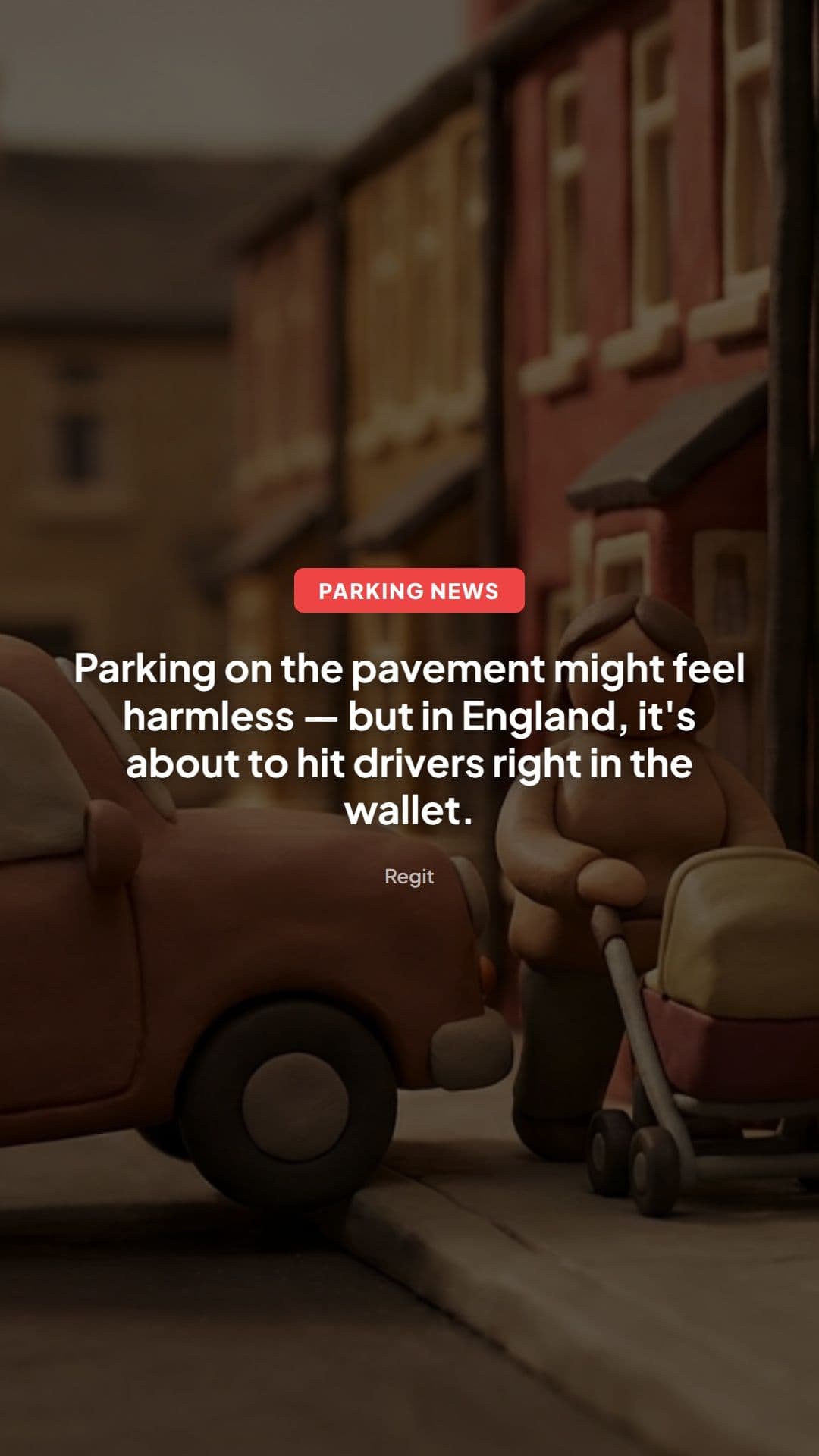
Imagine you're pushing a pram along a residential street, and halfway down the pavement a car has mounted the kerb, leaving you roughly eighteen inches of space between its wing mirror and a garden wall. You either squeeze through or step into the road. For millions of people across England, this isn't a hypothetical — it's a Tuesday morning. That's precisely the problem that new legislation is finally attempting to fix, and if you drive in England, the changes coming in 2026 are something you genuinely need to understand.
What's Actually Happening
Buried within the English Devolution and Community Empowerment Act is a provision that will hand local councils in England the power to enforce pavement parking through their own civil enforcement officers (CEOs). The legislation is expected to take effect by late 2026, and when it does, drivers caught parking on the pavement could face penalties ranging from £60 to £130 depending on the location.
This isn't a minor administrative tweak. It represents a fundamental shift in who enforces pavement parking — moving responsibility away from the police and squarely into the hands of local authorities. For context, councils already enforce the vast majority of parking contraventions in England through civil enforcement, covering everything from yellow line violations to permit bay infringements. Pavement parking has, until now, sat in an awkward legal grey zone that left enforcement patchy, inconsistent, and largely ineffective.
The RAC, which polled drivers on the issue, found strong support for a ban among motorists — provided that sensible exemptions are built in for genuinely narrow streets where there is simply no practical alternative. That caveat is important, and we'll come back to it.
Why This Has Taken So Long
To understand why this matters, you need to appreciate just how long pavement parking has been a contested issue in England. Scotland moved ahead decisively: the Transport (Scotland) Act 2019 introduced a near-blanket ban on pavement parking that came into full effect in 2023, with fines of up to £100. Wales is pursuing similar reforms. England, by contrast, has been stuck.
The core problem has been legislative. Outside London — where the Greater London Council (General Powers) Act 1974 already prohibits pavement parking across the capital — there has been no consistent national framework. Police technically have powers under Section 72 of the Highways Act 1835 to prosecute obstruction of the footway, but this is a criminal offence requiring police time and court proceedings. In practice, officers have neither the capacity nor the appetite to pursue what is often treated as a minor nuisance. The result? Widespread, largely unpunished pavement parking across English towns and cities.
The Transport Select Committee called for reform as far back as 2019, recommending a default ban with local exemptions. The Department for Transport consulted on the issue in 2020. Progress has been agonisingly slow — until now.
The Legal Angle: What the New Framework Actually Does
The new powers under the English Devolution and Community Empowerment Act create a civil enforcement regime for pavement parking, analogous to the existing framework under the Traffic Management Act 2004, which governs most council-issued Penalty Charge Notices (PCNs).
Here's what that means in practice:
- Civil enforcement officers — the people you see issuing parking tickets on yellow lines — will be able to issue PCNs for pavement parking
- Fines are expected to follow the standard two-tier PCN structure: lower penalty (likely £60) and higher penalty (likely £130) for more serious or persistent contraventions, or in higher-band enforcement areas such as London
- Drivers will retain the standard appeals process: informal challenge to the issuing council, then formal representation, and ultimately an independent appeal to the Traffic Penalty Tribunal (outside London) or London Tribunals
- Councils will need to designate which streets are subject to enforcement, which is where the exemption framework becomes critical
That last point is crucial. Unlike Scotland's near-blanket ban, the English approach appears to involve councils actively designating streets — meaning there will be a patchwork of enforcement across different local authority areas, at least initially. This creates both opportunity and confusion for drivers.
The Exemption Question: Narrow Streets and Rural Roads
One of the most contentious aspects of any pavement parking reform is what happens on genuinely narrow roads where vehicles parking entirely on the carriageway would block traffic flow. The RAC's polling specifically flagged this concern, and it's a legitimate one.
Think of older Victorian terraced streets, rural lanes, or tight residential roads where the carriageway itself is barely wide enough for two cars to pass. In these situations, a degree of pavement parking has historically been tolerated — even informally expected — because the alternative is gridlock.
The expectation is that councils will have the power to exempt specific streets from enforcement where road geometry makes pavement parking practically unavoidable. However, the process for designating these exemptions, and how consistently councils will apply them, remains to be seen. Drivers on streets that feel like they should be exempt but haven't been formally designated could find themselves on the wrong end of a PCN.
What Drivers Should Know: Practical Advice
Whether you're a regular pavement parker out of habit or someone who does it occasionally because "everyone else does," here's what you need to take on board before 2026 arrives.
1. Start paying attention to your regular parking spots now If you routinely park with two wheels on the kerb outside your home or near your workplace, now is the time to assess whether that will be enforceable under the new rules. Don't wait until the first round of PCNs lands.
2. Check whether your street is likely to be designated for enforcement Once councils begin their designation processes — which should be publicly consulted on — pay attention to local notices and council communications. Many councils will publicise which streets are being brought into enforcement scope.
3. Understand the appeals process before you need it If you receive a PCN for pavement parking, the process will mirror existing parking enforcement. You'll have 28 days to pay at the reduced rate or 28 days to challenge informally. Keep any evidence — photographs of the street width, signage, or road markings — that might support a case that enforcement was unjustified on a particular road.
4. Don't assume rural or residential means exempt The assumption that "it's a quiet street, nobody will bother" is exactly the kind of thinking that leads to unexpected fines. Civil enforcement officers cover residential streets already. Adding pavement parking to their remit simply expands what they're looking for.
5. Consider the wider context of who pavement parking harms This isn't just about fines. Pavements blocked by vehicles cause real difficulties for wheelchair users, people with pushchairs, those with visual impairments, and elderly pedestrians. Understanding the genuine harm involved — rather than viewing enforcement purely as a revenue exercise — helps frame why this reform has such broad public support.
Looking Ahead: What This Really Means Going Forward
The shift to civil enforcement of pavement parking is, in many ways, the logical completion of a journey England began when it decriminalised most parking contraventions under the Road Traffic Act 1991 and subsequently the Traffic Management Act 2004. Handing enforcement to local authorities has, for most parking offences, produced more consistent and visible enforcement than relying on police. There's every reason to think the same will be true here.
That said, the coming months will be critical. The quality of the designation process — how transparently councils identify exempt streets, how well they communicate changes to residents, and how consistently they train enforcement officers — will determine whether this reform is seen as fair or punitive.
There are also questions about revenue neutrality. Critics of parking enforcement have long argued that councils use PCN income as a stealth revenue stream rather than purely as a compliance tool. Under the Traffic Management Act, councils are technically required to ring-fence surplus parking income for transport-related expenditure. The same principles are expected to apply here, but scrutiny will be needed.
For drivers, the headline message is straightforward: the informal tolerance of pavement parking in England is ending. By late 2026, what has been a largely unenforced habit for millions of motorists will carry a financial consequence of up to £130. The time to adjust your parking behaviour — and to engage with your local council's designation consultations — is now, not when the first wave of PCNs starts arriving through letterboxes.
England is, belatedly, catching up with Scotland, Wales, and much of the rest of Europe. For pedestrians, cyclists, and anyone who has ever had to step into a road to get past a badly parked car, it's long overdue.
Written by
David Chen
Consumer Rights Expert
Ready to Challenge Your Ticket?
Let our AI analyse your PCN and generate a professional appeal letter in minutes.
Start Free Appeal