England councils to fine pavement parking: what changes
Councils in England are set to gain powers to fine pavement parking. What the new rules mean for drivers, exemptions, enforcement and appeals.

Marcus Campbell
30 June 2026
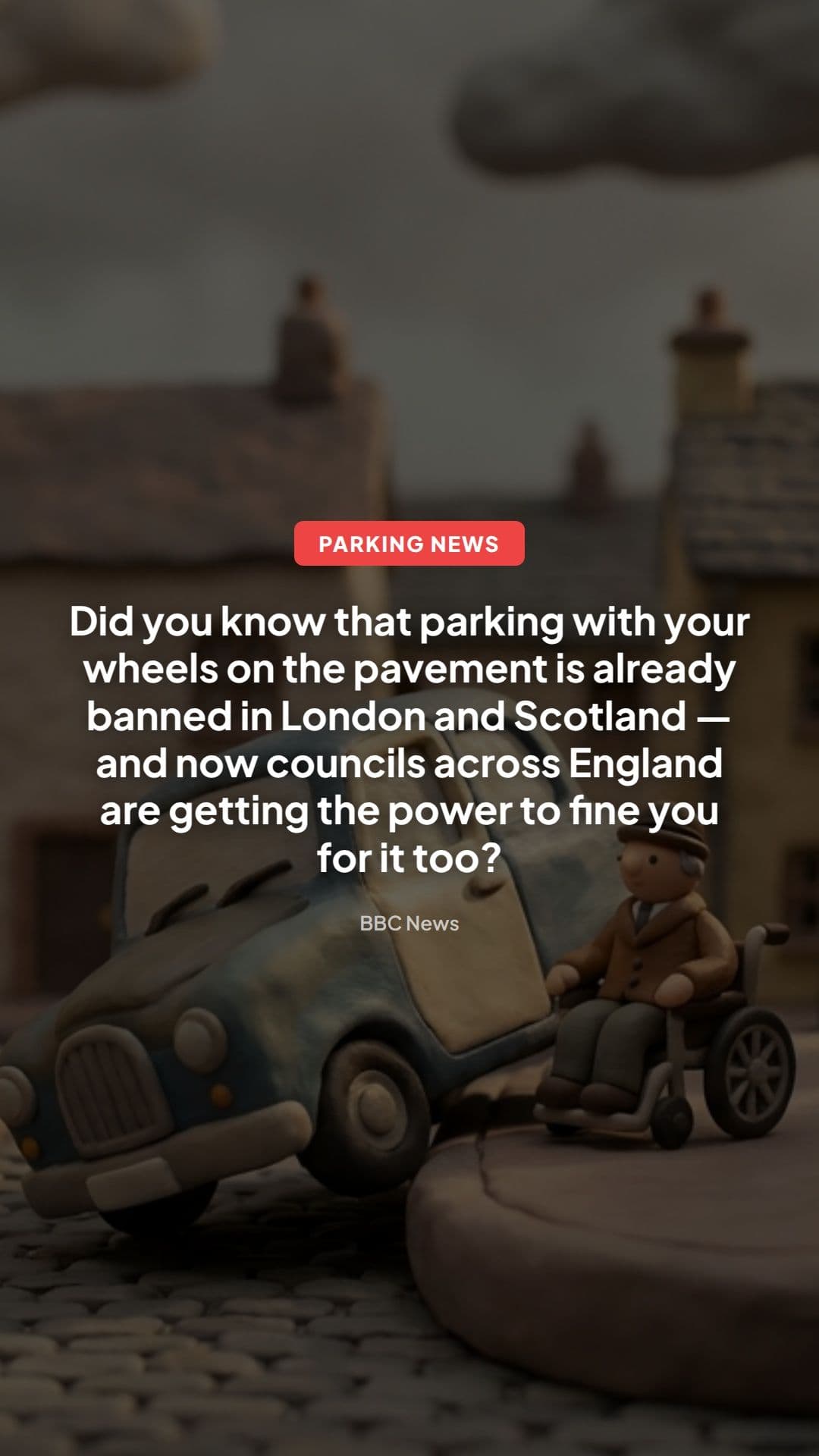
England's Pavement Parking Crackdown: What the New Council Powers Really Mean for Drivers
Imagine pushing a pram along a pavement, only to find your path completely blocked by a car that's half-mounted the kerb. You're forced into the road, into traffic, hoping drivers see you in time. It's a scenario that plays out thousands of times every day across England — and for far too long, there has been precious little that local councils could do about it. That is now set to change, and the implications for millions of drivers are more significant than the headlines might suggest.
What's Actually Happening
According to a BBC News report, councils across England are to be granted new powers to issue fines directly to motorists who park on pavements and obstruct pedestrians. The move brings England into line with rules that have been in place in London since 1974 and in Scotland since 2023.
Under the proposed framework, local authorities will be able to deploy civil enforcement officers — the people most of us still call traffic wardens — to issue Penalty Charge Notices (PCNs) to drivers who block footways. This is a fundamental shift. Currently, outside of London, pavement parking is largely a matter for the police, who have neither the resources nor, frankly, the appetite to treat it as a priority. The result has been a chaotic patchwork of enforcement, with councils watching helplessly as pavements are routinely used as free overflow car parks.
This isn't a snap decision. The government has been consulting on pavement parking reform for years. A Department for Transport consultation ran as far back as 2020, and the issue has been debated in Parliament on multiple occasions since. The fact that it has taken this long to reach this point tells you something about the political complexity involved — not least the tension between protecting pedestrians and not being seen as yet another attack on drivers.
Why This Matters More Than You Think
The scale of the problem is genuinely serious. Pavement parking isn't merely an inconvenience — it is a safety hazard with measurable consequences.
Research by the Guide Dogs charity found that 95% of blind and partially sighted people have been forced into the road because of pavement obstruction. For wheelchair users, parents with buggies, and people with mobility difficulties, a blocked pavement isn't a minor annoyance — it can make entire streets inaccessible.
Then there's the structural damage. Pavements are not engineered to bear the weight of motor vehicles. A single car repeatedly mounting the kerb can crack and undermine the surface, leading to the kind of trip hazards that cost councils — and ultimately taxpayers — significant sums to repair.
There's also a broader question of what kind of streets we want to live in. The pavements outside our homes exist for pedestrians. The normalisation of pavement parking sends a signal that driver convenience routinely trumps pedestrian safety, and that signal has consequences for how people use and feel about their neighbourhoods.
The Legal Angle: What Law Actually Applies?
This is where things get genuinely interesting, because the legal situation around pavement parking in England is surprisingly murky.
There is no blanket national law making pavement parking illegal outside London. The offence that currently applies — and only partially — is found in Section 72 of the Highways Act 1835, which makes it an offence to wilfully obstruct the free passage of a highway. A pavement is technically part of the highway, so parking on it could be prosecuted under this provision. However, the Act predates the motor car by several decades, and in practice it is rarely invoked.
In London, the position is clearer. Section 15 of the Greater London Council (General Powers) Act 1974 introduced a specific prohibition on driving or parking on urban roads with a speed limit of 40mph or less, except where signs explicitly permit it. This is enforced as a civil matter through PCNs, and it works.
Scotland took a more comprehensive approach with the Transport (Scotland) Act 2019, which introduced a near-total ban on pavement parking, double parking, and parking at dropped kerbs, with enforcement powers granted to local councils. The Scottish model is widely regarded as the template for what England is now attempting to implement.
The new powers for English councils will almost certainly be delivered through amendments to the Traffic Management Act 2004, which is the existing legislative framework for civil parking enforcement in England. Under this model, PCNs are issued by civil enforcement officers employed by the council, not the police. Fines are typically £70 in lower-band areas and £50 outside London, though the government has been consulting on raising these figures.
Crucially, civil enforcement means no criminal record for the driver — but it does mean the fine escalates if unpaid, can be referred to a debt collection agency, and ultimately can result in a county court judgment.
What Drivers Need to Know Right Now
Even before new legislation formally comes into force, there are practical steps every driver should be aware of:
1. The "wholly on the pavement" distinction matters Under the proposed rules, the key test is likely to be whether a vehicle is causing an obstruction to pedestrians. Simply having two wheels on the kerb may or may not constitute an offence depending on whether the pavement remains passable. However, drivers should not assume that leaving a narrow gap is automatically a defence — enforcement officers will assess whether the space is practically usable by a person with a pram or wheelchair.
2. Signage will be critical in the transition period As with any new enforcement regime, there will be a period during which signage and road markings are inconsistent. Councils will need to decide how to communicate the new rules locally. Keep an eye out for new signs in your area — ignorance of a sign is generally not a defence once it is properly in place.
3. London drivers are already subject to these rules If you drive in Greater London, pavement parking has been enforceable for over 50 years. PCN code 62 ("Parked with one or more wheels on or over a footway, central reservation or verge") is already in active use. If you've been getting away with it in London, you've been lucky — not legal.
4. Exemptions are likely to exist but will be narrow The Scottish legislation includes exemptions for loading and unloading, emergency situations, and cases where the road itself is too narrow for a vehicle to park without mounting the pavement. English legislation is expected to include similar carve-outs, but they will be tightly defined. "There was nowhere else to park" is almost certainly not going to be an accepted defence.
5. Appeals will follow the standard PCN process If you receive a PCN for pavement parking under the new regime, the appeals process will follow the same route as any other council-issued PCN: informal representation to the council, formal representation if the informal appeal fails, and ultimately an independent adjudicator at the Traffic Penalty Tribunal (outside London) or London Tribunals. The burden will be on you to show either that the vehicle was not causing an obstruction or that there was a procedural error in how the PCN was issued.
Looking Ahead: The Road to Enforcement
It would be naïve to suggest this reform will be seamless. Scotland's experience is instructive here. Despite the 2019 Act receiving Royal Assent, enforcement in Scotland did not begin until November 2023 — a gap of four years — largely because councils needed time to train officers, install signage, and update their IT systems. England's rollout is likely to face similar delays, and with 317 local highway authorities to bring on board, consistency of enforcement is going to be a genuine challenge.
There is also the question of political will at the local level. Some councils will embrace these powers enthusiastically, particularly in urban areas where pavement parking is a chronic problem. Others — particularly in rural areas where roads are narrow and parking infrastructure is limited — may be more cautious about enforcement, wary of alienating residents who have been parking this way for decades out of practical necessity.
For drivers, the honest message is this: the direction of travel is clear, and it has been for some time. The days of treating pavements as overflow parking are numbered. Whether you drive in a city or a market town, it is worth reassessing your parking habits now — not just to avoid a fine, but because the pedestrians sharing those pavements deserve better than being forced into the road every time someone decides the kerb is a convenient spot to leave their car.
The pavement is not a car park. Soon, councils across England will have the tools to enforce that simple principle. The smart move for drivers is to get ahead of it.
Written by
Marcus Campbell
Former Traffic Warden
Ready to Challenge Your Ticket?
Let our AI analyse your PCN and generate a professional appeal letter in minutes.
Start Free Appeal