Enfield PCNs up 71%: why parking enforcement surged
Enfield Council issued 121,429 PCNs in 2025/26—up 71%. We unpack the enforcement expansion, impounds rise and what drivers can do next.

Hannah MacLeod
23 April 2026
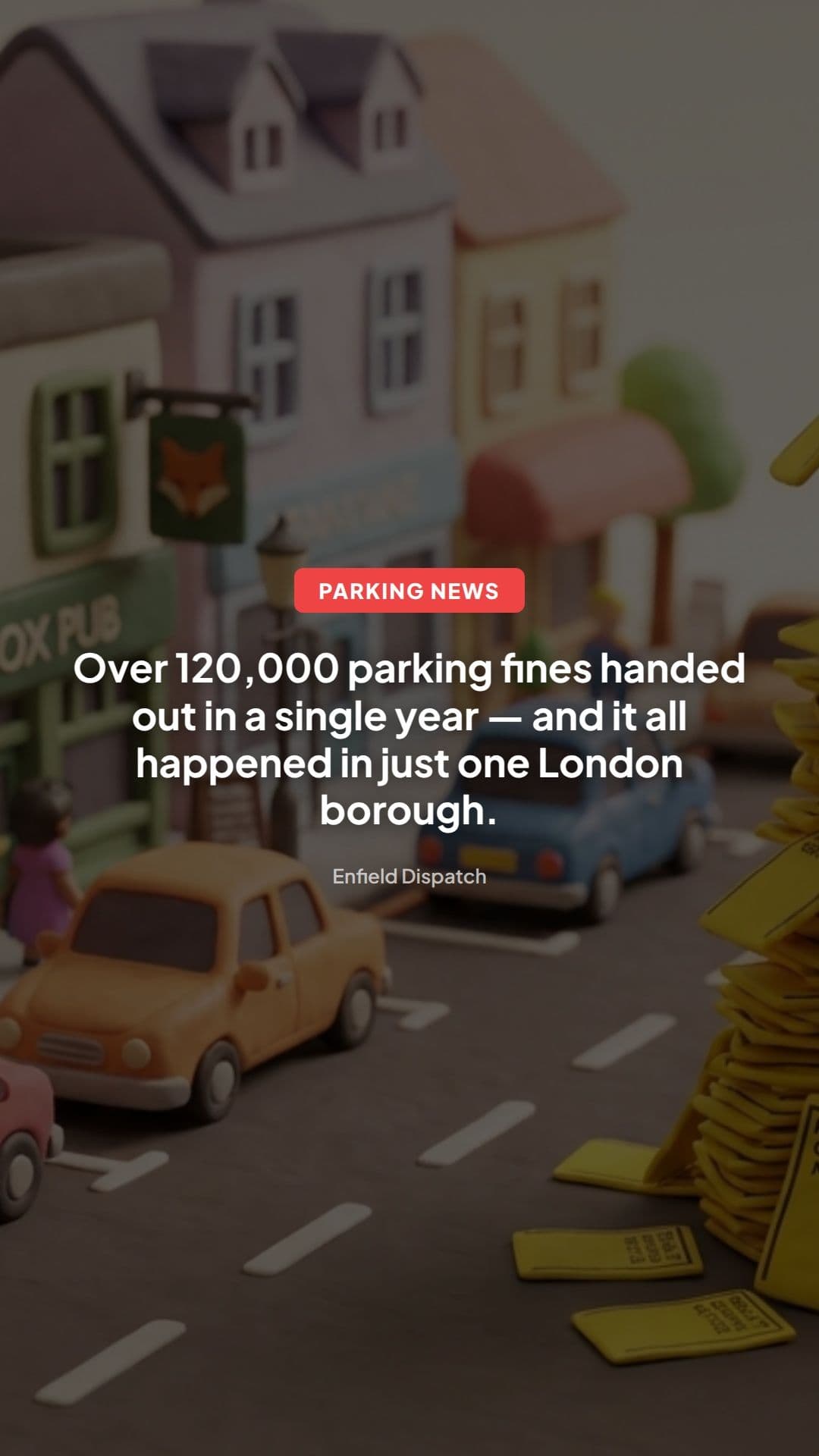
Enfield's Parking Fine Surge: What a 71% Rise in PCNs Means for Every Driver
A dramatic jump in penalty charge notices isn't just a local story — it signals a broader shift in how councils are approaching enforcement, and every driver needs to understand what's changing
The Numbers That Should Make Every Driver Sit Up
Imagine receiving a parking fine every four and a half minutes, around the clock, every single day of the year. That's roughly what happened in Enfield during 2025/26. According to figures reported by the Enfield Dispatch, the north London borough issued 121,429 penalty charge notices in that financial year — a staggering 71% increase on the 71,005 PCNs issued the previous year, and the highest total the council has recorded since 2018/19.
That's not a statistical blip. That's a deliberate, strategic escalation — and Enfield isn't the only council heading in this direction.
What Actually Happened in Enfield
The headline figure is striking, but the story behind it matters just as much. Enfield Council expanded its civil enforcement officer (CEO) team — the people formerly known as traffic wardens — and the results were immediate and dramatic. More boots on the ground means more contraventions observed, more tickets issued, and, crucially, more vehicles impounded.
Yes, impoundments also rose. Vehicles can be removed in cases involving persistent evaders — drivers who have accumulated multiple unpaid PCNs — or in situations involving specific contraventions such as parking on a clearway or blocking a dropped kerb. The council's decision to invest in enforcement capacity signals that this is not a temporary measure. Both main political parties in the borough, according to the Enfield Dispatch, have proposed further enforcement improvements, suggesting that whichever party holds the council going forward, the direction of travel is firmly towards tougher action.
This is worth pausing on. When political consensus exists on an issue — particularly one that generates significant revenue — it tends to stick.
Why This Matters Far Beyond Enfield
Enfield's surge doesn't exist in a vacuum. Across England, councils have been under sustained financial pressure for over a decade. Parking enforcement is one of the relatively few areas where local authorities can generate income — and unlike many council services, it scales with investment. Hire more CEOs, issue more PCNs, collect more revenue.
Under the Road Traffic Regulation Act 1984 and the Traffic Management Act 2004, councils that have taken over civil parking enforcement from the police — known as decriminalised parking enforcement (DPE) — are legally required to ring-fence any surplus from parking operations. That surplus must be spent on transport-related functions: road maintenance, public transport, cycling infrastructure, and so on. In theory, this prevents councils from using parking as a cash cow. In practice, however, the definition of "transport-related" is broad, and scrutiny of how these surpluses are actually spent is limited.
What Enfield's figures illustrate is a model that other cash-strapped councils are watching closely. If expanding your enforcement team produces a 71% increase in PCN income, the incentive to replicate that approach is obvious.
There's also a broader enforcement technology dimension. Councils are increasingly deploying CCTV-based enforcement — cameras mounted on vehicles or fixed to infrastructure — which allows contraventions to be captured without a CEO being physically present. While Enfield's increase appears primarily driven by additional officers, the integration of camera technology into enforcement operations is accelerating nationally, and it removes one of the traditional constraints on how many tickets a council can issue.
The Legal Angle: Your Rights When Enfield (or Any Council) Issues a PCN
Understanding the legal framework isn't just academic — it's your first line of defence.
When a council issues a PCN for an on-street contravention, it is doing so under Schedule 7 of the Traffic Management Act 2004. The process has a specific legal structure:
- Informal stage: You have 28 days from the date of the PCN to pay at the discounted rate (usually 50% of the full penalty) or to make informal representations challenging the notice.
- Formal stage: If your informal challenge is rejected, you'll receive a Notice to Owner (NTO). You then have 28 days to pay the full penalty or make formal representations.
- Independent adjudication: If your formal representations are rejected, you can appeal to an independent adjudicator — in London, this is the London Tribunals (Traffic Penalty Tribunal for the rest of England). This stage is free to use and the adjudicator is entirely independent of the council.
Critically, councils must follow strict procedural rules. A PCN that contains errors — an incorrect vehicle registration mark, a contravention code that doesn't match the circumstances, or a notice that fails to include required information — may be invalid. Similarly, if a CEO's observation period was insufficient for the specific contravention alleged, that can form the basis of a successful challenge.
The increased volume of PCNs being issued in Enfield also increases the statistical likelihood of errors. When enforcement teams are under pressure to issue more notices, procedural shortcuts sometimes follow. Drivers who receive a PCN should always check the basics: is the VRM correct? Is the contravention code accurate? Does the alleged time and location match reality?
For impoundments specifically, the council must follow the Road Traffic (Vehicle Emissions) (Fixed Penalty) (England) Regulations and related secondary legislation, and vehicles must be released promptly upon payment of the release fee plus any outstanding PCN debt. If a vehicle is removed unlawfully — for instance, where no valid contravention existed — the owner is entitled to claim compensation.
What Drivers in Enfield (and Beyond) Should Know Right Now
If you live in, work in, or regularly drive through Enfield, the practical implications are significant. Here's what to keep front of mind:
Check signage before you park. With more CEOs on patrol, the margin for error has shrunk. Restrictions that were rarely enforced before may now attract a ticket within minutes of a contravention beginning. Pay particular attention to controlled parking zone (CPZ) entry signs, which set out the hours of operation for an entire zone — these are often missed by unfamiliar drivers.
Don't assume a quiet street means no enforcement. Enfield's expanded team means coverage is wider. Streets that previously saw infrequent patrols may now be monitored regularly.
Keep evidence of payment. If you pay for parking — whether via a meter, PayByPhone, or another cashless system — screenshot or photograph your confirmation. App and payment system errors do occur, and having evidence is essential if you need to challenge a PCN.
Respond to PCNs promptly. The 28-day discount window is firm. Missing it means paying the full penalty. If you intend to challenge, do so within the discount period — a valid challenge, if accepted, will also preserve the discount.
If your vehicle is impounded, act quickly. Storage charges accrue daily, and the longer a vehicle remains in the pound, the more expensive recovery becomes. Ensure you have your V5C logbook or other proof of ownership ready.
Know your appeal route. Enfield is a London borough, so appeals beyond the formal representations stage go to London Tribunals. The process is straightforward and can be completed online. Adjudicators are genuinely independent and do overturn council decisions where the evidence supports it.
Looking Ahead: A New Normal for Parking Enforcement
Enfield's 71% spike in PCNs is not an anomaly — it's a preview. As councils across England continue to face funding pressures, and as the political consensus around parking enforcement as both a revenue tool and a traffic management instrument hardens, drivers should expect more of this, not less.
The cross-party support for further enforcement improvements in Enfield suggests that the expansion isn't going to be reversed after the next local election. And as enforcement technology — automatic number plate recognition, camera-equipped patrol vehicles, real-time data systems — becomes cheaper and more capable, the ceiling on how many contraventions can be captured and processed will continue to rise.
For drivers, the message is clear: the era of inconsistent, patchwork parking enforcement is ending. In its place is something more systematic, more data-driven, and considerably less forgiving of honest mistakes. Understanding your rights, checking restrictions carefully, and knowing how to challenge a PCN effectively has never been more important.
Enfield may be making the headlines today, but the council down the road is almost certainly taking notes.
Source: Enfield Dispatch — "Big rise in parking fines issued across Enfield"
Written by
Hannah MacLeod
Traffic Law Specialist
Ready to Challenge Your Ticket?
Let our AI analyse your PCN and generate a professional appeal letter in minutes.
Start Free Appeal