
Enfield Parking Tickets Raise £11m After Warden Surge
Enfield Council doubled its parking enforcement team, helping drive £11m in parking ticket income. We examine figures, surplus rules and drivers' rights.

The Parking Ticket Pal Editorial Team
30 September 2026
Enfield's £11m Parking Windfall: What It Really Tells Us About Council Enforcement in 2025
Picture this: you nip out to the shops, misjudge a bay marking by a few inches, and by the time you're back at your car there's a familiar yellow envelope tucked under the wiper. Multiply that scenario across tens of thousands of drivers in one London borough, and you start to understand how Enfield Council has ended up sitting on an £11 million parking windfall.
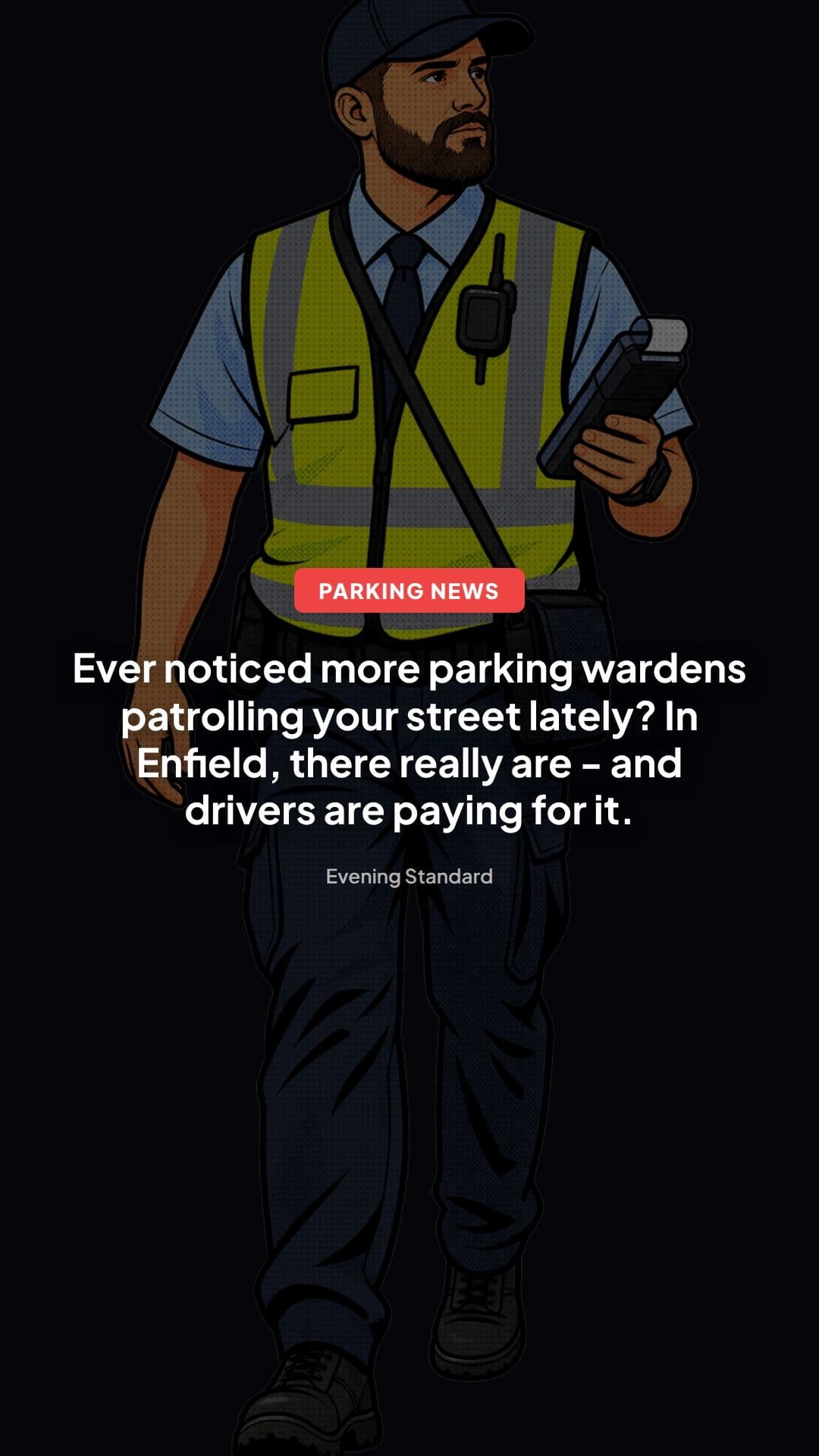
According to reporting from the Evening Standard, Enfield has significantly boosted its parking enforcement capacity, effectively doubling the number of civil enforcement officers patrolling its streets. The result is a sharp jump in ticket income and a hefty surplus for the council's parking services in the 2025/26 financial year. It's a story that will feel painfully familiar to anyone who has watched their local high street sprout double yellow lines, or noticed a warden appearing seemingly out of nowhere the moment their pay-and-display ticket expires.
What Actually Happened in Enfield
The core facts, as reported, are straightforward but striking. Enfield Council has substantially increased the number of parking wardens working across the borough. More wardens on the ground means more streets covered, more bays checked, and inevitably, more Penalty Charge Notices (PCNs) issued. The council's parking enforcement income has risen sharply as a direct consequence, with the Standard reporting a total of £11 million generated from parking tickets, contributing to a significant financial surplus for the authority's parking operation this financial year.
This isn't happening in isolation. Enfield sits within a wider London-wide, and indeed nationwide, trend of councils leaning more heavily on parking enforcement as a revenue stream. Local authorities across England have been reporting record parking surpluses in recent years, driven by a combination of rising Penalty Charge Notice rates, expanded Controlled Parking Zones, and, as in Enfield's case, simply putting more enforcement officers on the street.
What makes the "doubling of wardens" detail particularly notable is that it represents a direct, deliberate operational choice rather than a passive rise in fines. Councils don't need new legislation or a change in the law to do this. Under existing powers, local authorities can scale up their civil enforcement teams whenever they choose, provided the enforcement is carried out lawfully and the signage and road markings meet the required legal standards. Enfield has simply chosen to invest more heavily in enforcement, and the financial return has followed almost immediately.
Why This Story Matters Beyond Enfield
It's tempting to see this as a purely local story, but it speaks to something much bigger happening across English local government. Parking enforcement has become an increasingly important, and increasingly scrutinised, source of council income at a time when local authority budgets are under severe strain elsewhere.
Under the Traffic Management Act 2004, councils are legally required to ring-fence parking surpluses. Any profit made from on-street parking enforcement cannot simply disappear into the general council pot. Instead, it must be spent on transport-related purposes, things like road maintenance, concessionary travel schemes, or further improvements to the local highway network. That's an important legal safeguard, but it also creates a somewhat uncomfortable incentive structure. If issuing more tickets funds legitimate and popular local transport projects, councils have a built-in reason to enforce more aggressively, provided they stay within the rules.
The doubling of wardens in Enfield raises an obvious question that will resonate with drivers everywhere: is this about genuinely improving road safety and traffic flow, or is it primarily a revenue-generation exercise dressed up as enforcement? The honest answer is probably a mixture of both, and it's rarely possible to fully untangle the two motivations from the outside. What's clear is that wherever enforcement capacity increases sharply, ticket numbers and income tend to follow in lockstep, and Enfield is far from the only London borough where residents have noticed enforcement becoming markedly more visible.
The Legal Framework Behind Parking Enforcement
For drivers wondering exactly what powers councils have here, it's worth understanding the legal basis for all of this. Most parking contraventions in London and other decriminalised enforcement areas are dealt with under civil, rather than criminal, law. This stems from the Traffic Management Act 2004 (and earlier, the Road Traffic Act 1991 for London), which allows local authorities to enforce parking rules themselves using civil enforcement officers, rather than relying on the police.
A PCN issued under this civil regime is not a criminal fine. It's a civil penalty, which is precisely why it can be formally appealed through a structured process rather than contested in a criminal court. If a driver believes a ticket was issued unfairly, whether due to unclear signage, a broken pay machine, or a genuine administrative error, they have the right to challenge it, first through informal representations to the council, then through formal representations if that's rejected, and ultimately to an independent tribunal (in London, this is the London Tribunals service; elsewhere in England it's the Traffic Penalty Tribunal).
Crucially, for a PCN to be valid, the council must get the basics right: correctly maintained signage, accurately marked bays, and enforcement carried out within the specific rules of that particular zone or restriction. A sharp increase in enforcement activity, as we're seeing in Enfield, inevitably increases the volume of tickets issued, but it doesn't change any driver's underlying legal rights. Every PCN still has to meet the same legal standard to be enforceable, and every driver retains the same right to challenge one they believe is wrong.
What Drivers Should Know and Do
If you drive in or through Enfield, or indeed any borough that's been quietly ramping up its enforcement presence, there are some practical steps worth taking:
- Assume enforcement has intensified, even if you haven't noticed it yet. More wardens on patrol means restrictions that were once loosely enforced may now be checked far more regularly. Don't rely on old assumptions about how strictly a particular street or bay is monitored.
- Photograph the scene whenever you park. A quick photo showing your position relative to signs, lines, and bay markings, taken the moment you park, is often the single most useful piece of evidence if a PCN later arrives.
- Check the signage carefully, especially for restriction times. Many successful PCN challenges hinge on unclear or contradictory signage. If something genuinely doesn't make sense, it may be worth a closer look before you decide to challenge a ticket.
- Don't ignore a PCN and hope it goes away. Ignoring correspondence typically leads to escalating charges and, eventually, enforcement action. If you intend to challenge a ticket, do so promptly and within the stated deadlines.
- Understand the appeals ladder. Informal representations, formal representations, and independent tribunal appeals each have different rules and time limits. Getting the process right matters just as much as having a good underlying argument.
- Check if you're eligible for a resident's permit or visitor scheme. In heavily enforced boroughs, a valid permit is often the simplest way to avoid the vast majority of routine PCNs altogether.
None of this constitutes legal advice for any specific situation. If you've received a PCN and believe it was wrongly issued, or if the financial consequences are significant, it's always worth seeking guidance from the relevant tribunal service or a specialist adviser rather than relying solely on general information.
Looking Ahead
Enfield's £11 million enforcement surplus is unlikely to be the last headline of its kind this year. As councils across England continue to grapple with tight budgets, the temptation to expand parking enforcement as a relatively quick and legally straightforward way to boost income will remain strong. We're likely to see more boroughs following a similar path: more wardens, more tickets, and bigger surpluses reported in council accounts.
For drivers, the practical takeaway is simple even if the politics behind it are complicated. Enforcement is intensifying, not easing off, and the safest assumption is that any parking restriction you encounter is now more likely to be checked than it was a year or two ago. Being meticulous about where and how you park, understanding your rights when a ticket does arrive, and knowing how the formal appeals process works are no longer just useful bits of knowledge. In boroughs like Enfield, they're becoming essential.
Written by
The Parking Ticket Pal Editorial Team
Source-checked parking guidance
Ready to Challenge Your Ticket?
Let our AI analyse your PCN and generate a professional appeal letter in minutes.
Start Free Appeal