Easter bank holiday traffic: 21m trips & worst jams
Nearly 21 million UK leisure journeys are expected this Easter bank holiday. See peak congestion times, worst routes, fuel costs and how to avoid delays.

Emma Thompson
30 March 2026
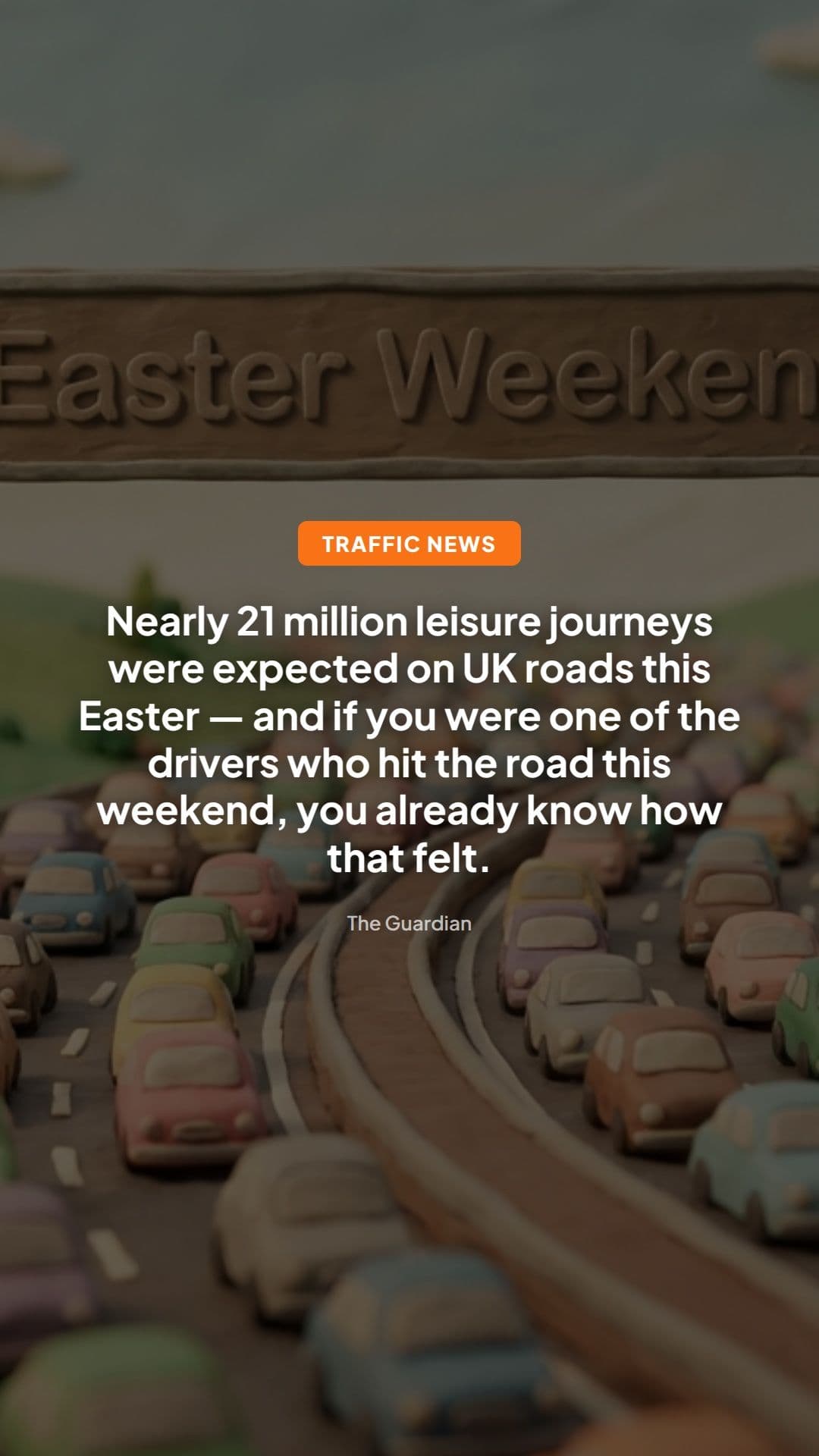
Easter Bank Holiday 2026: 21 Million Journeys, Soaring Fuel Costs, and What Every Driver Needs to Know Before They Set Off
Picture this: it's Good Friday morning, your bags are packed, the kids are strapped in, and you're feeling quietly optimistic about getting ahead of the traffic. Then the M5 grinds to a halt somewhere near Bristol, your fuel gauge is taunting you, and a roadside camera flashes as you instinctively creep into a yellow box junction out of sheer desperation. Welcome to Easter on Britain's roads.
This year, according to reporting by The Guardian, that scenario is more likely than at any point in the last four years. With nearly 21 million leisure journeys forecast across the Easter bank holiday weekend, 2026 is shaping up to be the most congested Easter since before the cost-of-living crisis began to bite. The question isn't just how to survive the traffic — it's how to avoid the cascade of fines, charges, and legal headaches that inevitably follow when millions of drivers are stressed, rushed, and operating in unfamiliar territory.
What's Driving the Easter Rush?
The scale of this Easter's expected road usage isn't accidental. Several converging factors have pushed leisure travel back up towards pre-pandemic highs, even as household finances remain stretched.
Firstly, the timing of Easter 2026 falls particularly favourably for extended breaks. With Good Friday on 3 April and Easter Monday on 6 April, many workers can create a ten-day break by taking just a handful of annual leave days around the bank holidays. That kind of value is irresistible when international flights remain expensive and staycation destinations — Cornwall, the Lake District, the Norfolk Broads — are actively marketing themselves as premium alternatives to European travel.
Secondly, despite ongoing concerns about fuel prices (more on those shortly), demand for road travel has proved remarkably resilient. Families, in particular, tend to drive rather than fly when travelling as a group, partly because of cost and partly because of the sheer logistical difficulty of getting young children through airports. Add in the growing popularity of motorhomes and campervans — a sector that boomed during Covid and has never fully retreated — and you have a recipe for seriously congested A-roads and motorways.
The AA and RAC have both flagged Good Friday afternoon and Saturday morning as the peak danger periods, with the M25, M5, A30, A303, and A1 all expected to see significant tailbacks. Historically, these routes carry the heaviest leisure traffic towards the south-west, the south coast, and northbound towards Yorkshire and Scotland.
Why Fuel Prices Make This More Complicated
The backdrop to this Easter rush is one of continued fuel price volatility. As we've seen throughout early 2026, petrol and diesel costs have been subject to sharp fluctuations driven by global oil markets, the strength of the pound, and wholesale energy dynamics. Drivers planning long journeys are likely to feel the cost acutely.
What many drivers don't realise is that fuel price stress directly influences driving behaviour in ways that increase legal risk. When you're watching the fuel gauge and trying to make it to a cheaper forecourt, you're more likely to speed slightly, take shortcuts through unfamiliar roads, or make hasty decisions at junctions. Each of those behaviours carries real legal consequences — and enforcement doesn't take bank holidays off.
It's also worth noting that fuel duty in the UK currently sits at 52.95 pence per litre, unchanged since the freeze introduced in 2022 and extended through subsequent Budgets. VAT at 20% is applied on top of both the fuel cost and the duty itself. That means a significant portion of what you're paying at the pump is fixed regardless of market conditions — something worth bearing in mind when budgeting for a long-distance Easter run.
The Legal Landscape: What the Law Says About Holiday Driving
Bank holidays don't suspend traffic law. This sounds obvious, but the reality is that many drivers operate with a kind of informal assumption that enforcement is lighter over holiday weekends. In some cases, that's partially true — certain local authority parking enforcement teams operate reduced services. But camera-based enforcement, motorway monitoring, and police road traffic operations continue uninterrupted, and often intensify.
Here are the specific legal areas most relevant to Easter weekend driving:
Speed Limits and Variable Speed Cameras
Under the Road Traffic Regulation Act 1984, speed limits apply at all times unless a specific exemption is in place. Smart motorway variable speed limits — those displayed on overhead gantry signs — are legally enforceable once illuminated, even if the limit seems temporarily low due to congestion management rather than an immediate hazard. Drivers caught travelling above a displayed variable limit face a Fixed Penalty Notice of £100 and three penalty points, rising significantly if the matter goes to court.
During Easter weekend, Highways England (now National Highways) typically activates variable speed limits extensively on key corridors to manage flow. Treating a 50mph gantry sign as advisory rather than mandatory is a costly mistake.
Mobile Phone Use
Despite years of campaigning, illegal mobile phone use whilst driving remains stubbornly common. Since March 2022, the law was tightened under amendments to the Road Traffic Act 1988 — it is now illegal to hold and use a mobile phone for virtually any purpose whilst driving, including taking photos, scrolling, or checking maps. The penalty is £200 and six penalty points. For new drivers within their first two years of passing their test, six points means an automatic licence revocation.
Parking Enforcement at Coastal and Rural Destinations
This is where many Easter drivers get caught out. Popular destinations — seaside towns, national park villages, historic market towns — often have highly specific and localised parking rules that visitors simply aren't aware of. Residents' permit zones, limited waiting bays with obscure sign combinations, and private land car parks with aggressive enforcement operators are all concentrated precisely in the places people flock to over Easter.
Under the Traffic Management Act 2004, local authorities have full civil enforcement powers over on-street parking. Private landowners enforce through contract law, with operators typically affiliated to either the British Parking Association (BPA) or the International Parking Community (IPC). The rules and appeal routes differ significantly between council-issued Penalty Charge Notices and private Parking Charge Notices — a distinction that matters enormously if you receive one.
What Drivers Should Know: Practical Advice for the Easter Weekend
Plan your fuel stops deliberately. Use apps like Petrol Prices or GasBuddy to identify cheaper forecourts along your route before you leave. Avoid motorway service stations where possible — fuel at services can be 15-20p per litre more expensive than nearby supermarket forecourts.
Leave earlier than feels necessary. The data consistently shows that departures before 7am on Good Friday and Easter Saturday encounter dramatically lighter traffic than mid-morning starts. If you can get moving by 6am, you'll likely save two hours or more on a journey to the south-west.
Photograph your parking. Whenever you park in an unfamiliar location — particularly in coastal towns, national parks, or private car parks — take a dated photograph of your vehicle in the space and the nearest parking sign. This single habit can make the difference between winning and losing an appeal if you receive a ticket.
Check enforcement hours carefully. Many parking restrictions in tourist areas apply at unusual times — including Sundays and bank holidays — specifically because that's when visitor pressure is highest. Don't assume that a restriction you'd expect to be suspended on a bank holiday actually is. Check the sign.
Know your grace periods. Under the British Parking Association Code of Practice and equivalent IPC standards, private car park operators are required to allow a minimum ten-minute grace period after a paid session expires before issuing a charge. For council-enforced on-street parking, a similar grace period principle applies, though the specifics vary by authority. If you return to your car slightly late, document the time carefully.
Keep your paperwork. If you pay for parking digitally — via an app or contactless machine — screenshot or save your confirmation immediately. Payment system failures do occur, and having contemporaneous evidence of a successful transaction is your strongest defence.
Looking Ahead: What Easter 2026 Tells Us About British Motoring
The forecast of 21 million Easter journeys is more than a traffic statistic — it's a signal that Britain remains overwhelmingly car-dependent for leisure travel, regardless of fuel costs, congestion warnings, or environmental pressure. The infrastructure simply hasn't kept pace with demand, and that gap is unlikely to close quickly.
What this means practically is that the legal and financial risks of driving over peak holiday periods will continue to grow. More cameras, smarter enforcement technology, and increasingly complex local parking regimes mean that the uninformed driver faces a genuine financial minefield. The drivers who fare best aren't necessarily those who avoid the roads — they're the ones who understand the rules, document their journeys properly, and know their rights when things go wrong.
This Easter, the roads will be busier than they've been in four years. Go prepared, go informed, and if something does go wrong — whether it's a ticket, a fine, or an enforcement dispute — remember that the appeals process exists precisely because mistakes happen, and challenging an unjust penalty is always worth the effort.
Safe travels.
Written by
Emma Thompson
Traffic Law Specialist
Ready to Challenge Your Ticket?
Let our AI analyse your PCN and generate a professional appeal letter in minutes.
Start Free Appeal