East Midlands Airport Parking Fines: Why £200 Was Issued
A dad was issued two £100 airport parking fines at East Midlands Airport despite paying the £5 drop-off fee. Find out what drivers can do next.

Raj Patel
2 August 2026
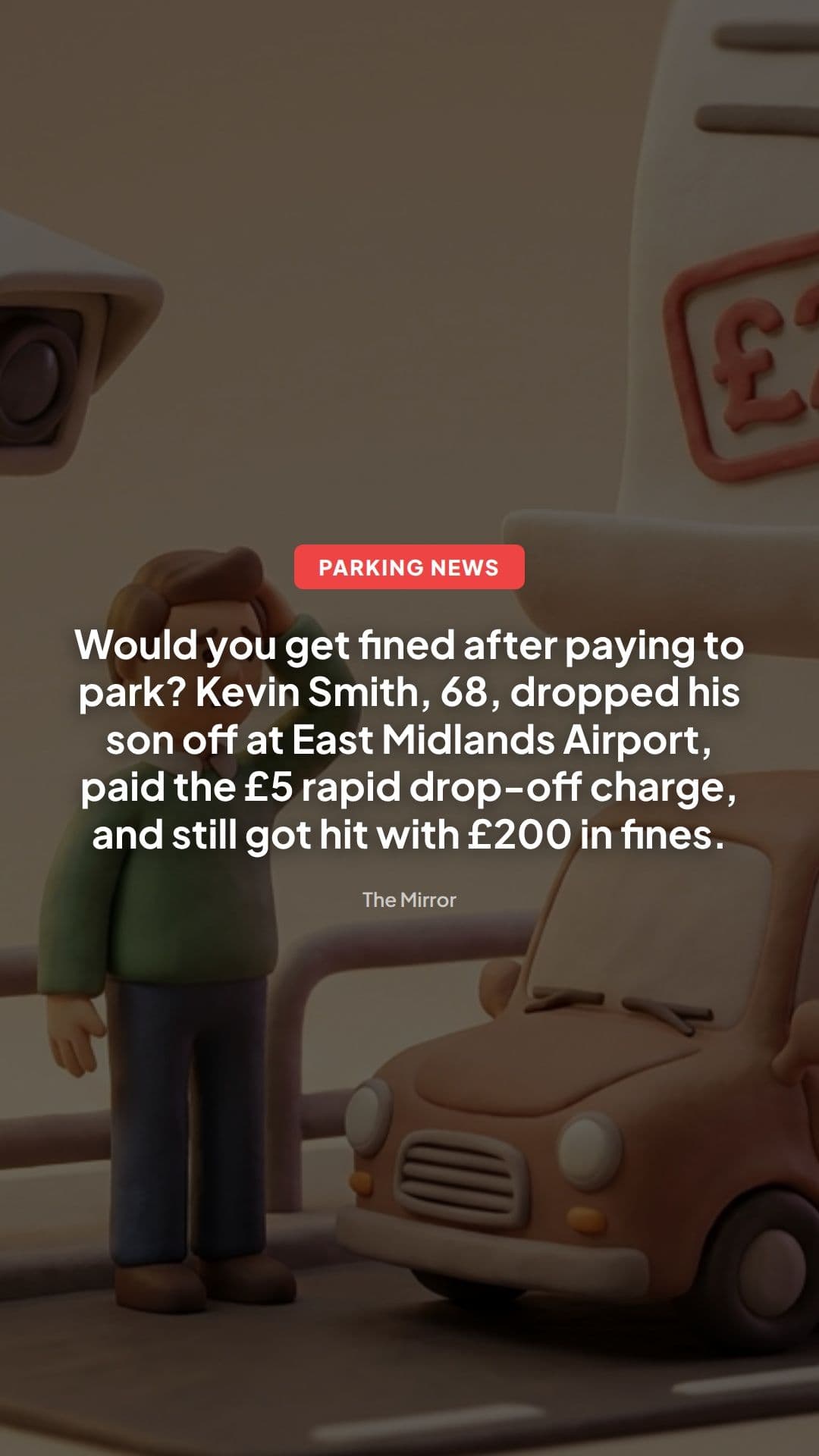
£200 for parking that didn't happen: the airport drop-off trap catching out honest drivers
Picture the scene. You're at East Midlands Airport, dropping a relative off for their flight. You pull into the designated drop-off zone, pay your £5, kiss goodbye, and drive off within minutes. Job done, receipt in hand, conscience clear. Weeks later, a penalty notice lands on your doormat demanding £100. Then it happens again. Suddenly you're £200 out of pocket for parking you paid for and barely used.
This is exactly what one father says happened to him, according to a report in the Mirror, and it's a story that will ring uncomfortably true for anyone who has used an airport's paid drop-off zone in the past few years.
What happened
The details are straightforward but troubling. A driver used East Midlands Airport's drop-off zone on two separate occasions, paying the required £5 charge each time as instructed. Despite doing everything asked of him, he received two separate £100 penalty charge notices, one for each visit, taking the total to £200.
The driver has publicly criticised the fines as "unfair," arguing that he complied with the airport's payment system on both occasions. The case has understandably drawn attention to how drop-off zone enforcement works at UK airports, and whether the systems in place are fit for purpose or simply designed to catch people out.
What makes this case particularly frustrating is the apparent disconnect between compliance and consequence. This isn't a driver who ignored signage, overstayed a free period, or dodged a fee. He paid. Twice. And still ended up facing four-figure penalties in percentage terms compared to the tiny sum he'd already handed over.
Why it matters: the airport parking gold rush
Airport drop-off charges have become a fixture of UK air travel over the past decade, and they show no sign of disappearing. What began as a way to manage traffic flow outside busy terminals has, in the eyes of many critics, morphed into a lucrative revenue stream for airport operators and their car park management contractors.
East Midlands Airport is far from alone in charging for what used to be a free, quick stop to say goodbye to a loved one. Airports across the country, including Gatwick and Stansted, have introduced or increased drop-off fees in recent years, with charges creeping steadily upwards. Some airports now charge more for a few minutes at the kerb than many town centre car parks charge for an entire day.
The trouble is that these zones are typically managed by automatic number plate recognition (ANPR) cameras linked to third-party payment systems, often run by private parking operators rather than the airport itself. This creates exactly the kind of gap where things can go wrong, and where drivers who have genuinely paid can still end up with a penalty notice because of a technical or administrative failure rather than any wrongdoing on their part.
Common culprits in cases like this include:
- Number plate misreads, where the ANPR camera captures the registration incorrectly, meaning the payment recorded doesn't match the vehicle logged as entering
- Payment system glitches, where a genuine transaction doesn't sync properly with the enforcement database
- Timing discrepancies, where a driver is charged for exceeding a permitted time window despite paying correctly
- App or website errors, particularly when drivers are asked to enter registration details manually and a simple typo (a common issue, as we've explored in relation to VRM entry errors) causes a mismatch
Any one of these could plausibly explain how a driver who paid twice still ended up with two separate fines. It's a sobering reminder that paying doesn't always guarantee protection, particularly when the systems recording that payment are opaque and the driver has no way of checking, in real time, that everything has been logged correctly.
The legal angle: what rights do drivers actually have?
Here's where things get more nuanced, because airport drop-off zones don't always operate under the same rules as council-issued parking tickets.
If the land is privately owned or leased, and it usually is at airports, any penalty notice issued is a Parking Charge Notice (PCN) governed by contract law, not a statutory traffic penalty. This is a crucial distinction. A private parking charge is essentially the operator's claim that you breached the terms of a contract you entered into by driving onto their land, typically by exceeding a time limit or failing to pay correctly. It is not, in the strict legal sense, a "fine" in the way a criminal penalty is.
This matters for several reasons:
The burden of proof shifts. In contract law, if you can demonstrate you complied with the terms, such as by paying the correct amount within the required window, the operator has to show why the charge is still valid. A genuine proof of payment, such as a bank statement, app confirmation, or email receipt, is strong evidence in any appeal.
Trade body codes of practice apply. Most reputable private parking operators are members of either the British Parking Association (BPA) or the International Parking Community (IPC), both of which operate codes of practice that set out how ANPR enforcement should work, what signage must be displayed, and how appeals should be handled. If you're unsure of the difference, our guide on BPA versus IPC membership explains what protections each offers drivers.
There's a formal appeals route. If an operator rejects your initial appeal, and they are a member of an accredited trade body, you can escalate to an independent appeals service, either POPLA (for BPA members) or the Independent Appeals Service (for IPC members). These are free to use and designed to give drivers a genuinely independent hearing rather than leaving the parking company as judge and jury in its own case.
New rules are on the horizon. The government has been consulting on tightening private parking regulation, including proposals for a cap on charges and clearer, fairer appeals processes. Airport drop-off zones, given how frequently they generate complaints, are likely to remain firmly in the spotlight as these reforms take shape.
It's worth stressing that every case turns on its own facts and evidence. If you find yourself facing a similar situation, the specifics of your payment method, the signage in place, and the operator's own terms will all matter, and it's sensible to seek proper advice or use the formal appeals channels available rather than assume any two cases will be treated identically.
What drivers should know: protecting yourself at drop-off zones
There are practical steps every driver can take to reduce the risk of ending up in this exact situation:
Keep every scrap of evidence. Screenshot the payment confirmation, save the email receipt, and note the exact time you paid and the registration number you entered. If a dispute arises months later, this evidence is your entire case.
Double-check the registration you enter. Many drop-off payment systems require you to manually type your number plate. A single mistyped character can render your payment invisible to the enforcement system, even though you've genuinely paid.
Photograph the signage. Terms and conditions at drop-off zones can be surprisingly complex, covering time limits, exact boundaries of the paid zone, and what counts as a breach. A photo taken at the time provides a record of what was actually displayed, which can be crucial if the signage later turns out to be unclear or contradictory.
Act quickly if a PCN arrives. Most private parking appeals have strict deadlines. Don't sit on a penalty notice hoping it will go away. Respond promptly, in writing, with your evidence attached.
Know your escalation options. If your appeal to the operator fails, check whether they're a member of the BPA or IPC and use the relevant independent appeals service before considering payment or further action.
Looking ahead
Cases like this one add to a growing pile of evidence that airport drop-off enforcement needs closer scrutiny. As charges creep higher and enforcement becomes ever more automated, the margin for error, and the potential for genuinely compliant drivers to be wrongly penalised, only grows.
With regulatory reform of the private parking industry inching forward, and public frustration with airport charges continuing to build, stories like this father's £200 ordeal are likely to keep fuelling calls for tighter oversight of how drop-off zones are policed. Until then, the safest approach for any driver heading to the airport is simple: pay, keep the proof, and never assume that a receipt guarantees you won't hear from the parking company again.
Written by
Raj Patel
Transport Policy Analyst
Ready to Challenge Your Ticket?
Let our AI analyse your PCN and generate a professional appeal letter in minutes.
Start Free Appeal