Ealing PCN Pedestrian Zone: Appeal Allowed—Key Lesson
London Borough of Ealing PCN for entering a pedestrian zone was overturned. Learn the key evidence and signage points drivers can use in similar appeals.

Sarah Mitchell
24 June 2026
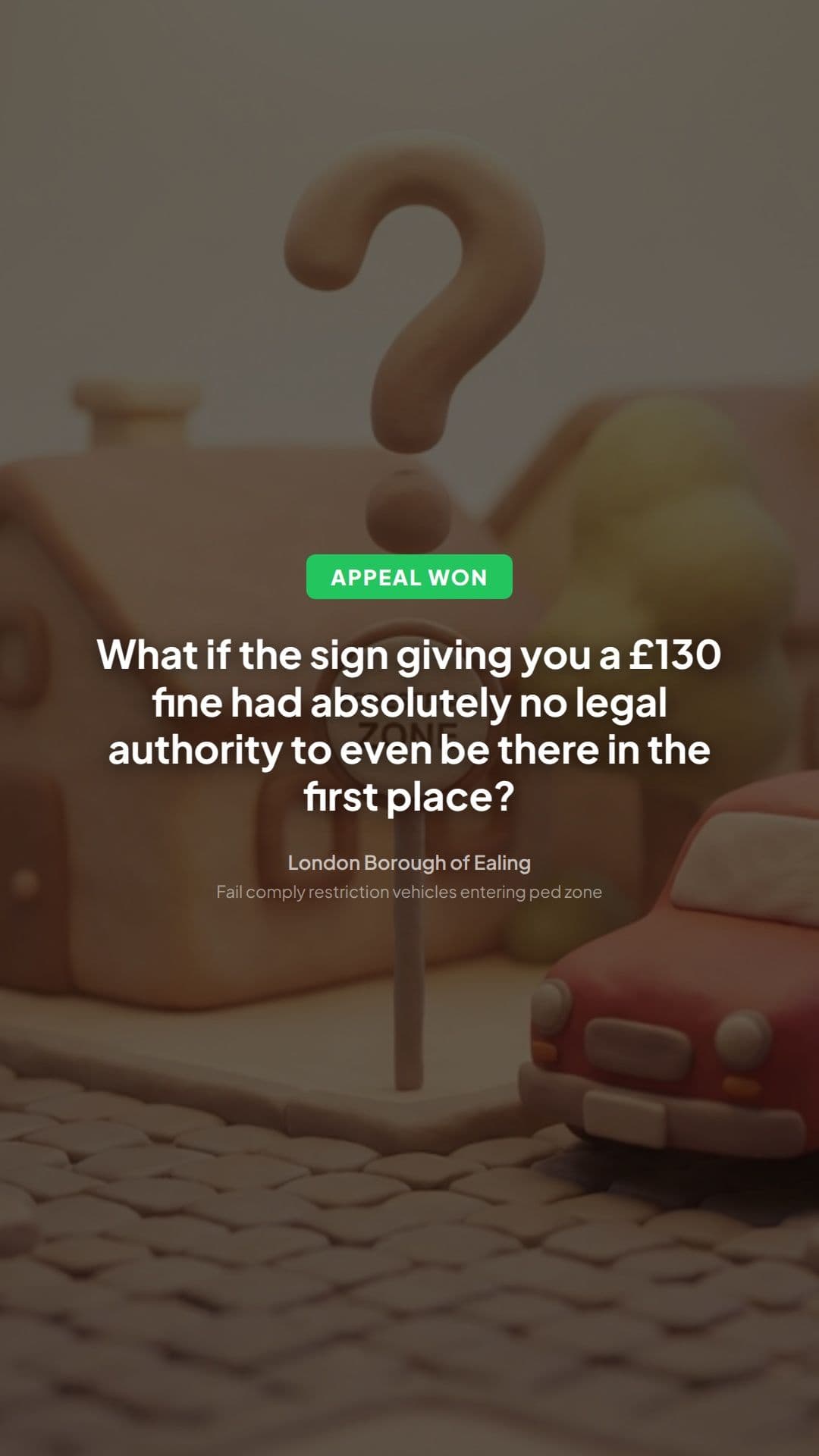
When a "Pedestrian Zone" Isn't Actually a Pedestrian Zone: The Sign That Wasn't Legal
A Cleaning Company Drives Into a Bureaucratic Trap — and Wins
Imagine receiving a parking fine for entering a pedestrian zone — only for a tribunal to discover that the pedestrian zone doesn't actually exist in law. Not that it was poorly signposted, or that the hours were ambiguous, but that the legal foundation for the zone itself had never been properly established. The signs were there. The penalty charge notice arrived. The fine was real. But the legal authority to issue it? Nowhere to be found.
That is precisely what happened in a recent case involving Guaranteed Cleaning Limited and the London Borough of Ealing — and the outcome carries important lessons for every driver who has ever been caught by a restriction they assumed must be legitimate simply because there was a sign saying so.
The Case: A Van, a School Street, and a Penalty Charge Notice
Guaranteed Cleaning Limited received a Penalty Charge Notice (PCN) from Ealing Council for allegedly failing to comply with a restriction on vehicles entering a pedestrian zone. The contravention code used was one that councils rely upon when a driver enters a street designated as a pedestrian-only area during restricted hours.
The street in question was Perimeade Road, between the western kerb-line of Fairfield Drive and its junction with Federal Road — part of what Ealing had designated as a "school street" under The Ealing (Perivale School Streets) (No.1) Order. School streets are an increasingly common feature of urban Britain, where roads near schools are closed to motor vehicles during drop-off and pick-up times. In principle, they are a reasonable public safety measure. In practice, as this case demonstrates, they can be implemented in ways that fall short of the legal requirements.
A representative, Mr Murray Smith, appeared on behalf of Guaranteed Cleaning Limited. Ealing Council sent nobody to defend their own PCN.
The Arguments: What the Driver Said, and What the Council Didn't
Mr Smith's argument was precise and targeted. He did not dispute the existence of the restriction on Perimeade Road. He did not claim his vehicle had a valid exemption, or that the times were wrong, or that the signs were unclear. Instead, he went straight to the root of the matter: the Traffic Management Order (TMO) that Ealing had used to create the restriction does not actually establish a pedestrian zone.
His argument, in essence, was this: a pedestrian zone sign can only be lawfully placed on a road if there is a specific legal instrument — an Act of Parliament, an order, a regulation, a bylaw, a resolution, or a notice — that actually creates a pedestrian zone. Ealing's order did none of that. It created a motor vehicle prohibition on a specific stretch of road. That is a different thing entirely.
The council, for its part, offered no counter-argument. No representative attended the tribunal hearing. Their case went undefended.
The Decision: Appeal Allowed
The adjudicator allowed the appeal in full. The PCN was cancelled. Guaranteed Cleaning Limited owed nothing.
The reasoning was clear: because the TMO did not create a pedestrian zone, the pedestrian zone signs placed on Perimeade Road had no lawful basis. And if the signs had no lawful basis, the penalty charge notice issued for allegedly breaching those signs could not be enforced.
The Legal Reasoning: Why This Matters in Plain English
This case hinges on a specific piece of traffic sign law that most drivers — and, it seems, some councils — are unaware of.
The Traffic Signs Regulations and General Directions 2016 govern which signs can be placed on UK roads and under what circumstances. Schedule 8, Part 5 of those regulations contains a critical rule: certain signs, including pedestrian zone boundary signs, can only be placed on a road to indicate the effect of a legal instrument that actually restricts or prohibits the use of that road by traffic. The sign must reflect a legal reality. It cannot create one.
Put simply: the sign must follow the law, not substitute for it.
In this case, Ealing had created a motor vehicle prohibition — which is a perfectly legitimate thing to do. But they had then placed pedestrian zone boundary signs on the road, as if it were a designated pedestrian zone. The problem is that a motor vehicle prohibition and a pedestrian zone are two distinct legal concepts. You cannot use the signage for one to indicate the other.
The adjudicator drew on a 2022 tribunal decision — Josephine Dayan v London Borough of Barnet — which had previously established this same principle. In that case, the tribunal held that for a zone boundary sign to be lawful, the underlying TMO must actually create a zone. If it does not, the sign is unauthorised, and any penalty charge notices issued on the basis of that sign cannot stand.
This is not a technicality in the pejorative sense — it is a fundamental principle of the rule of law. Councils have real power to restrict roads and issue fines. But that power must be exercised through proper legal channels, with the correct instruments and the correct signage. When a council skips a step, even inadvertently, drivers cannot be penalised for the council's own failure to follow the law correctly.
The fact that Ealing sent no representative to the hearing is also telling. It suggests either that the council did not take the appeal seriously, or that it had no meaningful defence to offer. Either way, the absence of any counter-argument left the adjudicator with only one reasonable conclusion.
Lessons for Drivers: What This Case Teaches You
1. A sign on a road is not automatically lawful
Most drivers assume that if a sign is there, it must be legitimate. This case is a reminder that signs can be installed without proper legal authority. If you receive a PCN for entering a restricted area, it is worth asking whether the signage itself has a valid legal foundation.
2. The type of restriction matters — and the terminology is precise
A "motor vehicle prohibition" and a "pedestrian zone" are not the same thing in law, even if they look similar on the ground. Councils must use the right legal instruments and the right signs for the specific type of restriction they are creating. A mismatch between the two can invalidate enforcement.
3. Check the Traffic Management Order
When you challenge a PCN, you can request the TMO that underpins the restriction. This is a public document. If the TMO does not actually create the type of restriction indicated by the signage, that is a powerful ground of appeal — as this case demonstrates.
4. Council no-shows at tribunal can be significant
When a council fails to appear at a tribunal hearing, it leaves its case entirely undefended. Adjudicators are not there to argue the council's case for them. If you have a solid legal argument and the council does not turn up to rebut it, your chances of success increase substantially.
5. Precedent cases are your friend
The adjudicator in this case relied on Josephine Dayan v London Borough of Barnet, a 2022 tribunal decision that had already established the same principle. When building an appeal, it is worth researching whether similar cases have already been decided in drivers' favour. Tribunal decisions, while not binding in the way court judgments are, carry real persuasive weight.
Key Takeaway
A sign on a road is only as powerful as the law behind it. If a council cannot point to a legal instrument that actually creates the restriction shown on the sign, the sign has no authority — and neither does the fine.
This case is a reminder that parking enforcement is not simply about what you can see on the street. It is about whether the legal groundwork has been properly laid. When councils cut corners — even unintentionally — the consequences fall on drivers. Knowing how to look behind the sign, and challenge what you find there, can make all the difference.
Written by
Sarah Mitchell
Parking Rights Advocate
Ready to Challenge Your Ticket?
Let our AI analyse your PCN and generate a professional appeal letter in minutes.
Start Free Appeal