E-scooter crashes: injury payouts hit £110m in UK
UK e-scooter and e-bike injury payouts have topped £110m. We explain the rules gap, insurance implications and what drivers and riders should know.

Carlos Mendoza
7 July 2026
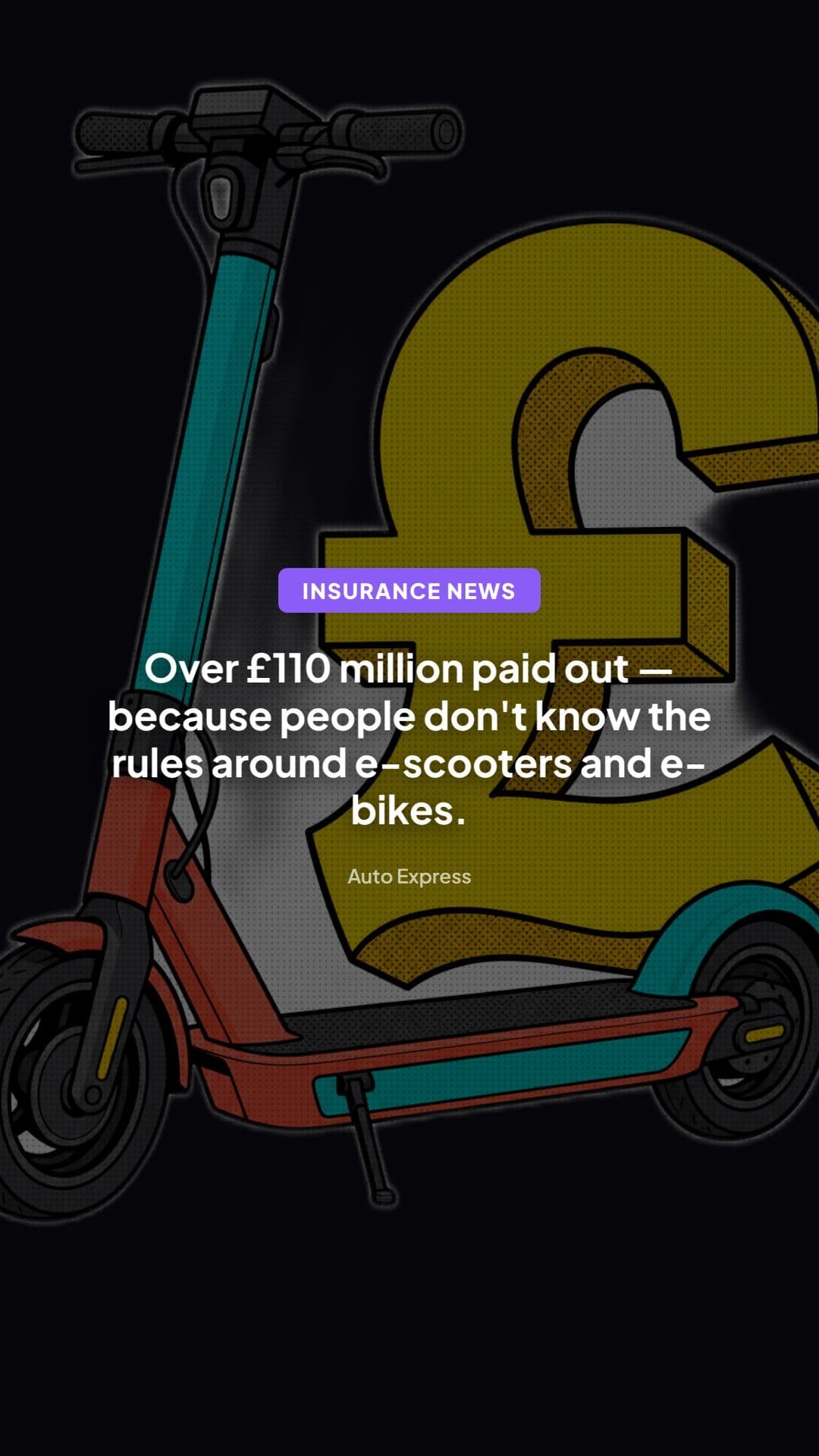
E-Scooters, E-Bikes and a £110 Million Problem: What Every UK Driver Needs to Know
There's a quiet revolution happening on Britain's roads, and it's costing the insurance industry a fortune. E-scooters dart through junctions. Delivery e-bikes weave between lanes. Rental machines pile up on pavements. And somewhere in the middle of all this, ordinary drivers are left wondering: who exactly is responsible when something goes wrong?
The answer, it turns out, is far from straightforward — and a new report suggests that confusion is proving extremely costly.
What's Actually Happening
According to figures reported by Auto Express, insurance industry payouts relating to injuries caused by e-scooter and e-bike collisions have now surpassed £110 million. That's not a figure accumulated over decades of gradual change — this is the product of a relatively short period during which these vehicles have exploded in popularity across UK towns and cities.
Critics aren't just pointing at the sheer number of incidents. They're highlighting something arguably more troubling: a fundamental knowledge gap about who has what rights and responsibilities on the road. Riders don't always know what they're legally permitted to do. Drivers don't always know how to respond. And pedestrians — often the most vulnerable in any collision — are caught in the crossfire of a system that hasn't yet caught up with the technology it's supposed to govern.
This isn't a niche problem. It touches every road user in the country.
Why This Matters: The Context Behind the Numbers
To understand why £110 million in payouts has accumulated, you need to understand just how chaotic the regulatory landscape around these vehicles actually is.
E-scooters occupy a peculiarly awkward legal position in the UK. Under the Road Traffic Act 1988 and the Highway Act 1835, privately owned e-scooters are classified as motor vehicles. That means riding one on a public road or pavement is illegal — full stop. You need insurance, a driving licence, and road tax to operate a motor vehicle legally, and e-scooters cannot currently be registered or taxed in the UK. Private e-scooters are, therefore, banned from public roads and pavements alike.
And yet, rental e-scooter trials — run under government-approved schemes in cities including London, Manchester, and Liverpool — are entirely legal on roads and cycle lanes. These trials have been running since 2020 and have been repeatedly extended. So you can legally ride a Lime or Tier scooter in certain cities, but your own identical-looking machine is technically an offence.
E-bikes are a different matter but no less complicated. A legal e-bike — or EAPC (Electrically Assisted Pedal Cycle) — must meet strict criteria under the Electrically Assisted Pedal Cycles Regulations 1983 (as amended). The motor must not exceed 250 watts, must not propel the bike above 15.5mph, and must cut out when the rider stops pedalling. Meet those criteria, and you can ride without a licence, insurance, or road tax, on roads and cycle lanes alike.
But here's the problem: the UK market is flooded with e-bikes that don't meet those standards. Higher-powered machines, throttle-controlled bikes, and modified vehicles are being ridden on public roads in large numbers — often by people who have no idea they're operating an uninsured motor vehicle. And when those machines are involved in a collision, the insurance implications become deeply murky.
The Legal Angle: Who Pays When Things Go Wrong?
This is where the £110 million figure starts to make sense.
When a collision involves a standard motor vehicle — a car, a van, a lorry — the insurance framework is well established. The Motor Insurers' Bureau (MIB) exists to compensate victims of uninsured or untraced drivers, and the system, while imperfect, broadly functions. But e-scooters and non-compliant e-bikes exist in a grey zone that can leave injured parties fighting for compensation from multiple directions simultaneously.
Consider a scenario: a delivery rider on a high-powered e-bike runs a red light and collides with a pedestrian. Is the bike a motor vehicle? If so, the rider needed insurance and didn't have it. Does the MIB pick up the tab? Possibly — but establishing liability, vehicle classification, and coverage can take months of legal wrangling. Meanwhile, if a driver swerves to avoid an e-scooter and collides with another car, their own insurer may face a claim even though the scooter rider was the proximate cause.
The Road Traffic Act 1988 requires that any person using a motor vehicle on a road must be insured against third-party liability. If an e-scooter or non-compliant e-bike qualifies as a motor vehicle — and legally, many do — then their uninsured use creates exactly the kind of liability gap the MIB was designed to address. But the volume of incidents is now placing significant strain on that system, and ultimately, those costs filter through to every motorist's premium.
There's also a growing body of case law emerging from county courts around incidents involving these vehicles, though no single landmark ruling has yet clarified the position comprehensively. The Law Commission reviewed e-scooter regulation extensively and published recommendations in 2023, but primary legislation to implement those changes has not yet been passed. That legislative vacuum is, in large part, why the confusion — and the payouts — continue to mount.
What Drivers Should Know: Practical Advice
If you're a driver navigating roads increasingly shared with e-scooters and e-bikes, here's what you need to keep in mind:
1. Assume the other party may be uninsured If you're involved in a collision with an e-scooter or e-bike rider, don't assume they have insurance. Gather as much information as possible at the scene — name, contact details, description of the vehicle, and any witnesses. Report the incident to police if there is injury or significant damage.
2. Contact the Motor Insurers' Bureau if you can't trace the other party If the rider flees the scene or has no insurance, the MIB may be able to compensate you for personal injury. Visit mib.org.uk for guidance on making an uninsured or untraced driver claim.
3. Check your own dashcam footage immediately Dashcam evidence has become increasingly important in disputes involving micro-mobility vehicles. If you have footage, preserve it and share it with your insurer promptly.
4. Know the difference between legal and illegal e-scooters on the road A rider on a rental scooter in an approved trial area is operating legally. A rider on a private scooter is not — regardless of how responsible they appear. This distinction matters if you're trying to establish fault.
5. Don't assume cycle lane rules protect you from e-bike incidents Many drivers believe that because e-bikes use cycle infrastructure, collisions are the cyclist's problem. That's not necessarily true. If a collision occurs at a junction or crossing, fault can be shared or attributed to the driver depending on the circumstances.
6. Review your own insurance policy Some comprehensive policies now include specific provisions — or specific exclusions — relating to incidents involving micro-mobility vehicles. It's worth checking what your policy says, particularly if you frequently drive in urban areas.
Looking Ahead: What Needs to Change
The £110 million figure is almost certainly going to rise before it falls. The government's rental trial schemes continue to expand, private e-scooter ownership shows no sign of declining despite the legal ban, and the enforcement capacity to address illegal use remains woefully inadequate. Police forces across the country have acknowledged that they lack the resources to consistently pursue illegal e-scooter riders, particularly in cities.
What's needed — and what campaigners have been calling for — is a coherent legislative framework that clearly defines vehicle categories, sets enforceable standards, requires appropriate insurance, and educates both riders and other road users about the rules. The Law Commission's 2023 recommendations would go some way towards achieving this, but without parliamentary action, they remain just that: recommendations.
There's also a strong argument for a public awareness campaign targeted at both riders and drivers. The knowledge gap identified in this report isn't inevitable — it's the product of regulatory inaction and poor public communication. Other countries that have introduced clear e-scooter legislation — including France and Germany — have done so alongside rider education programmes and mandatory liability insurance requirements.
Until the UK follows suit, the burden will continue to fall on drivers, insurers, and ultimately the wider public. That £110 million isn't an abstract industry statistic. It's reflected, in small but measurable ways, in the premiums every motorist pays each year.
The roads are changing. The law, frustratingly, is struggling to keep pace.
Written by
Carlos Mendoza
Parking Technology Analyst
Ready to Challenge Your Ticket?
Let our AI analyse your PCN and generate a professional appeal letter in minutes.
Start Free Appeal