DVSA MOT Photo Rules Start 3 August: What Drivers Need to Know
DVSA will introduce MOT photo uploads from 3 August 2026 to combat fraud. Find out what the new evidence rules mean for UK drivers and garages.

Isabella Romano
1 August 2026
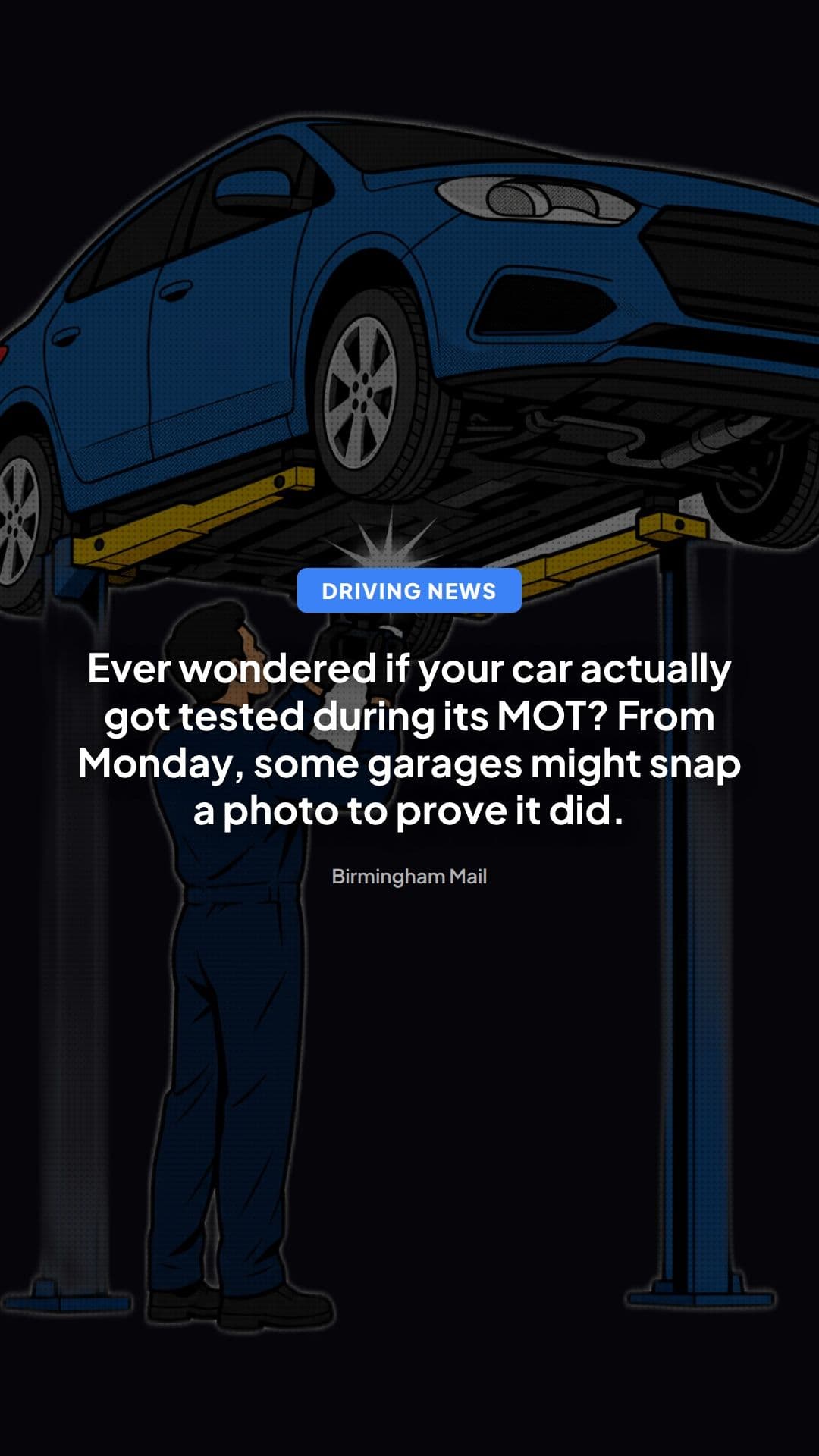
MOT Testing Gets a Camera Upgrade: What the DVSA's Photo Rule Means for You
Picture this. You drop your car off for its MOT, pop to the shops, and come back an hour later to collect it with a fresh certificate. But did the tester actually put your vehicle up on the ramp, or did they simply glance at your logbook and rubber-stamp the paperwork? For most drivers, that question never crosses their mind. From August 2026, the DVSA wants to make sure it never has to.
What's Actually Changing
The Driver and Vehicle Standards Agency has confirmed that a new photo-upload feature will roll out to MOT testing stations from 3 August 2026. In practical terms, testers at participating garages will be able to capture and upload a photograph as part of the testing process, creating a timestamped visual record that the vehicle was physically present and inspected.
According to the Birmingham Mail's report, the rollout will initially cover around 2,500 garages, a meaningful slice of the UK's testing network but far from universal coverage on day one. The DVSA's stated aim is straightforward: reduce fraud by tightening up the evidence trail around what happens during a test.
This isn't a wholesale rewrite of the MOT scheme. It's a targeted technical intervention aimed squarely at a specific weak point, the ability for unscrupulous testers or garages to issue certificates for vehicles that were never properly examined, or in the worst cases, never even turned up.
Why This Matters More Than It Looks
On the surface, a photo-upload feature sounds like a minor administrative tweak. But it touches something that matters enormously to ordinary drivers: trust in the MOT system.
The MOT test exists as a baseline roadworthiness check. It's meant to catch bald tyres, failing brakes, corroded structural components and dodgy lighting before they turn into accidents. The entire system relies on testers doing their job properly and the DVSA being able to verify, after the fact, that they did.
Fraudulent MOTs, sometimes dubbed "ghost MOTs" in industry and consumer coverage, undermine that entire premise. If a garage can issue a pass certificate without ever inspecting the car, drivers can end up on the road in vehicles with genuinely dangerous defects, unaware they're driving on borrowed time. Insurers, too, rely on a valid MOT as one of the conditions of cover being upheld. A certificate obtained fraudulently is essentially worthless, and if it later emerges that a test was falsified, that has knock-on consequences for the vehicle's insurance validity and the driver's own legal position, since driving without a valid MOT is itself an offence under the Road Traffic Act 1988.
Photographic evidence gives the DVSA a much stronger audit trail. Instead of relying purely on paperwork and tester attestation, there's now a visual record tying a specific vehicle to a specific test at a specific time. That's a meaningful upgrade to the integrity of the whole system, even if it's an invisible one from the driver's seat.
The Legal and Regulatory Backdrop
MOT testing in Great Britain is governed primarily by the Road Traffic Act 1988 and the accompanying Motor Vehicles (Tests) Regulations 1981, with the DVSA responsible for overseeing the network of authorised testing facilities and the conduct of individual testers. Testers themselves must be approved and are subject to ongoing monitoring, audits and, in serious cases, removal of their authorisation to conduct tests.
The DVSA already has various fraud-detection mechanisms in place, including data analysis that flags suspicious patterns, such as testers who complete tests suspiciously quickly, or garages with pass rates that look statistically implausible. The photo-upload feature slots into this existing enforcement architecture as an additional layer of evidence, rather than replacing anything.
For drivers, the legal stakes around MOT compliance are worth restating plainly. Using a vehicle without a valid MOT (where one is required) can result in a fine, and if the lack of a valid test is linked to the vehicle being in a dangerous condition, penalties can be considerably more severe, including points on your licence in certain circumstances. Beyond the criminal law angle, a missing or fraudulent MOT can also invalidate motor insurance, leaving a driver personally liable for damages following a collision. This is why the integrity of the testing system isn't just a bureaucratic concern, it has real teeth for individual motorists who might unknowingly be relying on a worthless certificate.
It's also worth noting that fraudulent MOT certification can expose garages and testers to serious consequences of their own, including prosecution for offences under fraud legislation, not just the loss of their DVSA testing authorisation. This new photographic evidence requirement will likely make it considerably harder for a rogue tester to argue, after the fact, that a proper inspection took place.
What Drivers Should Actually Know
For the vast majority of motorists who use reputable garages and get genuine, thorough tests, this change will be almost entirely invisible. You won't be asked to pose for a photo. The camera work, as far as we understand from the reporting, is aimed at the vehicle and the testing process itself, not the customer.
That said, there are a few practical things worth keeping in mind:
- Check whether your usual garage is part of the initial rollout. With roughly 2,500 garages included from launch, this won't cover every testing station in the country immediately. If your MOT is due shortly after 3 August 2026, it's worth asking your garage whether they're part of the scheme, though in practice this shouldn't change how your test is conducted or what it costs.
- Keep your paperwork regardless. A photo-upload system on the DVSA's side doesn't remove the importance of you retaining your own MOT certificate and service history. If you ever need to demonstrate your vehicle's condition and testing history, whether for insurance purposes, a sale, or a dispute, your own records remain essential.
- Be wary of suspiciously cheap or fast MOTs. If a garage is offering to "sort your MOT" in a way that feels too quick or too cheap to involve a genuine inspection, that's a red flag worth taking seriously, both for your safety and your legal exposure. A fraudulent certificate protects nobody if you're later stopped with defective brakes or bald tyres.
- Understand your own liability. If it later transpires that an MOT you paid for and received in good faith was fraudulent, the practical fallout, needing a fresh genuine test, potential insurance complications, falls on you as the vehicle owner, even though you did nothing wrong. This is precisely the kind of scenario the DVSA is trying to reduce through better evidence gathering.
- Know where to check the official record. The government's official MOT history checking service remains the definitive way to verify a vehicle's testing history, including past results and advisories, and is worth using whenever you're buying a used car or want to confirm a vehicle's compliance status.
Looking Ahead
The DVSA's photo-upload feature is a modest-sounding change with a genuinely important purpose: shoring up confidence in a testing system that millions of drivers rely on every year without a second thought. Starting with around 2,500 garages suggests this is being treated as a phased rollout rather than a big-bang launch, and it wouldn't be surprising to see coverage expand significantly if the initial phase proves effective at catching or deterring fraudulent practice.
It also fits a broader pattern we've seen across UK motoring regulation recently, where digital evidence, whether that's photographic records, ANPR data, or app-based verification, is increasingly used to close gaps that paperwork alone couldn't police effectively. Much like moves to tighten enforcement around driving test bookings or crack down on dubious practices in other corners of the motoring world, this is part of a steady drift towards better data trails underpinning routine motoring compliance.
For most drivers, the sensible response is simply to keep doing what you should already be doing: using MOT testing stations you trust, keeping your own records, and checking your vehicle's MOT history if you're ever in doubt. If you do find yourself caught up in a dispute over a fraudulent or contested test, whether as a buyer who's discovered a car's history doesn't add up, or a driver facing consequences from a garage's wrongdoing, it's worth seeking guidance from the DVSA directly or a motoring solicitor, since the specifics of individual cases can carry real legal weight.
This is not a change that should alarm honest drivers. If anything, it should reassure them that the system underpinning one of motoring's most routine yet safety-critical checks is getting a little harder to cheat.
Written by
Isabella Romano
Civil Enforcement Officer
Ready to Challenge Your Ticket?
Let our AI analyse your PCN and generate a professional appeal letter in minutes.
Start Free Appeal