DVSA driving test booking rules tightened to cut no-shows
DVSA tightens driving test booking rules: learners must book themselves and changes are limited, aiming to reduce no-shows and shorten UK waiting lists.
Grace O'Sullivan
23 June 2026
Driving Test Booking Crackdown: What the New Rules Really Mean for Learners
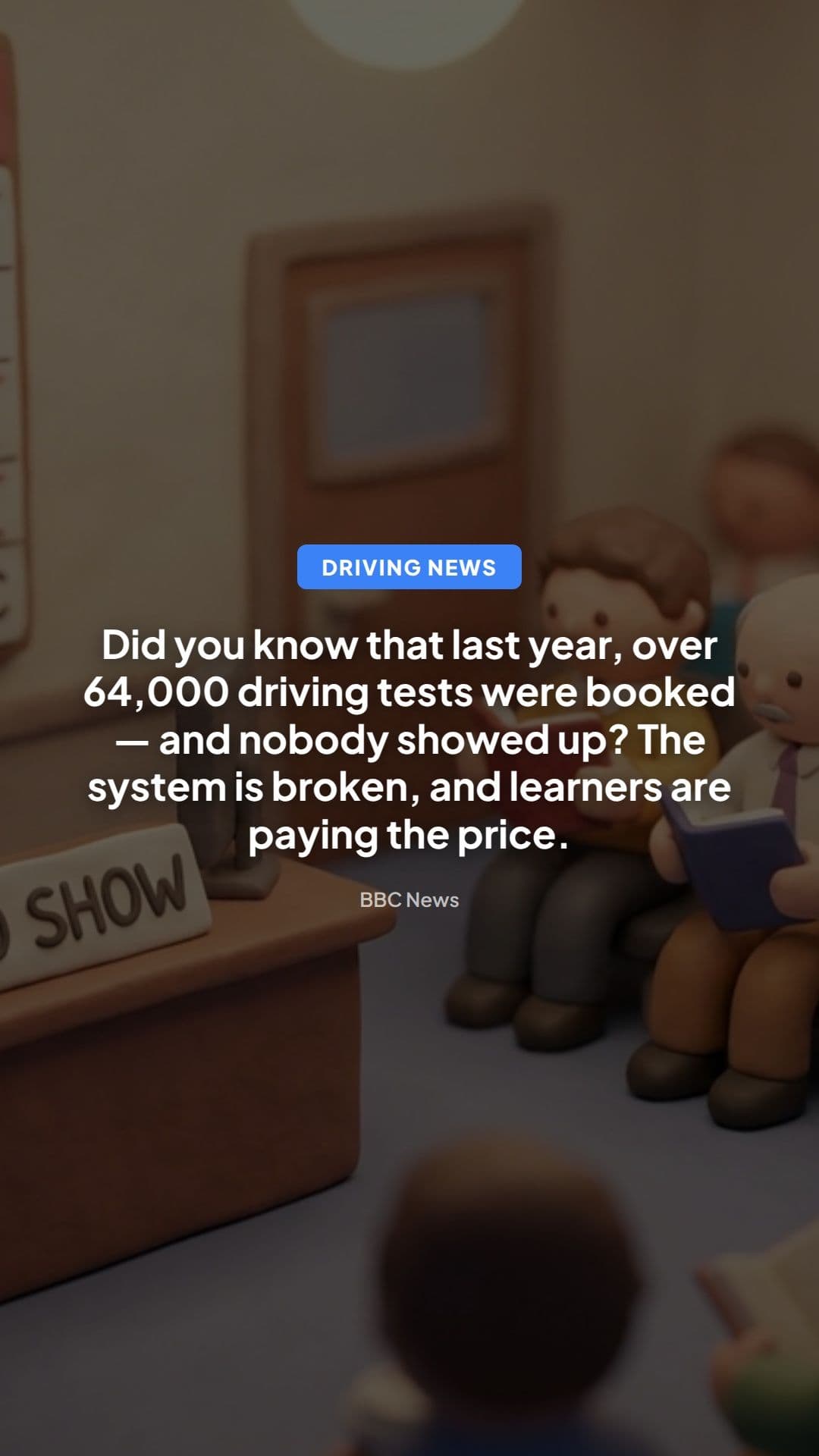
Every year, tens of thousands of driving test slots vanish into thin air. Not because the roads were icy, not because the examiner called in sick — but because candidates simply didn't show up. No call. No cancellation. Just an empty car and a wasted hour that another anxious learner could have used. Now, the Driver and Vehicle Standards Agency (DVSA) has had enough, and the rule changes it has introduced represent the most significant shake-up to the booking system in years.
But what exactly has changed, who does it affect, and what should you do if you're currently in the queue? Let's get into it.
What's Actually Changed — And Why Now?
According to reporting by the BBC, the DVSA has introduced two major changes to the way practical driving tests are booked and managed.
First, learner drivers must now book their own tests directly, rather than having their driving instructor do it on their behalf. Second, the number of times a booking can be rescheduled has been capped, preventing the repeated shuffling of test slots that had become widespread.
These measures follow a sustained period of chaos in the testing system. Waiting times for practical tests ballooned dramatically in the aftermath of the COVID-19 pandemic, when test centres were forced to close for months. Even as centres reopened, the backlog proved stubbornly difficult to clear. Candidates were waiting six months or more for a slot in some parts of the country — a situation that pushed many learners to use third-party booking services that would snap up multiple slots speculatively, then sell them on at a premium.
The no-show problem compounded everything. When candidates — or more often, instructors booking on behalf of multiple pupils — failed to cancel slots they no longer needed, those appointments were lost entirely. The DVSA has not published a precise annual figure for wasted appointments, but internal data cited in parliamentary questions has pointed to tens of thousands of lost test slots per year. In a system already stretched to breaking point, that's an enormous amount of squandered capacity.
Why This Matters Beyond the Queue
On the surface, this looks like an administrative tidying-up exercise. In reality, it touches on something much more fundamental: the economics and fairness of access to a driving licence.
Learning to drive in the UK is expensive. According to the AA's most recent estimates, the average learner spends around £1,000–£1,500 on lessons before passing, and that figure doesn't account for the test fee itself (currently £62 for a weekday test, £75 for evenings and weekends). Every month a learner spends waiting for a test slot is another month of paying for top-up lessons to stay sharp — a cost that falls disproportionately on younger and lower-income candidates who may not be able to afford to wait.
Meanwhile, the secondary market in test slots — where third-party apps and websites would buy up appointments and resell them for £30, £50, or more — created a two-tier system. Those who could afford to pay extra got faster access. Those who couldn't were stuck at the back of an already long queue. The DVSA has previously warned that using such services breaches its terms and conditions, though enforcement has been patchy at best.
By requiring candidates to book directly, the DVSA is attempting to close the loophole that allowed bulk booking in the first place. Instructors booking dozens of slots speculatively — a practice that was technically against the rules but widespread — becomes far harder when each booking must be tied to an individual candidate account.
The Legal Framework Behind the Changes
The DVSA operates under the Road Traffic Act 1988 and the Motor Vehicles (Driving Licences) Regulations 1999, which set out the framework for how driving tests must be conducted and who has authority over the booking and administration of tests. The agency has considerable discretion in setting operational rules around bookings, cancellations, and eligibility — meaning these changes don't require new primary legislation to implement.
The rescheduling cap is particularly significant from a consumer rights perspective. Under the Consumer Rights Act 2015, service providers must ensure their terms and conditions are fair and clearly communicated. Candidates who book tests and then find themselves unable to reschedule — due to illness, bereavement, or other genuine emergencies — may wonder whether the new cap could work against them unfairly.
The DVSA has not yet published exhaustive guidance on what constitutes an acceptable reason for exceeding the rescheduling limit, and this is an area worth watching. If the cap is applied rigidly without any discretionary process for exceptional circumstances, it could face challenge. Historically, courts and tribunals have taken a dim view of blanket rules that fail to account for individual hardship — particularly where a financial penalty or loss of a booking fee is involved.
It's also worth noting that driving instructors operate under their own regulatory framework, governed by the ADI (Approved Driving Instructors) Register, maintained by the DVSA. Instructors who were found to be booking tests speculatively on behalf of pupils could theoretically face regulatory consequences, including removal from the register. Whether the DVSA will pursue enforcement action against instructors who abused the old system remains to be seen.
What Drivers and Learners Should Know Right Now
If you're currently learning to drive or supporting someone who is, here's what the new rules mean in practice:
1. Book your own test — and do it early. You can no longer rely on your instructor to handle this for you. Log in to the DVSA's official booking portal at gov.uk and set up your own account. Book as soon as you feel you're approaching test-ready standard, because waiting lists in urban areas remain long.
2. Treat your test date seriously from the moment you book. With rescheduling now limited, you can't afford to book speculatively and change your mind multiple times. Discuss your readiness honestly with your instructor before committing to a date.
3. Know your rights if circumstances change. If you need to reschedule due to illness or a genuine emergency, document everything. Keep medical certificates, correspondence, or any evidence that supports your case. If you believe the rescheduling cap is being applied unfairly to your situation, you can raise a formal complaint with the DVSA and, if necessary, escalate to the Parliamentary and Health Service Ombudsman.
4. Avoid third-party booking services. These remain against DVSA terms and conditions. Using them risks losing your fee and potentially being flagged on your account. Stick to the official gov.uk portal.
5. Cancel promptly if your plans change. If you genuinely cannot make your test, cancel as soon as possible — ideally more than three clear working days in advance to retain your fee. This frees up the slot for another candidate and keeps you on the right side of the rules.
6. Check the test fee refund policy. The DVSA's current policy allows a full refund if you cancel with three clear working days' notice. Cancelling later than this means forfeiting your fee. With the new rescheduling limits in place, understanding this policy before you book is more important than ever.
Looking Ahead: Will This Actually Fix the Problem?
The honest answer is: probably yes, but only partially.
The no-show and speculative booking problem has been structural, not accidental. It emerged because demand massively outstripped supply, and people responded rationally — if sometimes unfairly — by trying to game the system. Closing the booking loopholes addresses one side of the equation, but the other side — supply — remains the deeper issue.
The DVSA has been working to increase examiner capacity, including recruiting additional examiners and extending testing hours. But examiner training takes time, test centre capacity is fixed, and the backlog built up over several years cannot be cleared overnight.
There is also the question of digital exclusion. Requiring candidates to book their own tests online assumes a level of digital literacy and internet access that not every learner — particularly older candidates or those from disadvantaged backgrounds — may have. The DVSA should ensure that telephone booking remains a viable alternative and that support is available for those who struggle with online systems.
Longer term, the driving test system may need more fundamental reform. Some commentators have suggested that modular testing — separating theory, hazard perception, and practical elements more distinctly, and allowing candidates to pass components independently — could help manage demand more flexibly. Others have pointed to the need for more test centres in urban areas where waiting lists are longest.
For now, the new rules represent a meaningful step in the right direction. Tens of thousands of wasted test slots every year is not a minor inefficiency — it's a systemic failure that costs learners money, delays them from working and living independently, and undermines public confidence in the system. The DVSA is right to act. The test of whether these measures succeed will come in the waiting list data over the next twelve to eighteen months.
In the meantime, if you're a learner driver: book early, book yourself, and treat that appointment like the valuable — and increasingly hard-won — resource that it is.
Written by
Grace O'Sullivan
Municipal Enforcement Expert
Ready to Challenge Your Ticket?
Let our AI analyse your PCN and generate a professional appeal letter in minutes.
Start Free Appeal