DVLA ‘01’ Driving Licence Code: Avoid a £1,000 Fine
Drivers who need glasses or contact lenses must follow the DVLA ‘01’ licence code. Learn when eyesight rules can lead to a £1,000 fine.

Carlos Mendoza
7 August 2026
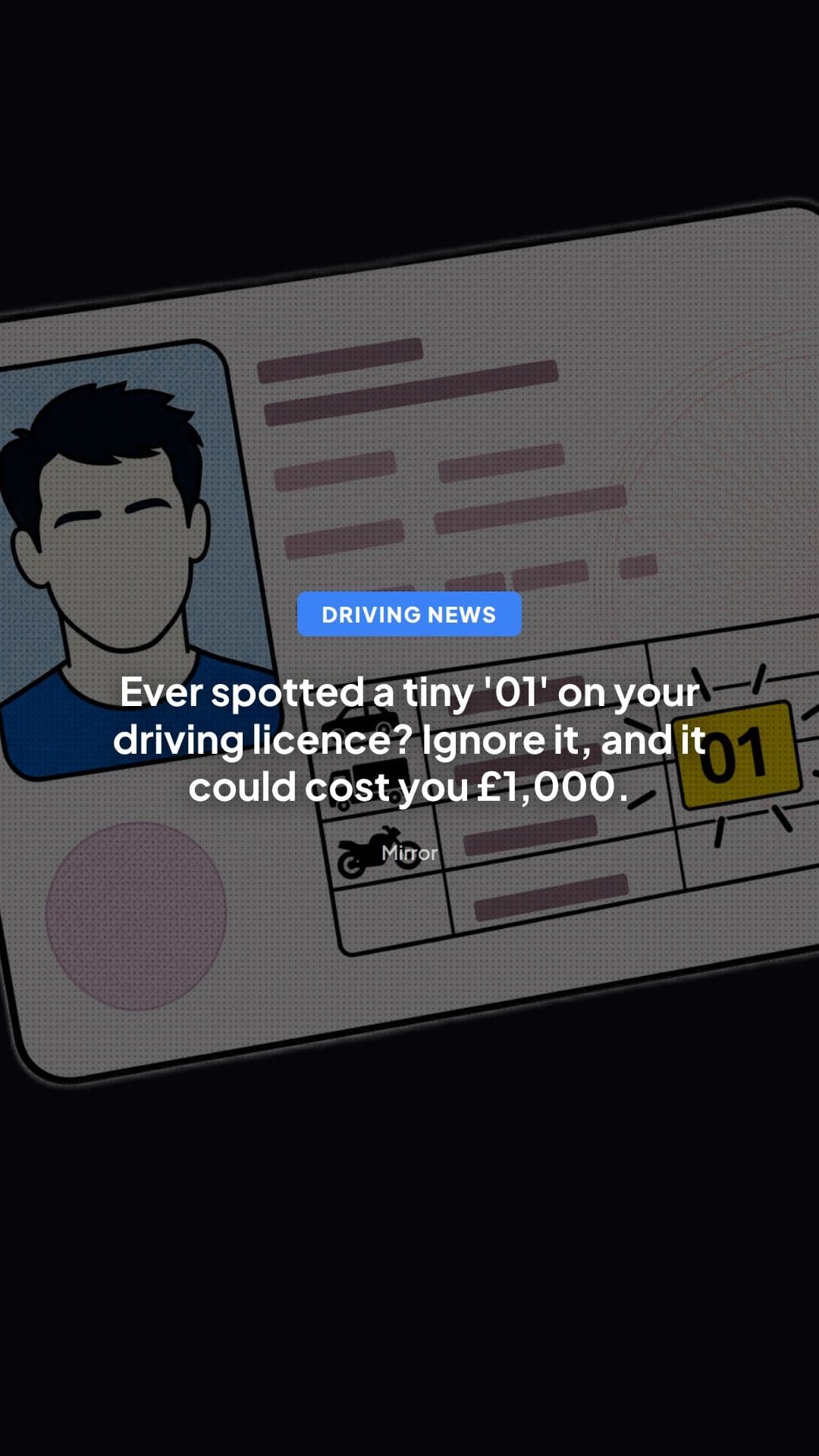
DVLA ‘01’ rule for drivers wearing glasses: when ignoring it could cost £1,000
Take a moment to check your driving licence. Turn it over, look at the back, and scan the list of codes under "restrictions". If you see the number "01" sitting there, you are legally required to wear glasses or contact lenses every single time you get behind the wheel. Skip them for a "quick trip to the shops" and you could be committing a criminal offence, one that carries a fine of up to £1,000 and could unravel your entire insurance policy if something goes wrong.
It sounds like a minor administrative detail. In practice, it is one of the most overlooked rules on the road, and one that catches out far more drivers than you might expect.
What the DVLA ‘01’ code actually means
Every UK driving licence contains a section for restriction codes, small numeric flags that tell police officers, employers and the DVLA exactly what conditions apply to your entitlement to drive. Code 01 is the eyesight correction code. It is added to your licence when you have needed glasses or contact lenses to pass your eyesight test, either during your original driving test or during a subsequent medical review.
Once that code is on your licence, wearing corrective lenses is not a suggestion, it is a legal condition of your entitlement to drive. According to the Mirror's reporting on the rule, drivers who ignore the restriction and get behind the wheel without their glasses or contact lenses risk penalties and could effectively invalidate their driving entitlement altogether.
This is not a new rule dressed up as news. It has existed for decades. What has changed is the growing awareness campaign around it, driven partly by the sheer number of drivers who either forget the code exists or assume it is a box-ticking exercise rather than a hard legal line.
Why this matters more than it seems
Millions of UK drivers rely on glasses or contact lenses. The population is ageing, eyesight naturally deteriorates over time, and conditions such as long-sightedness, astigmatism and cataracts become more common as drivers move through their 40s, 50s and beyond. Many people who passed their driving test decades ago with 20:20 vision now need correction and may not have thought to check whether their licence reflects that.
There is also a less obvious risk group: contact lens wearers who occasionally drive without lenses in, perhaps because they ran out, felt irritation, or simply forgot. If your licence carries the 01 restriction, the law does not distinguish between "I forgot my glasses" and "I chose not to wear them". Both are treated as driving in contravention of your licence conditions.
The stakes extend well beyond a roadside telling-off. Poor eyesight is a genuine road safety issue. The ability to read a number plate, judge distances, spot pedestrians and react to hazards all depend on adequate vision. A driver who cannot see clearly is a hazard not just to themselves but to everyone else on the road, which is precisely why the eyesight standard is baked into road traffic law rather than left as a matter of personal judgement.
The legal position, explained
The core legal requirement sits within the Road Traffic Act 1988. Section 96 makes it an offence to drive a motor vehicle on a road if you cannot meet the "prescribed" eyesight standard, which includes the classic number plate test: being able to read a vehicle registration plate from 20 metres away (this was previously measured as 20.5 metres under the old-style plates, and the distance is slightly shorter for the newer, narrower font).
If you need glasses or contact lenses to meet that standard, and your licence carries the 01 restriction, you must wear them whenever you drive. Failing to do so, and being caught, can lead to:
- A fixed penalty notice, or prosecution through the courts if the case is more serious
- A fine of up to £1,000
- Three penalty points on your licence
- Potentially a driving ban, particularly if the case goes to court and a magistrate takes a dim view of the risk created
Crucially, police officers have the power to request a roadside eyesight test if they have any reason to suspect a driver's vision is inadequate, for example after a near-miss, a minor collision, or simply an officer's observation that a driver is struggling to read signage. Refusing or failing that test can lead to your licence being revoked on the spot in some circumstances, pending further medical assessment by the DVLA.
There is a wider medical disclosure angle too. Certain eyesight conditions, such as significant visual field defects, double vision, or progressive eye diseases, are legally "notifiable" conditions that must be reported to the DVLA regardless of whether you already wear corrective lenses. Failing to notify the DVLA of a relevant medical condition is itself a separate offence, and can also result in a fine of up to £1,000. This sits alongside other DVLA enforcement powers that have been in the news recently, including the agency's ability to cancel licences en masse where records are incomplete or medical information has not been updated.
The insurance trap most drivers do not consider
Here is where the consequences can escalate quickly. Motor insurance policies require you to hold a valid driving licence and to drive in accordance with its conditions. If you are involved in an accident while driving without your required glasses or contact lenses, and it emerges that you were in breach of the 01 restriction, your insurer may argue that you were not driving in accordance with your licence at the time of the incident.
That opens the door to a declined claim, or in more serious cases, a charge of driving without insurance, since a policy obtained on the basis of a valid licence can be treated as void if the licence conditions were being broken at the material time. This is a similar principle to other licence and documentation issues that have tripped up UK drivers, where a seemingly small administrative detail on a licence or policy ends up having major financial consequences after a crash.
In other words, this is not simply a "you might get a ticket" issue. It is a "you might find yourself personally liable for a serious accident" issue.
What drivers should actually do
The good news is that compliance is genuinely simple. A few practical habits will keep you on the right side of the law:
- Check your licence now. Look for the 01 code on the back of your photocard licence. If it is there, treat wearing your glasses or contacts as non-negotiable, in the same category as wearing a seatbelt.
- Keep a spare pair in the car. Glasses get lost, sat on, or left at home. A spare pair in the glovebox removes the temptation to "just drive carefully" without them.
- Get regular eye tests. Opticians generally recommend a test every two years, though this should be more frequent if you have a diagnosed condition or if your optician advises it. If your prescription has changed significantly, your existing glasses may no longer be adequate even if you are technically wearing them.
- Know the number plate test. If you are ever unsure whether your eyesight meets the legal standard, try reading a parked car's number plate from 20 metres in good daylight. If you cannot do it reliably, that is a strong signal you should not be driving until you have had your eyes checked.
- Tell the DVLA about notifiable conditions. If you have been diagnosed with an eye condition that affects your visual field, night vision, or overall acuity, check the DVLA's official guidance on notifiable medical conditions and update your records promptly rather than waiting for a problem to arise.
- Be honest with your optician. If you drive for a living or cover high annual mileage, mention this during your eye test so your optician can flag any concerns relevant to driving standards specifically, which are stricter for vocational Group 2 licence holders such as HGV and bus drivers.
Looking ahead
Eyesight compliance is likely to stay firmly on the radar as enforcement technology across UK roads becomes more sophisticated. Number plate recognition cameras, AI-assisted policing tools and tighter DVLA data-matching are already reshaping how driving offences are detected in other areas, and it would not be surprising to see growing calls for mandatory eyesight checks at licence renewal, particularly for older drivers, echoing debates that have already surfaced around broader driving licence reforms.
For now, though, the rule remains straightforward and entirely within every driver's control. If your licence has the 01 code, wearing your glasses or contact lenses is not optional. It is the difference between a lawful journey and a potential £1,000 fine, penalty points, and an insurance headache that could follow you for years. If you are ever in doubt about your entitlement to drive or how a medical condition might affect your licence, the DVLA's official guidance and your GP or optician are the right places to seek clarity, rather than risking it on the road.
Written by
Carlos Mendoza
Parking Technology Analyst
Ready to Challenge Your Ticket?
Let our AI analyse your PCN and generate a professional appeal letter in minutes.
Start Free Appeal