Driverless cars in London by 2026: what drivers need to know
BBC tests suggest robo-taxis could reach London by end of 2026. What it means for UK motorists, liability, insurance, parking rules and enforcement.

Lisa Rodriguez
5 July 2026
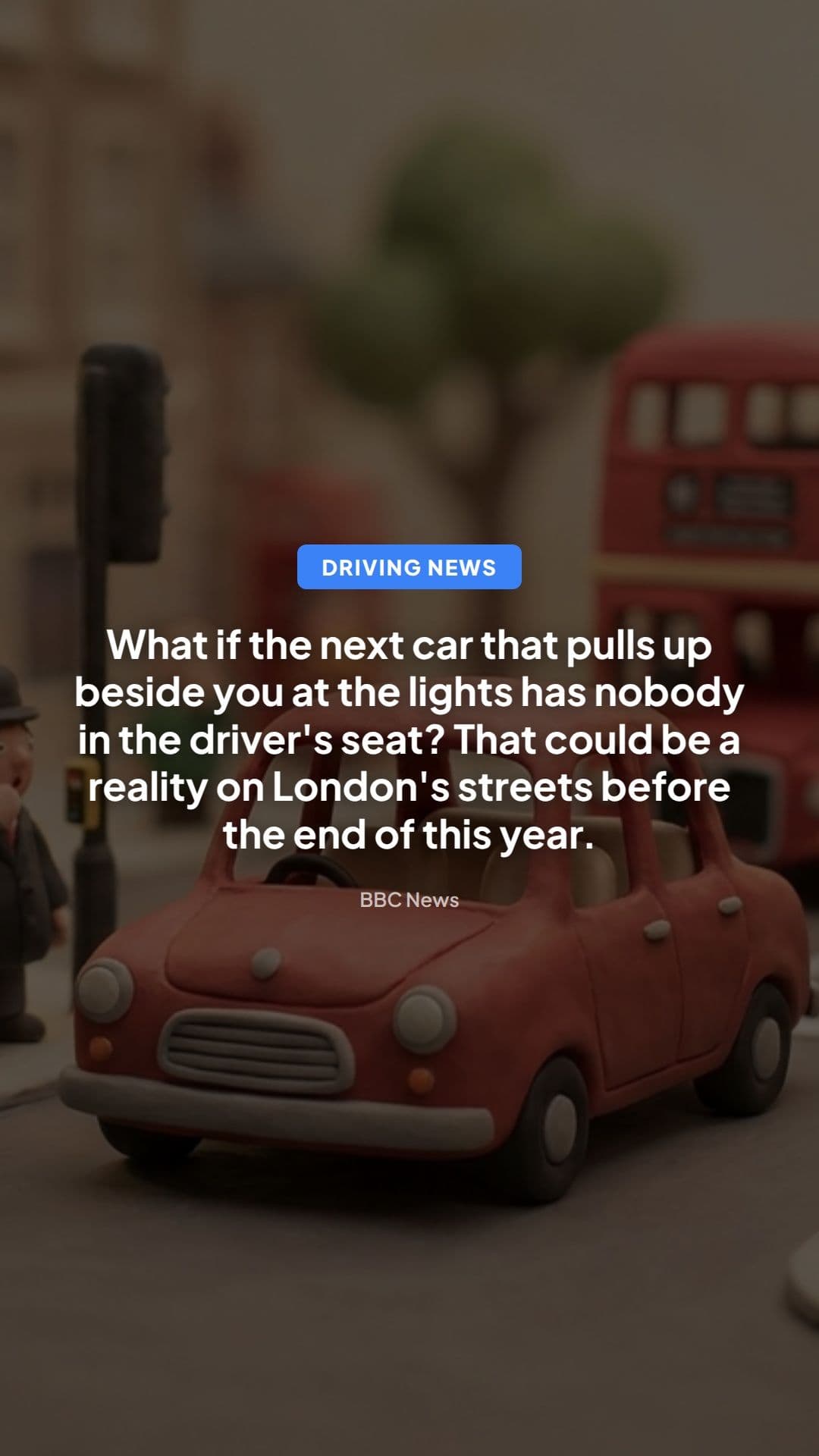
Driverless Cars Are Coming to London — But Are We Ready for Them?
Imagine hailing a taxi on a rain-soaked London street, climbing in, and realising there's no one behind the wheel. No driver to make small talk with, no one to blame for taking the long route, no human being in control at all. According to a striking new BBC report, that scenario could become reality on London's streets before the end of 2026. It sounds like science fiction. It very nearly isn't.
What the BBC Report Actually Found
The BBC's recent test and investigation into autonomous vehicle technology revealed something genuinely remarkable: technology firms are not merely experimenting with self-driving cars in controlled environments — they are actively preparing to deploy commercial robo-taxi services in London within the next 12 to 18 months.
During trials, AI-based systems demonstrated an ability to handle some of the most complex urban driving scenarios imaginable: busy junctions, unpredictable cyclists, pedestrians stepping out unexpectedly, and the kind of chaotic, multi-lane roundabouts that confuse even experienced human drivers. The vehicles used sophisticated sensor arrays — combining LiDAR, radar, and high-resolution cameras — to build real-time maps of their surroundings and make split-second decisions.
The companies involved are not small start-ups operating on shoestring budgets. Several are backed by significant investment from major automotive and technology groups, and at least one has already been running commercial robo-taxi operations in cities in the United States and Asia. London, with its dense population, complex road network, and status as a global technology hub, is seen as the ultimate proving ground.
The BBC's journalists rode in these vehicles through central London streets and reported that the experience was, in their words, surprisingly smooth — though the technology still occasionally required human safety operators to intervene in particularly unusual situations.
Why This Matters More Than You Might Think
This is not the first time we have heard promises about autonomous vehicles arriving imminently. The industry has been making bold predictions for well over a decade, and those predictions have consistently slipped. So why should we pay attention now?
The honest answer is that the technology has genuinely matured at a pace that would have seemed implausible even five years ago. The AI systems powering modern autonomous vehicles are fundamentally different from earlier generations. They learn continuously from millions of miles of real-world driving data, improving their ability to predict human behaviour — the single hardest problem in autonomous driving — with every journey completed.
More importantly, the commercial pressure to deploy is now enormous. Investors have poured billions into this sector and expect returns. The window for being the first company to crack the London market is seen as strategically critical. That commercial urgency is doing what years of technical optimism alone could not: forcing real-world deployment rather than endless trials.
For ordinary UK drivers, the implications are wide-ranging. If robo-taxis become a viable alternative to private car ownership in urban areas, it could reshape everything from car insurance markets to the demand for city-centre parking spaces. Some analysts predict that widespread autonomous vehicle adoption could reduce the number of privately owned cars in London by as much as 30% within a generation.
The Legal Angle: Where UK Law Currently Stands
Here is where things get genuinely complicated — and where the gap between technological capability and legal readiness becomes most apparent.
The Automated Vehicles Act 2024 is the cornerstone of the UK's legal framework for self-driving technology. Passed after years of consultation, it establishes a formal authorisation regime for autonomous vehicles and, crucially, shifts legal liability away from the human occupant when an authorised self-driving system is in control. This is a profound legal shift. Under traditional road traffic law, a driver is responsible for the actions of their vehicle. The 2024 Act creates a new category — the Authorised Self-Driving Entity (ASDE) — which bears responsibility when things go wrong in autonomous mode.
However, the Act's practical implementation is still being worked through. The Centre for Connected and Autonomous Vehicles (CCAV), a joint unit of the Department for Transport and the Department for Business and Trade, is developing the detailed technical and safety standards that vehicles must meet before they can be authorised. As of mid-2025, those standards are not yet fully finalised.
What this means in practice is that any company wishing to deploy commercial robo-taxis in London by the end of 2026 will need to navigate a regulatory approval process that is, by any honest assessment, still being built as the vehicles approach the starting line.
There are also significant questions around data protection and privacy. Autonomous vehicles generate extraordinary amounts of data about the environments they operate in — including detailed images of public streets, pedestrians, and other road users. The UK General Data Protection Regulation (UK GDPR) applies to this data, and the Information Commissioner's Office has yet to publish comprehensive guidance specifically addressing autonomous vehicle data collection at commercial scale.
Insurance presents another layer of complexity. The Automated and Electric Vehicles Act 2018 already requires that insurers cover autonomous vehicles during periods of self-driving, with the insurer then able to seek recovery from the manufacturer or software provider where appropriate. But the practical claims handling processes for incidents involving fully driverless commercial vehicles — with no human driver to interview or assess — remain largely untested in UK courts.
What Drivers Should Know Right Now
Even if you never intend to use a robo-taxi, the arrival of autonomous vehicles on UK roads will affect you in practical ways. Here is what you need to be aware of:
- Sharing the road with autonomous vehicles requires different instincts. These systems are programmed to be extremely cautious and rule-compliant. In practice, this means they will stop for pedestrians earlier than most human drivers, leave larger gaps at junctions, and may hesitate in ambiguous situations. Tailgating or cutting in front of them aggressively could cause unexpected braking events.
- Incident reporting will work differently. If you are involved in a collision with a driverless vehicle, there will be no driver to exchange details with in the traditional sense. You should note the vehicle's registration, the name of the operating company (which will be displayed on the vehicle), and contact the police if there is any injury or significant damage. Your insurer will need to pursue the ASDE rather than an individual driver.
- Your own insurance policy may need reviewing. Some motor insurance policies contain clauses that were written with the assumption that all other vehicles on the road are human-driven. As autonomous vehicles become more common, it is worth checking with your insurer how your policy handles incidents involving driverless vehicles.
- Expect temporary road disruptions during expanded trials. As companies test their systems across wider areas of London, you may encounter vehicles moving unusually slowly, stopping unexpectedly, or taking unconventional routes. These are features of trial operations rather than faults.
- Be aware of new road markings and infrastructure. Some boroughs are already discussing dedicated lanes or priority routes for autonomous vehicles. These could carry new restriction codes and enforcement implications for conventional drivers who stray into them.
Looking Ahead: The Road to 2026 and Beyond
The honest assessment is that deploying commercial robo-taxis in London by the end of 2026 is ambitious — possibly very ambitious. The regulatory framework is not yet complete, public trust remains fragile, and London's roads present challenges that even the most sophisticated AI systems have not fully conquered. The city's complex mix of Victorian street layouts, temporary traffic management schemes, unmarked junctions, and deeply unpredictable human behaviour makes it genuinely one of the hardest operating environments on the planet.
But the direction of travel is unmistakable. The Automated Vehicles Act 2024 demonstrates that the UK government is committed to being a global leader in this technology, and the commercial momentum behind deployment is stronger than it has ever been. Whether the first commercial robo-taxi appears in London in late 2026, 2027, or 2028, it is coming.
For UK drivers, the most important thing is to engage with this transition rather than ignore it. The legal landscape is shifting, the roads are changing, and the assumptions we have held about driving — about who is responsible, who is in control, and what it means to share the road — are being fundamentally rewritten.
The driverless revolution will not arrive all at once. But it is arriving. And the more informed drivers are about what that means legally, practically, and financially, the better placed they will be to navigate whatever comes next.
Source: BBC News — "Driverless cars could be heading to London by the end of 2026"
Written by
Lisa Rodriguez
Automotive Journalist
Ready to Challenge Your Ticket?
Let our AI analyse your PCN and generate a professional appeal letter in minutes.
Start Free Appeal