Dover delays: EU border checks paused amid heat chaos
Extra EU border checks were suspended at Dover after 2+ hour ferry queues in hot weather. What it means for UK drivers crossing Channel this bank holiday.

Sophie Dubois
24 May 2026
Dover's EU Border Check Suspension: What Really Happened — and What Every Cross-Channel Driver Must Know
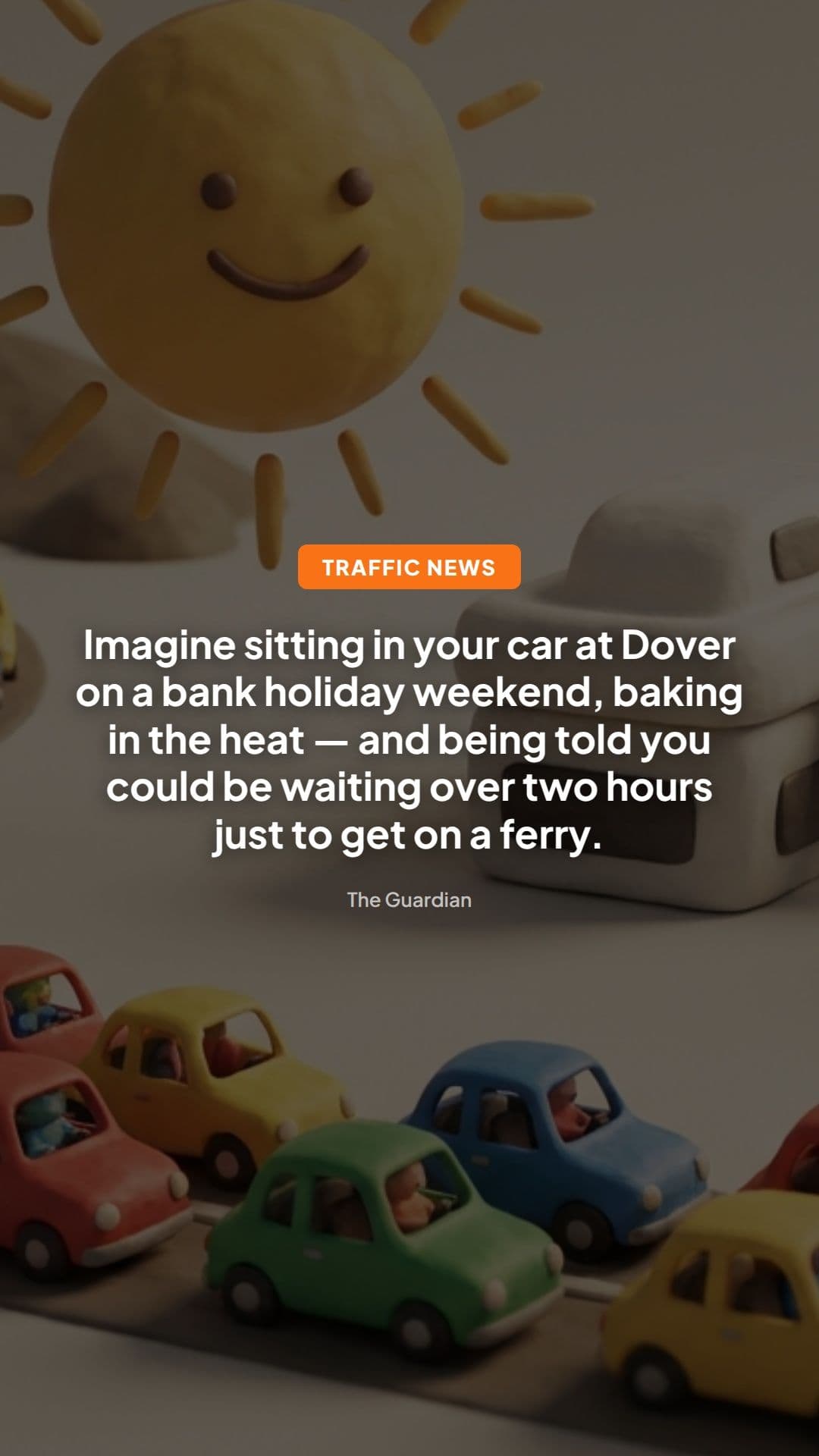
Picture this: you've packed the car, loaded up the kids, and set off for a European summer holiday. You've planned the route, booked the ferry, and even allowed an extra hour for good measure. But as you join the queue at Dover, the minutes tick by — then the hours. Outside, the temperature is climbing past 30°C. Inside the car, tempers are rising faster than the mercury. This is exactly what thousands of drivers experienced over the recent bank holiday period, when a combination of new EU border checks, sweltering heat, and sheer volume of traffic created a perfect storm at the UK's busiest cross-Channel ferry terminal.
What Happened at Dover
According to reporting by The Guardian, extra EU border checks at Dover were temporarily suspended after queues stretched beyond two hours at the ferry terminal during a period of unusually hot weather. The disruption hit during one of the busiest travel periods of the year, with families and holidaymakers making the most of the bank holiday to head to France and beyond.
The checks in question are part of the rollout of the Entry/Exit System (EES) — the EU's new automated border control mechanism that requires non-EU nationals, including British passport holders post-Brexit, to have their fingerprints and photographs registered when entering and exiting the Schengen Area. The system was designed to replace the manual stamping of passports and to create a digital record of every traveller's movements across EU external borders.
The suspension wasn't a policy reversal — it was a pragmatic, temporary measure by French border authorities (who operate passport control on the UK side of the Channel under the Le Touquet Treaty) to prevent the situation from deteriorating further. Once queues eased, checks resumed. But the episode exposed just how fragile the system remains when volume and conditions conspire against it.
Why It Matters: The Bigger Picture Behind the Queues
This incident is far more than a one-off bank holiday inconvenience. It sits at the intersection of several significant, long-running issues that every British driver planning a trip to Europe needs to understand.
Brexit and the End of Free Movement
Before the UK left the EU, British citizens crossed into Schengen countries with little more than a cursory glance at their passport. Free movement meant minimal border friction. Since Brexit, UK nationals are treated as third-country nationals — the same category as Americans, Australians, or Canadians — and are subject to the same entry checks. That means passport validity rules (your passport must be less than 10 years old and have at least three months' validity beyond your planned departure date), and now, the biometric registration requirements of EES.
The EES: Long-Delayed, Now Arriving in Phases
The EES has had one of the most protracted rollouts in recent EU border history. Originally planned for 2022, it was delayed repeatedly due to concerns about infrastructure readiness, particularly at high-volume crossings like Dover and Calais. The system finally began phased implementation in 2024, with full deployment continuing into 2025 and 2026.
The core problem at Dover is physical throughput. The terminal was not designed with biometric registration booths in mind. Each traveller — every adult in every car — must present themselves for fingerprinting and facial scanning. For a family of four, that's four individual registrations. Multiply that across thousands of vehicles on a hot bank holiday, and the arithmetic of delay becomes painfully obvious.
The Le Touquet Treaty: Why French Officers Are in Kent
One detail that confuses many British drivers is why French border police are operating on British soil. The answer lies in the Le Touquet Treaty of 2003, a bilateral agreement between the UK and France that allows each country to conduct juxtaposed border controls on the other's territory. In practice, this means French officers check passports and conduct EES registrations at Dover (and Folkestone for Eurostar), while UK Border Force operates at Calais and Coquelles. This arrangement has been both a practical success and a political flashpoint since Brexit, but it remains in force and underpins the entire cross-Channel border operation.
The Legal Angle: What Rights Do Drivers Actually Have?
No Legal Entitlement to a Specific Crossing Time
It's worth being clear: there is no legal right to cross the border within a given timeframe. Border checks — whether conducted by UK Border Force or French authorities under the Le Touquet Treaty — are lawful exercises of sovereign border control powers. Delays, however frustrating, do not give rise to compensation claims against the government or ferry operators in most circumstances.
Ferry Operator Obligations
Your contract is with the ferry operator — P&O Ferries, DFDS, or Brittany Ferries, depending on your booking. Under the EU Passenger Rights Regulation (EU) No 1177/2010, which the UK retained in domestic law via the European Union (Withdrawal) Act 2018 (now consolidated under UK law), passengers on sea voyages are entitled to compensation if a ferry is delayed by more than 90 minutes at departure, provided the delay is the operator's fault.
However — and this is crucial — if the delay is caused by border checks rather than the operator's own operations, the operator is unlikely to be liable. Most ferry terms and conditions explicitly exclude delays caused by border control authorities. Always read the small print before assuming you can claim.
Health and Safety Considerations in Extreme Heat
The suspension of EES checks in this instance appears to have been driven, at least in part, by welfare concerns for travellers sitting in stationary vehicles in extreme heat. Whilst there is no specific UK statute requiring border authorities to suspend checks in hot weather, the Health and Safety at Work etc. Act 1974 and associated regulations impose general duties of care, and the Human Rights Act 1998 (incorporating Article 3 of the European Convention on Human Rights, which prohibits inhuman or degrading treatment) provides a theoretical backstop — though courts set a very high threshold for what constitutes a violation.
In practical terms, the suspension was a sensible operational decision rather than a legally mandated one.
What Drivers Should Know: Practical Advice for Cross-Channel Travel
If you're planning a drive-on ferry crossing to France or Belgium in 2026 or beyond, here's what you genuinely need to prepare for:
- Allow significantly more time than pre-Brexit. Two to three hours' buffer before your ferry departure is no longer excessive — it's prudent. During peak periods (bank holidays, school holidays, August), consider even longer.
- Check your passport meticulously. It must be issued less than 10 years before your travel date and valid for at least three months after your planned return. These are two separate checks — a passport can fail one while passing the other.
- EES registration is mandatory for all adults. Every non-EU national aged 12 and over must complete biometric registration on their first Schengen entry. This takes time. Plan for it, don't be surprised by it.
- Travel with water and sun protection. This sounds obvious, but thousands of drivers were caught in stationary queues in 30°C+ heat without adequate supplies. Keep a cool bag with drinks accessible from inside the car.
- Book morning sailings where possible. Early crossings tend to process more smoothly before the day's peak volume builds. Afternoon and early evening slots on bank holiday Fridays are historically the worst.
- Check real-time updates before you leave. Both the Port of Dover and ferry operators publish live disruption information. The RAC Traffic News service and Traffic England (via Highways England) also provide M20 and A2 corridor updates relevant to the Dover approach.
- Know your ferry rebooking rights. If you miss your sailing due to border delays, contact your operator immediately. Many will rebook you on the next available sailing at no extra charge if the delay was outside your control, though this is a commercial gesture rather than a legal right in most cases.
Looking Ahead: Will It Get Worse Before It Gets Better?
Bluntly: quite possibly, yes — at least in the short to medium term.
The EES is still bedding in. Dover's infrastructure was not built for biometric processing at scale, and while both the UK and French governments have invested in additional kiosks and processing lanes, the pace of improvement has lagged behind the pace of passenger volume growth. Summer 2026 is expected to see record cross-Channel traffic as pent-up demand for European holidays continues.
There are longer-term solutions being discussed. Pre-registration portals — allowing travellers to submit biometric data before they arrive at the port — have been proposed and are in development. If implemented effectively, these could dramatically reduce border processing times. But implementation timelines remain uncertain.
The UK government has been in ongoing dialogue with French authorities about throughput capacity, and there is political pressure on both sides to prevent a repeat of the scenes witnessed this bank holiday. Whether that pressure translates into meaningful infrastructure investment before the summer peak remains to be seen.
For British drivers, the message is uncomfortable but clear: the frictionless cross-Channel motoring of the pre-Brexit era is gone. What replaces it is a more bureaucratic, more time-consuming process that demands more preparation, more patience, and considerably more water in the boot. Plan accordingly — and hope the weather cools down.
Based on reporting by The Guardian. Additional analysis and legal commentary is original to this publication.
Written by
Sophie Dubois
Traffic Law Specialist
Ready to Challenge Your Ticket?
Let our AI analyse your PCN and generate a professional appeal letter in minutes.
Start Free Appeal