Diesel hits 160.3p: UK fuel prices surge—what next?
Diesel has climbed to 160.3p per litre in mid-March 2026. See what’s driving the rise, how petrol compares, and what UK drivers can do to cut costs.

Raj Patel
24 March 2026
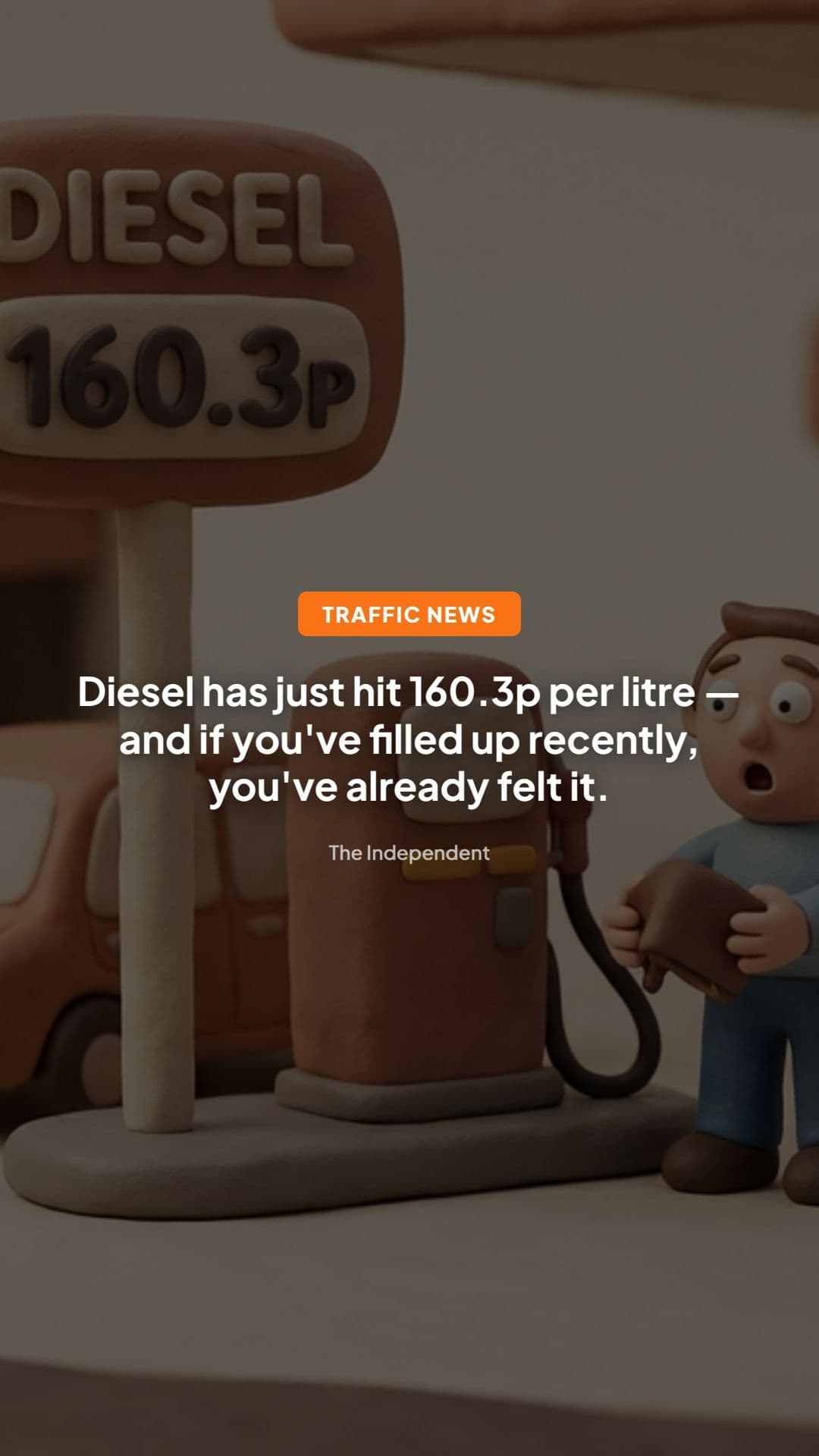
Why Diesel Hitting 160.3p Per Litre Should Make Every UK Driver Stop and Think
There's a particular kind of dread that settles in when you pull up to a fuel pump, squint at the price board, and feel your stomach drop. For millions of diesel drivers across the UK, that feeling returned with a vengeance in mid-March 2026, as average prices surged to 160.3p per litre — a figure that represents not just a painful hit to household budgets, but a symptom of far deeper structural problems in how British drivers are taxed, supplied, and ultimately squeezed at the forecourt.
This isn't simply a story about oil markets doing what oil markets do. It's about policy, transparency, consumer rights, and the very real decisions that ordinary people — commuters, tradespeople, rural families — are being forced to make every time they need to fill up.
What's Actually Happening at the Pumps?
According to data cited by The Independent, drawing on RAC fuel monitoring figures, diesel prices climbed to an average of 160.3p per litre in mid-March 2026. That represents a sharp increase since late February — a rise that has caught many drivers off guard after a period of relative stability.
To put that in context: filling a typical 60-litre diesel tank now costs around £96, compared with roughly £88 just weeks ago. For someone filling up twice a month — a modest assumption for a regular commuter — that's an additional £16 per month, or nearly £200 per year that simply wasn't in the budget.
The RAC, which tracks pump prices daily across thousands of forecourts, attributes the spike largely to movements in wholesale oil markets, which themselves reflect a complex cocktail of geopolitical tensions, OPEC+ production decisions, and shifting demand patterns globally. Importantly, prices remain below the catastrophic 2022 peak — when diesel briefly touched nearly 200p per litre in the wake of Russia's invasion of Ukraine — but the month-on-month trajectory is pointing sharply upward, and analysts are watching closely.
Why This Matters More Than the Numbers Suggest
Here's the thing that often gets lost in the breathless coverage of fuel price spikes: the pump price you see is not primarily determined by the cost of oil. In fact, for most of what you pay at the forecourt, you're not paying for diesel at all — you're paying tax.
Let's break it down. As of early 2026, fuel duty stands at 52.95p per litre — a rate that has been frozen since March 2022, when the government introduced a temporary 5p cut that has since been repeatedly extended. On top of that, VAT at 20% is applied to the entire pump price, including the duty itself. That means roughly 65-70p in every litre you buy goes directly to the Treasury, regardless of what's happening in the oil markets.
This matters because it fundamentally changes the nature of the conversation. When wholesale prices rise, drivers feel it immediately and fully. When they fall, the relief is muted — partly because retailers are slow to pass on savings, and partly because the fixed tax component means the floor price never drops as far as consumers might expect.
The Competition and Markets Authority (CMA) has previously examined this asymmetry and found that UK fuel retailers have historically been quicker to raise prices when wholesale costs increase than to reduce them when costs fall. This "rockets and feathers" pricing behaviour — prices shoot up like a rocket but fall like a feather — is a well-documented phenomenon in the UK fuel market, and it costs drivers hundreds of millions of pounds collectively every year.
The Legal and Regulatory Landscape
You might be wondering: is there anything actually illegal about the way fuel is priced in the UK? The honest answer is nuanced.
Under the Competition Act 1998, coordinated pricing between competitors — where retailers effectively agree, formally or informally, to keep prices artificially high — would constitute anti-competitive behaviour and could attract significant fines from the CMA. However, proving such coordination is notoriously difficult, and parallel pricing (where companies independently arrive at similar prices by watching each other) is not, in itself, unlawful.
The Fuel Retailers Association and consumer groups have long called for greater price transparency obligations. Currently, there is no legal requirement for fuel retailers to publish their prices in a standardised, publicly accessible format — though the CMA's ongoing scrutiny of the sector has pushed for voluntary commitments in this direction.
It's also worth noting that Trading Standards has powers under the Weights and Measures Act 1985 to ensure that the quantity of fuel dispensed at a pump matches what you're charged for. If you ever suspect a pump is short-measuring — and it does happen — you have a right to report this to your local Trading Standards office, and the retailer can face prosecution.
For company car and fleet drivers, there are additional considerations. HMRC's Advisory Fuel Rates (AFRs), updated quarterly, determine the approved mileage rates for diesel vehicles used for business purposes. With pump prices rising, the AFR for diesel may not keep pace in real time, meaning employees who use their own diesel vehicles for work could find themselves temporarily out of pocket between rate reviews. It's worth checking the current AFR and, if necessary, raising the issue with your employer or fleet manager.
What Drivers Should Know Right Now
The frustration of rising fuel prices is entirely legitimate — but there are concrete steps drivers can take to reduce their exposure and ensure they're not paying more than they need to.
Use price comparison tools actively. The PetrolPrices.com website and app aggregates crowdsourced and retailer-reported prices across the UK, allowing you to identify the cheapest forecourt within a reasonable radius. In some areas, the difference between the most and least expensive forecourt can be 10p per litre or more — a saving of £6 on a 60-litre fill.
Time your fill-ups strategically. Wholesale price movements typically take one to two weeks to filter through to the pump. If prices are rising, filling up sooner rather than later — before the next wave hits — can save money. Conversely, if wholesale prices drop, waiting a week or two before filling up may be worthwhile.
Consider supermarket forecourts. Tesco, Sainsbury's, Asda, and Morrisons consistently undercut the major branded forecourts by several pence per litre. If you're already shopping there, combining a fuel stop with your weekly shop is a straightforward saving.
Check your tyre pressures. Under-inflated tyres increase rolling resistance and can reduce fuel economy by up to 3%. At current prices, that's a meaningful cost. The Highway Code (Rule 227) reminds drivers to ensure their vehicle is in a roadworthy condition, which includes correct tyre inflation — so there's a legal dimension here too, not just an economic one.
For diesel drivers specifically: modern diesel engines benefit from regular motorway runs to burn off particulate filter deposits. Short urban journeys cause diesel particulate filters (DPFs) to clog, reducing efficiency and potentially leading to costly repairs. If you predominantly drive short distances, it's worth considering whether diesel remains the right fuel type for your usage pattern.
Looking Ahead: Is Relief on the Horizon?
The honest answer is: not immediately, and possibly not for some time.
Global oil markets remain volatile, and the factors driving the current price spike — OPEC+ production discipline, geopolitical uncertainty, and recovering post-pandemic demand in Asia — show no clear signs of reversing in the short term. The UK's own energy policy, still navigating the transition away from fossil fuels, offers little in the way of immediate consumer relief.
The government faces a genuine dilemma. Fuel duty is a significant revenue stream — it raises approximately £25 billion per year for the Treasury. Any meaningful cut would need to be offset elsewhere, and with public finances under sustained pressure, the political will to act decisively has been conspicuously absent.
What could change the picture is sustained CMA pressure on forecourt pricing transparency. If retailers are compelled to publish prices in real time and in a standardised format, the resulting competition could — at least at the margins — narrow the gap between wholesale and pump prices. The CMA has signalled its willingness to pursue this agenda, and the fuel sector should expect continued scrutiny.
For now, though, the burden falls disproportionately on those who have the least choice: rural drivers with no realistic alternative to the car, tradespeople whose livelihoods depend on diesel vans, and lower-income households for whom fuel costs represent a significant share of disposable income. These are not abstract statistics — they are real people absorbing real costs, with limited options and limited relief in sight.
The 160.3p figure on that forecourt price board is more than a number. It's a reflection of tax policy, market structure, geopolitical risk, and regulatory inertia — all landing, as they so often do, squarely on the driver's wallet.
Written by
Raj Patel
Transport Policy Analyst
Ready to Challenge Your Ticket?
Let our AI analyse your PCN and generate a professional appeal letter in minutes.
Start Free Appeal