
Cuban Embassy Car's £52k London Congestion Charge Bill
A Cuban embassy vehicle ran up over £52,000 in London congestion charge and ULEZ penalties. See how unpaid road-charge fines can escalate quickly in London.

The Parking Ticket Pal Editorial Team
26 September 2026
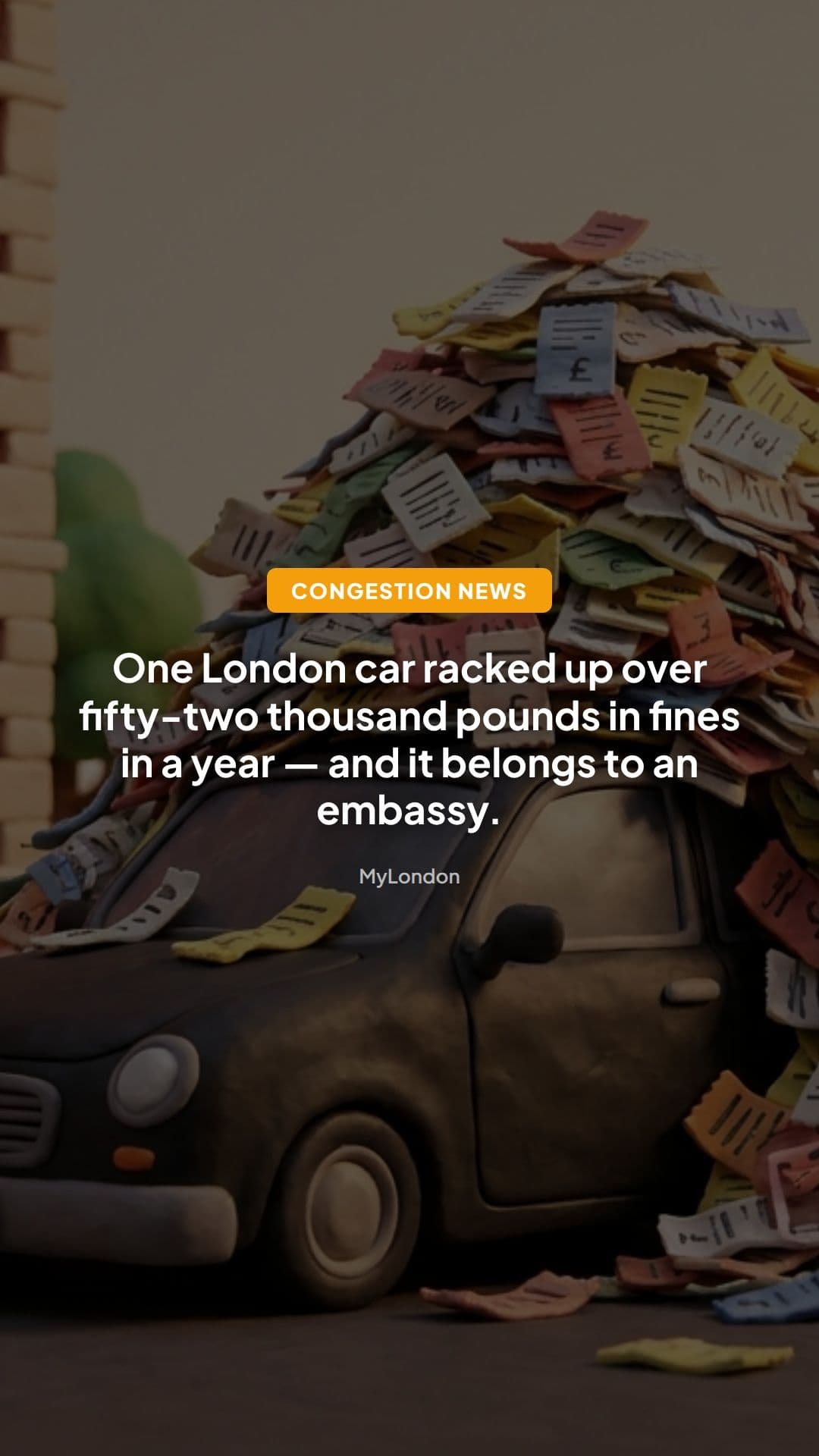
Cuban Embassy Car's £52,000 Fine Bill: How London's Congestion Charges Spiral Out of Control
A Bill Most Drivers Could Never Imagine
Picture a single car, on a single set of number plates, quietly clocking up more than £52,000 in penalty charges over the course of a year. No court summons landing on the doormat, no bailiff at the door, no clamp on the wheel. Just a growing tab that, for most of us, would trigger a very different chain of events involving debt collectors, county court judgments and possibly the loss of the vehicle itself.
That is precisely what happened with a car registered to the Cuban embassy in London, according to reporting by MyLondon. The vehicle is said to have amassed a record-breaking sum in unpaid congestion charge and Ultra Low Emission Zone (ULEZ) penalties within a single year, a figure so large it puts into sharp focus a problem that Transport for London (TfL) has wrestled with for two decades: what happens when the people driving through London's charging zones simply refuse to pay, and the usual enforcement tools do not apply?
What Actually Happened
According to the report, the embassy vehicle repeatedly entered London's congestion charging zone and the ULEZ without paying either charge, and without settling the resulting Penalty Charge Notices (PCNs) that TfL issued as a consequence. Because each unpaid daily charge generates its own separate penalty, and because those penalties can escalate if left unpaid, the numbers compounded quickly. Over twelve months, the combined total reportedly topped £52,000, described as a record for a single vehicle linked to a diplomatic mission.
This is not an isolated quirk. Cuba is far from the only country whose diplomatic vehicles have racked up unpaid congestion charge debt in London. The US embassy has for years been the most prominent example, with historic debts running into the millions of pounds. Other missions have also featured on TfL's radar over the years. What makes the Cuban case notable is the sheer speed and scale of the accumulation attributed to just one car.
Why This Story Matters Beyond One Embassy Car
It is tempting to read this as a quirky one-off, but it exposes something much bigger: a genuine gap between the rules that apply to ordinary London drivers and the rules that, in practice, apply to accredited diplomats.
For a typical motorist, missing a congestion charge payment triggers a PCN. Ignore that, and the debt can be registered with the court, escalated to bailiffs, and ultimately enforced through clamping, seizure of the vehicle, or a county court judgment that can affect credit records. TfL has robust machinery for chasing down ordinary drivers who dodge the charge, and it uses that machinery routinely.
Diplomatic vehicles sit outside almost all of that enforcement chain. Vehicles bearing diplomatic plates are effectively immune from clamping, seizure and most forms of civil enforcement in the UK, a direct consequence of long-standing international law designed to protect diplomats from harassment or coercion by the host state. TfL can still issue the PCNs, and it does, but actually collecting the money relies almost entirely on the goodwill of the mission in question, or on diplomatic pressure exerted through the Foreign, Commonwealth and Development Office (FCDO).
That creates an obvious asymmetry. London taxpayers fund the roads, the cameras and the enforcement infrastructure behind the congestion charge and ULEZ. Ordinary residents and businesses pay up, often reluctantly, because the consequences of not doing so are serious. Meanwhile, a small number of diplomatic vehicles can drive through the same cameras, generate the same charges, and simply not pay, with next to no practical downside beyond an unflattering headline.
The Legal Angle: Diplomatic Immunity and the Congestion Charge Standoff
The legal root of this problem lies in the Vienna Convention on Diplomatic Relations 1961, which the UK has implemented through the Diplomatic Privileges Act 1964. Article 31 of the Convention gives diplomats immunity from the civil and administrative jurisdiction of the host state in most circumstances, and Article 34 exempts diplomatic staff from "all dues and taxes, personal or real, national, regional or municipal."
Here is where the dispute has always centred: is the congestion charge a tax, or is it a charge for a service? TfL's long-standing position, backed by the UK government, is that the congestion charge and ULEZ are charges for the use of a service (access to the road network or a cleaner-air scheme), not taxes, and therefore diplomats are not exempt from paying them. Several embassies, most vocally the United States, have argued the opposite, treating the charge as a tax from which they are immune under Article 34, and have refused to pay on principle for years.
This is not a matter that has been definitively settled by a UK court ruling against a specific mission, largely because diplomatic immunity itself makes it extremely difficult to bring proceedings against an accredited diplomat or embassy vehicle in the first place. The result is a long-running political and diplomatic impasse rather than a clean legal resolution. Each year, the FCDO publishes a report to Parliament detailing unpaid congestion charge debt and other alleged abuses of diplomatic privilege by foreign missions in London, naming the countries involved and the sums outstanding. It is a naming-and-shaming exercise rather than an enforcement mechanism, because there is little else the UK can practically do without straining diplomatic relations.
For everyday drivers, none of this legal nuance applies. If you drive into the congestion charge zone or the ULEZ without paying, you are not shielded by any Vienna Convention protection, and TfL's enforcement powers apply in full.
What This Means for Ordinary Drivers
While diplomatic vehicles operate in a different legal universe, the mechanics of how their fines built up so quickly are a useful lesson for any driver who thinks a missed congestion charge payment is a minor, forgettable slip.
A few practical points worth remembering:
- The clock starts the same day. The congestion charge and ULEZ must be paid by midnight on the day of travel, or by midnight the following charging day at a higher rate. Miss both windows and a PCN follows automatically, generated by the same automatic number plate recognition (ANPR) cameras that flagged the embassy vehicle.
- Penalties are issued per day, not per trip. If you drive into either zone on multiple days without paying, you can receive a separate PCN for each day. This is exactly how a bill can spiral so quickly, whether you are an embassy car or a regular commuter who has simply forgotten to register.
- Early payment brings a real discount. PCNs issued by TfL are typically reduced if paid within a set window (usually 14 days), and increase substantially if left unpaid. Settling promptly, rather than letting several notices pile up, can make a significant difference to the total.
- You do have a right to challenge a PCN. If you believe a penalty was issued in error, perhaps due to a payment glitch, an incorrect vehicle registration record, or a valid exemption, you can make formal representations to TfL, and if unsuccessful, escalate the matter to an independent tribunal. It is always worth checking whether a genuine payment was made but not correctly logged before assuming the charge is valid.
- Ignoring PCNs has real consequences for ordinary drivers, unlike for diplomatic vehicles. Unpaid penalties can be registered as debt, passed to enforcement agents, and ultimately result in clamping or vehicle seizure. There is no equivalent immunity for the rest of us, so the sensible approach is always to deal with a PCN promptly rather than let it accumulate.
Anyone unsure about a specific penalty, particularly around payment proof or unusual charging zone circumstances, should treat this as a moment to seek clear guidance on the appeals process rather than assume the debt will simply go away.
Looking Ahead
Stories like this one tend to resurface every few years, usually when a Freedom of Information request or an FCDO report reveals another eye-watering total attached to a diplomatic mission. The underlying standoff, over whether the congestion charge and ULEZ count as taxes or service charges, shows no sign of resolution, because neither side has strong incentive to change position and the UK's diplomatic relationships mean heavy-handed enforcement against embassies carries risks far beyond a parking dispute.
What is likely to continue is public scrutiny. Every time a new figure like this £52,000 total emerges, it renews pressure on the FCDO and TfL to explain what, if anything, is being done to recover these debts, and it fuels a broader debate about fairness given how uncompromising enforcement is against ordinary motorists for the same unpaid charges. For Londoners footing the bill for the roads, cameras and clean air measures these charges are meant to fund, that gap between rhetoric and recovery is unlikely to stop grating any time soon.
Written by
The Parking Ticket Pal Editorial Team
Source-checked parking guidance
Ready to Challenge Your Ticket?
Let our AI analyse your PCN and generate a professional appeal letter in minutes.
Start Free Appeal