
Cuban Embassy Car’s £52k Congestion Charge Fine Bill
A Cuban embassy-linked vehicle has amassed over £52,000 in unpaid London Congestion Charge and ULEZ penalties. We examine how the fines mounted up over time.

The Parking Ticket Pal Editorial Team
18 September 2026
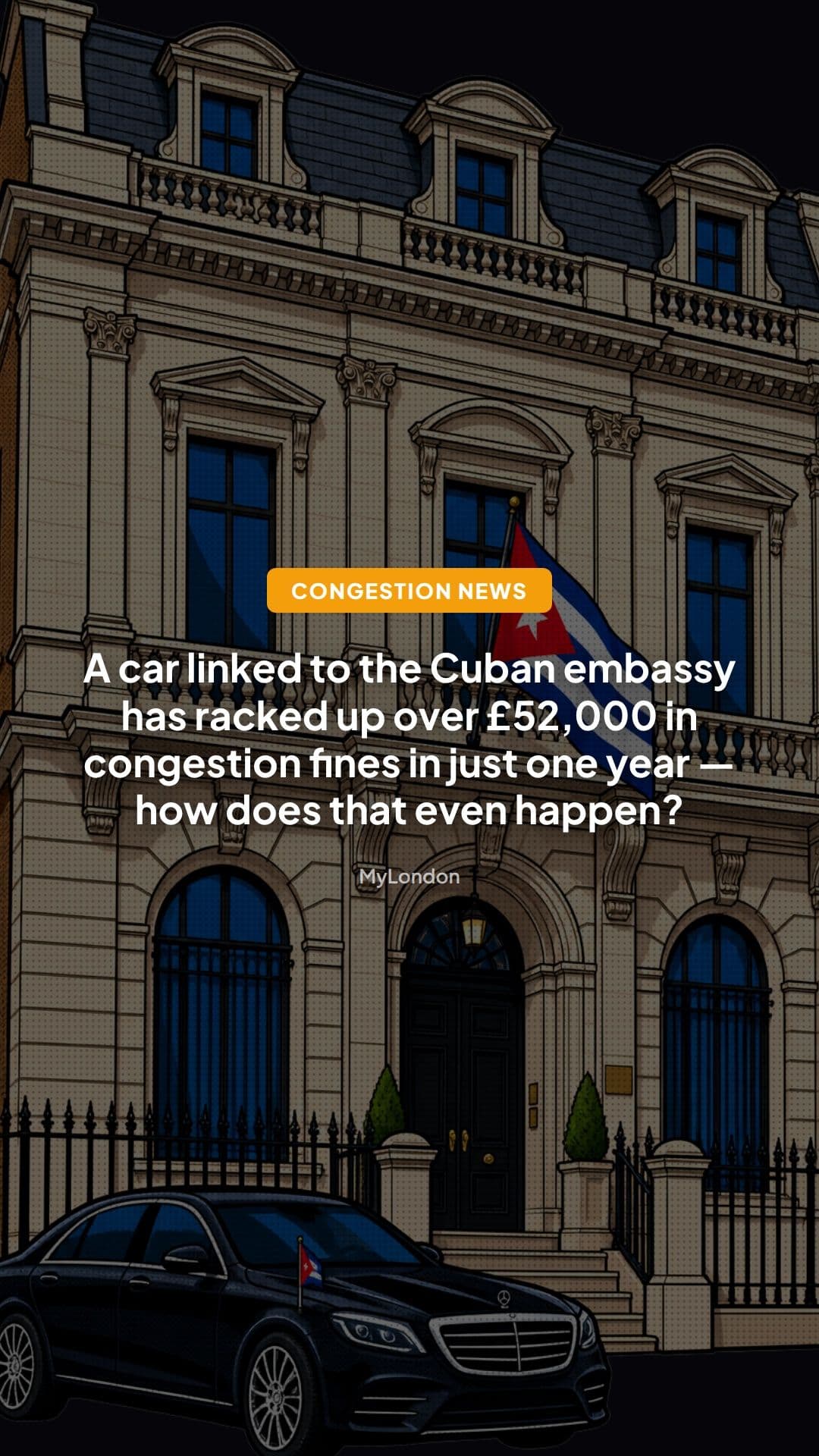
Cuban Embassy Car's £52,000 Congestion Charge Bill: Why Diplomatic Immunity Is Costing London Millions
Picture racking up a parking and congestion charge bill so large it could buy you a small flat outside London, or a very nice car, and simply never paying a penny of it. For most of us, that's a fantasy involving winning the lottery and losing all sense of responsibility. For at least one vehicle linked to the Cuban embassy in London, it's reportedly a straightforward reality, with more than £52,000 in unpaid Congestion Charge and ULEZ penalties accumulated in a single year.
It sounds almost too outlandish to be true. But it's the latest example of a long-running and largely unresolved tension between London's clean air and traffic policies and the centuries-old principle of diplomatic immunity.
What Happened
According to reporting by MyLondon, a vehicle connected to the Cuban embassy built up over £52,000 in penalties relating to London's Congestion Charge and Ultra Low Emission Zone (ULEZ) over the course of a year. The pattern described is one of repeated non-payment rather than a single catastrophic mistake: the vehicle apparently entered the charging zones again and again without settling the daily Congestion Charge or the ULEZ fee, allowing penalty charge notices to pile up largely unchecked.
This isn't a one-off embarrassment for Transport for London (TfL). It's part of a much bigger and more persistent problem. Diplomatic missions in London have, for years, been named among the worst offenders when it comes to unpaid Congestion Charge debts, and the Cuban embassy is far from alone in this. TfL and the Foreign, Commonwealth and Development Office (FCDO) publish periodic data on unpaid diplomatic Congestion Charge debt, and the figures involved across all embassies have historically run into the tens of millions of pounds.
What makes this particular case notable is the sheer speed and scale of the accumulation for a single vehicle. £52,000 in a year suggests not just occasional lapses but a consistent, almost routine, disregard for the charge, seemingly without meaningful consequence.
Why It Matters
At first glance, this might look like a quirky story about a rogue embassy car. But it touches on something with real consequences for ordinary London drivers and taxpayers.
The Congestion Charge and ULEZ exist to reduce traffic and cut harmful emissions in the capital. They only work as deterrents if people believe they'll actually have to pay them. Every unpaid penalty from a diplomatic vehicle represents charge revenue that TfL doesn't collect, revenue that's meant to fund London's transport network and support the very clean air goals the schemes exist to achieve.
There's also a fairness dimension that's hard to ignore. An ordinary motorist who drives into the Congestion Charge zone and forgets to pay by midnight the following charging day faces a penalty of up to £180 (reduced if paid promptly), rising further if it goes unpaid and progresses to enforcement action, potentially including bailiffs or vehicle clamping. Diplomatic vehicles, by contrast, can rack up debts many multiples the size of an average person's annual council tax bill with seemingly no equivalent enforcement teeth.
This isn't a new phenomenon. Diplomatic missions have disputed the legal basis of the Congestion Charge itself for years, with some governments arguing it constitutes a "tax" from which diplomats are exempt under international law, rather than a charge for a service. The UK government's position, and TfL's, has consistently been that the Congestion Charge is a charge for road use, not a tax, and therefore does not fall under diplomatic tax exemptions. That disagreement has never been definitively resolved in a way that changes behaviour, and cases like this show why.
The Legal Angle: Diplomatic Immunity and Its Limits
Diplomatic immunity in the UK is governed principally by the Diplomatic Privileges Act 1964, which incorporates the Vienna Convention on Diplomatic Relations 1961 into domestic law. Under this framework, diplomatic agents and their families enjoy broad immunity from the jurisdiction of UK courts, including, in practice, immunity from being compelled to pay many civil penalties through the usual enforcement routes.
Crucially, though, immunity from prosecution or civil enforcement is not the same as immunity from the underlying obligation. A diplomatic vehicle that enters the Congestion Charge zone without paying still incurs a penalty charge notice under the Congestion Charging scheme, made under powers in the Greater London Authority Act 1999. The debt exists. What's missing is a practical mechanism to force payment, because TfL cannot pursue bailiff action, clamp the vehicle, or take a diplomat to the county court in the way it would for a UK resident.
This is where the distinction between legal liability and legal enforceability becomes stark. The Foreign & Commonwealth Office periodically raises unpaid Congestion Charge debts with foreign missions through diplomatic channels, and in extreme or persistent cases, the UK government has occasionally taken more visible steps, such as raising the issue publicly or through diplomatic protest. But there's no routine, automatic mechanism that mirrors what happens to a resident who ignores a PCN.
For readers who deal with their own PCN disputes, it's worth understanding just how different this diplomatic scenario is from a typical private parking charge or council fine. If you're a private motorist facing an unpaid ticket, you don't have the luxury of diplomatic immunity, and ignoring correspondence can escalate quickly to a County Court Judgment, bailiff involvement, or clamping. Those processes and the formal representations and appeals available to ordinary drivers are covered in detail elsewhere, but the short version is: for the rest of us, the debt is very much enforceable.
What Drivers Should Know
If you're an everyday London driver reading this and feeling a flicker of injustice, that's understandable, but there are a few practical points worth bearing in mind.
You are not immune, so don't treat charges casually. The Congestion Charge and ULEZ are automated systems using ANPR cameras. Non-payment consistently results in a PCN, and unlike a diplomatic vehicle, your penalty will be pursued through the full civil enforcement chain if left unpaid.
Set up auto-pay or reminders. TfL offers Auto Pay and text/email reminder services for the Congestion Charge and ULEZ specifically because so many penalties arise from simple forgetfulness rather than deliberate evasion. If you regularly drive into the zones, this is the single easiest way to avoid an accidental penalty.
Know the payment deadline. The Congestion Charge must be paid by midnight on the next charging day after travel, not the same day, which surprises many first-time visitors to London. Missing that window triggers a PCN even if you intended to pay.
Challenge genuine errors promptly. If you believe a PCN was issued incorrectly, such as a cloned plate, a payment system error, or a vehicle that qualifies for an exemption or discount, you have a right to make representations to TfL. Doing so quickly, and keeping evidence such as payment confirmations or screenshots, gives you the best chance of a successful outcome.
Understand that enforcement escalates. Ignoring a Congestion Charge PCN, unlike a diplomat's vehicle, will lead to enforcement action, including registration with a debt recovery agency, County Court proceedings, or clamping in serious cases.
Looking Ahead
Stories like this Cuban embassy case tend to resurface public frustration every few years, prompting renewed calls for reform, whether that's through international negotiation, naming and shaming persistent non-payers, or pushing for bilateral agreements that treat road user charges differently from taxes. So far, none of these efforts have produced a lasting fix, and the fundamental legal shield of diplomatic immunity remains intact.
What's likely to keep happening is periodic embarrassment: occasional headline-grabbing figures, renewed diplomatic correspondence, and little practical change. For ordinary Londoners and visiting drivers, the lesson is less about outrage at embassies and more a reminder of the gulf between how immune and non-immune road users experience the same charging system. One group faces genuine financial and legal consequences for non-payment. The other, it seems, can simply let the invoices accumulate.
Written by
The Parking Ticket Pal Editorial Team
Source-checked parking guidance
Ready to Challenge Your Ticket?
Let our AI analyse your PCN and generate a professional appeal letter in minutes.
Start Free Appeal