Croydon Pedestrian Zone PCN Appeal Won: Key Lesson
A Croydon PCN for failing to comply with a pedestrian zone entry restriction was cancelled on appeal. Learn the evidence and signage checks drivers should use.

Emma Thompson
14 July 2026
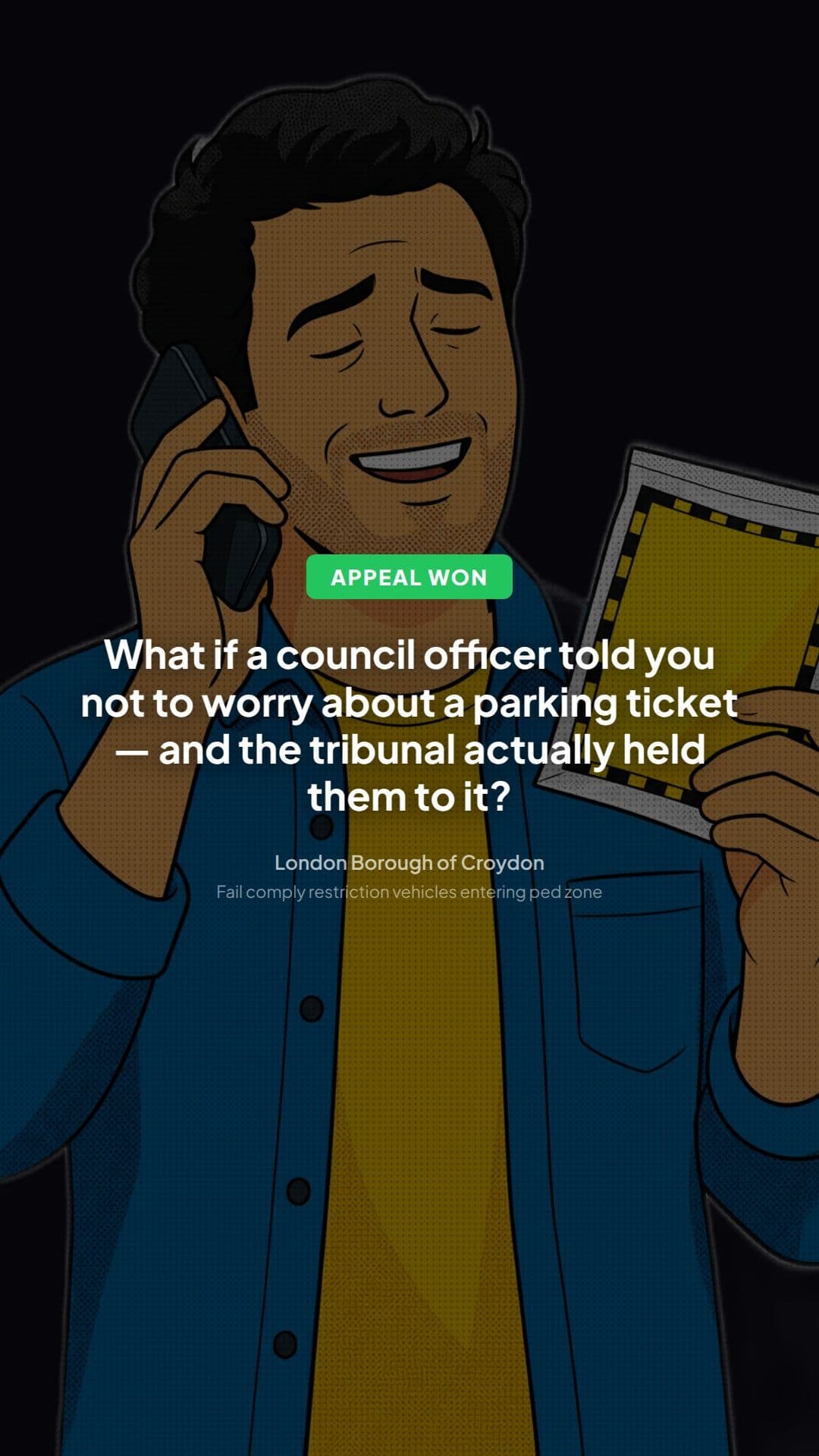
When a Council's Own Words Set You Free: The Croydon Pedestrian Zone Appeal That Every Driver Should Know About
There is a particular kind of frustration that comes from doing everything right and still ending up with a parking fine. You apply for the correct permit. You make the phone calls. You follow the guidance you are given. And then, weeks later, a penalty charge notice lands on your doormat anyway.
That is precisely what happened to one Croydon driver, and the way his tribunal appeal was decided contains a legal lesson that goes far beyond pedestrian zones or permit delays. It touches on something fundamental: whether a council can tell you one thing and then punish you for believing them.
The short answer, according to this adjudicator, is no.
The Case: A Permit, a Delay, and a Fine
The driver had entered a pedestrian zone in the London Borough of Croydon. Under the contravention code used, this is recorded as "fail to comply with restriction, vehicles entering pedestrian zone." In London, these restrictions are enforced under civil parking enforcement powers, and the penalties are real. For most drivers, entering a pedestrian zone without authorisation is an open-and-shut case.
But this driver had authorisation, or at least he was in the process of obtaining it. He had applied for a permit that would have entitled him to enter the zone. The problem was that the council had not yet issued it. There was, as the adjudicator noted, a "considerable delay" between the application and the permit being granted. During that gap, the driver continued to use the zone, and during that gap, the penalty charge notice was issued.
So far, this might sound like a straightforward case of bad timing. A delay on the council's part is unfortunate, but it does not automatically cancel a fine. The adjudicator acknowledged this directly: a delay alone, even an unjustified one, would not in itself provide legal grounds to cancel the penalty.
What changed everything was what the council had said to the driver on the phone.
The Arguments: What the Driver Said, and What the Council Did Not Effectively Counter
The driver attended the tribunal hearing in person and gave detailed evidence. He told the adjudicator that during the course of his telephone calls to the council, an officer told him, in words to that effect, not to worry. He was told that if a penalty charge notice were issued in the meantime, he could appeal it and it would not be enforced.
The council, for its part, did not appear to have effectively challenged this account. The adjudicator stated plainly that he saw no reason to doubt the truth of the driver's evidence. Crucially, he also noted that this was precisely the kind of reassurance a council might reasonably give to someone waiting on a permit. It was not an implausible story. It was, in fact, an entirely sensible administrative approach.
The Decision: Allowed, on the Basis of a Collateral Challenge
The appeal was allowed. No penalty could be demanded.
The adjudicator's reasoning rested on a principle sometimes called a "collateral challenge," which is a legal term worth unpacking because it is not one most drivers will have encountered.
The Legal Reasoning: What a Collateral Challenge Actually Means
In most parking appeals, you are challenging the penalty directly. You might argue the signs were unclear, the restriction did not apply to your vehicle, or you were not parked where the notice says you were. These are direct challenges to the contravention itself.
A collateral challenge is different. It does not dispute that a contravention technically occurred. Instead, it argues that the council's own conduct makes it wrong or unlawful for them to enforce the penalty. It is, in essence, saying: "Even if I technically broke the rule, you told me it would be fine, and I relied on that."
The legal concept underpinning this is sometimes referred to as legitimate expectation or, in broader terms, the principle that a public authority should not be able to resile from a clear assurance it has given to a person who has acted on it. The adjudicator used the word "resile," which means to retreat from or go back on a position. The council gave the driver a clear indication. The driver relied on it. The council then tried to enforce a penalty anyway. That, the adjudicator found, was not something the law would permit.
This is not a loophole. It is a protection rooted in basic fairness. Public bodies exercise significant power over ordinary people. If they give clear guidance and people act on it in good faith, those people should not then be penalised for doing so. The courts have long recognised this principle, and it can apply in parking appeals just as it can in other areas of administrative law.
What made this case work was the combination of three things. First, the assurance was specific and clear: not a vague suggestion, but a direct statement that a PCN would not be enforced. Second, the driver had genuinely relied on it by continuing to enter the zone. Third, the driver was able to give credible, detailed evidence of what was said, and the adjudicator believed him.
Lessons for Drivers: What This Case Tells Us
1. Keep records of every conversation with a council
This case turned on the driver's ability to give credible, detailed evidence of what a council officer told him. If you are in a dispute with a council about a permit, restriction, or enforcement matter, write down what you are told and when. Note the date, the approximate time, and the substance of the conversation. If possible, follow up a phone call with an email summarising what you were told. That paper trail could be the difference between winning and losing.
2. A delay in issuing a permit does not automatically cancel a fine
The adjudicator was explicit about this. If the driver had only argued that the council took too long to issue his permit, he would have lost. The delay was relevant context, but it was not sufficient on its own. The winning point was the specific assurance he had been given. Drivers waiting on permits should be cautious about assuming that a pending application provides protection from enforcement.
3. What a council officer tells you can matter legally
This is perhaps the most important lesson from this case. Many drivers assume that verbal guidance from a council officer carries no weight. In fact, if a public authority gives you a clear and specific assurance, and you act on it in good faith, that assurance can be enforceable in the right circumstances. It is not a guarantee, and the circumstances must be right, but it is far from irrelevant.
4. Attending in person can make a real difference
The adjudicator specifically noted that he heard the driver "in great detail" and accepted the truth of his evidence. Credibility mattered here. Attending a tribunal in person allows you to make your case directly, answer questions, and demonstrate that you are a reliable witness. For cases that turn on what was said or agreed, this can be decisive.
5. Consider whether a collateral challenge applies to your situation
If a council or its officers have given you specific guidance that you have relied on, and you are now facing enforcement that contradicts that guidance, this type of argument may be relevant to your appeal. This is a more complex area of law, and if the stakes are significant, it is worth seeking guidance from a specialist in parking or administrative law, or consulting the resources available through the relevant tribunal service.
The Key Takeaway
If a council officer tells you not to worry and that a fine will not be enforced, get it in writing, or at the very least record every detail of that conversation. A clear assurance from a public body is not just a polite gesture. In the right circumstances, it is something you are legally entitled to rely on, and a tribunal can hold the council to it.
This driver did not win because he found a technicality. He won because he told the truth, kept his evidence straight, and the law recognised that it would be fundamentally unfair to punish someone for trusting a council's own word.
This article is general information and case commentary about UK parking law. It is not legal advice. If you are dealing with a parking appeal and are unsure about the arguments available to you, consider consulting the relevant tribunal's guidance or seeking independent legal advice.
Written by
Emma Thompson
Traffic Law Specialist
Ready to Challenge Your Ticket?
Let our AI analyse your PCN and generate a professional appeal letter in minutes.
Start Free Appeal