Council Pays £470k in Its Own Clean Air Zone Fines
A council paid £470,000 after its own vehicles breached Clean Air Zone rules. We explain CAZ charges, liability and what the case means for drivers across the UK.

The Parking Ticket Pal Editorial Team
5 September 2026
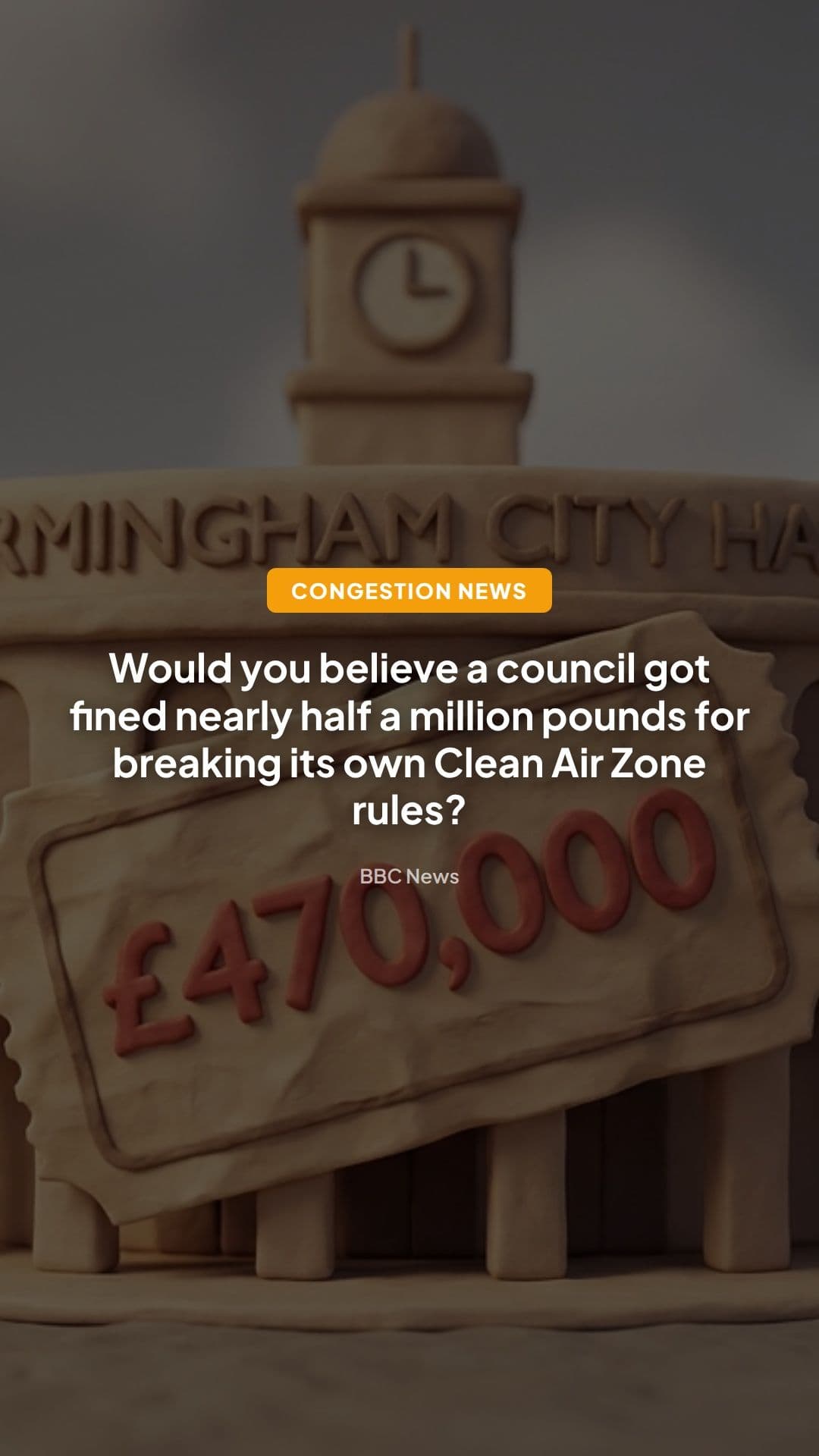
Council Pays £470k for Own Clean Air Zone Breaches: When the Enforcer Becomes the Enforced
The Irony That Writes Itself
There's something almost poetic about a local authority being caught out by the very traffic enforcement scheme it designed, policed and profited from. Yet that's exactly what has happened, with a council forking out £470,000 after its own vehicles repeatedly breached Clean Air Zone rules it created to keep polluting vehicles off certain streets.
For the thousands of ordinary drivers who've received a Clean Air Zone charge notice through their letterbox, often for a single unwitting trip through a zone, the news will land somewhere between vindication and disbelief. If a council with full knowledge of its own scheme's rules, its own vehicle fleet, and presumably its own compliance checking tools can rack up nearly half a million pounds in charges, what chance does the average motorist have of navigating these zones without a costly mistake?
What Actually Happened
According to the BBC report, the council was charged repeatedly under its own Clean Air Zone scheme because it operated vehicles that didn't meet the emissions standards required to travel through the zone without paying. Rather than being waved through on account of being a public body, the council's non-compliant vehicles, entering and exiting the very area they were legally responsible for enforcing, triggered the same automatic number plate recognition (ANPR) cameras used to catch everyone else, generating charge after charge until the total bill reached £470,000.
This isn't a case of a council being unfairly penalised by a system beyond its control. It's a case of institutional oversight: a public body that apparently either failed to upgrade or replace its non-compliant fleet in time, failed to register for any applicable exemptions, or simply failed to track how often its own vehicles were entering the zone.
The report also set out how the standard Clean Air Zone charges work for different types of vehicles, a structure that will be familiar to anyone who has looked into these schemes. Typically, cars, taxis and small vans are charged a daily rate if they don't meet the required emissions standard (usually Euro 6 for diesel and Euro 4 for petrol), while heavier vehicles such as HGVs, buses and coaches face a substantially higher daily charge, often several times more than the rate for private cars. It's precisely this two-tier structure, lower charges for cars, much steeper ones for larger commercial and public service vehicles, that will have compounded the council's bill if any of its fleet included larger, older vehicles such as refuse trucks or minibuses.
Why This Matters Beyond One Council's Bad Luck
Clean Air Zones exist for a serious public health reason. Poor air quality is linked to thousands of early deaths across the UK each year, and dirty engines pumping out nitrogen dioxide and particulate matter in densely populated urban areas are a direct target of these schemes. The zones were introduced following legal pressure on the UK government over its failure to tackle illegal levels of air pollution, with several cities including Birmingham, Bristol, Bradford, Sheffield and Portsmouth required to introduce charging zones as part of their statutory air quality plans.
But schemes like this only retain public trust if they're applied consistently and administered competently. When a council is caught paying charges under its own scheme, it raises awkward questions:
- Was public money being spent unnecessarily? Every pound paid in charges is effectively money moving from one council budget to another, or in some cases to central government, rather than being spent on frontline services.
- Was the fleet non-compliance a symptom of wider delay? Many councils have been slow to electrify or upgrade ageing vehicle fleets, often citing budget constraints, the same constraints used to justify charging residents and businesses for driving older vehicles.
- Did enforcement staff know their own vehicles were in breach? If the council's compliance monitoring wasn't picking up its own fleet's failures, what confidence can residents have that the system is accurately capturing genuine offenders, or conversely, that it isn't wrongly penalising vehicles that are in fact exempt or compliant?
There's also a reputational dimension. Clean Air Zones are already a source of considerable public frustration, seen by some as a stealth tax on drivers who can't afford to replace their vehicles. A story like this hands ammunition to critics who argue these schemes are more about revenue than air quality, even if that's not a fair characterisation of the underlying policy intent.
The Legal Framework Behind Clean Air Zones
Clean Air Zones in England operate under powers granted through the Environment Act 1995 and subsequent air quality directions issued by the Department for Environment, Food and Rural Affairs (Defra) and the Department for Transport. Local authorities required to introduce a zone must do so under a legal direction, meaning they don't always have full discretion over whether to charge, only how the scheme is structured within national guidance.
Crucially, these are not enforced in the same way as parking contraventions under the Traffic Management Act 2004. Clean Air Zone charges are typically civil penalties for non-payment, administered separately from parking enforcement, and payment is usually required within a set number of days of travel through the zone, after which a penalty charge notice can follow for non-payment.
There is no blanket exemption for public sector vehicles simply because they belong to the enforcing authority. Councils, like any other operator, are expected to register their fleets, pay applicable charges, or ensure vehicles meet the required emissions standard, or apply for any locally available exemption such as a sunset period for certain vehicle types. This case appears to demonstrate that the council either didn't secure exemptions in time or genuinely wasn't compliant, and simply absorbed the charges as a cost.
What Drivers Should Take From This
For ordinary motorists, the practical lessons are the same ones that apply regardless of which council finds itself in an embarrassing headline:
Check compliance before you travel. The government's official vehicle checker allows you to enter your registration and instantly see whether your car, van or other vehicle meets the required standard for any given Clean Air Zone. This takes moments and can save you an unexpected charge notice weeks later.
Don't assume proximity means safety. Zone boundaries are often complex, covering specific roads rather than whole postcodes, and it's entirely possible to cross in and out of a charging area without realising it, particularly in cities with multiple ring roads or complicated one-way systems.
Pay promptly if you are liable. Most schemes give you a short window, often up to midnight on the sixth day after travel, to pay the daily charge before a penalty notice is issued. Missing that window typically converts a modest daily fee into a much larger fixed penalty.
Know your exemptions. Certain vehicles, including some disabled adapted vehicles, historic vehicles and specific occupational categories, may be exempt or eligible for a temporary exemption period. It's worth checking your specific council's Clean Air Zone page rather than assuming national rules apply uniformly, since local schemes vary in detail.
Challenge genuine errors. If you believe a charge or penalty has been issued incorrectly, whether due to an ANPR misread, incorrect vehicle details, or a genuine exemption not being applied, most schemes have a formal challenge or appeal process. Keep evidence such as MOT certificates, V5C documents and any exemption confirmation to hand.
Looking Ahead
This episode is likely to fuel calls for greater transparency around how councils manage compliance of their own vehicle fleets, not just those of the public they charge. Expect scrutiny from local auditors, opposition councillors and possibly the National Audit Office equivalents at local level, particularly where public money has effectively been spent paying charges that could have been avoided through better fleet planning.
More broadly, as more UK cities consider or expand Clean Air Zones, this story serves as a reminder that these schemes are complex to administer correctly, even for the bodies that run them. For drivers, the safest approach remains the same: check before you travel, understand your vehicle's status, and don't assume that just because a council enforces the rules, it always gets them right either.
Written by
The Parking Ticket Pal Editorial Team
Source-checked parking guidance
Ready to Challenge Your Ticket?
Let our AI analyse your PCN and generate a professional appeal letter in minutes.
Start Free Appeal