Community car-sharing: can it cut UK traffic emissions?
Community-run car-sharing schemes could cut UK traffic emissions and reduce car ownership. We examine benefits, barriers, and what must change to scale.

Kwame Asante
10 May 2026
Could Community Car-Sharing Be the Key to Britain's Green Transport Revolution?
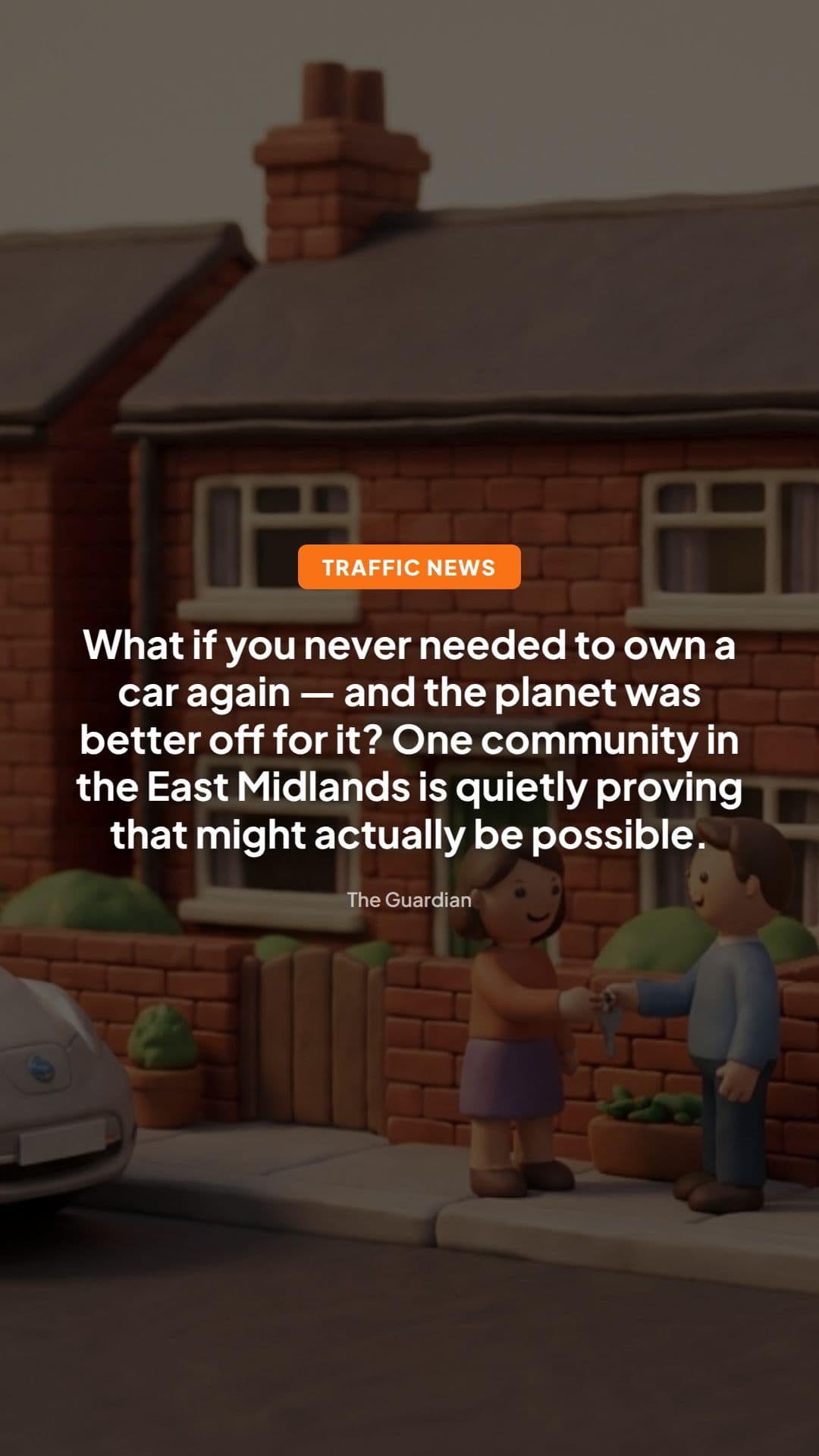
When a small group of volunteers in the East Midlands decided to share a single electric car between dozens of households, few imagined they might be pointing the way towards a genuinely cleaner Britain. But as The Guardian's recent feature reveals, community car clubs are doing something that government policy alone has consistently failed to achieve — making low-emission transport feel personal, local, and genuinely useful.
What's Actually Happening on the Ground
The Guardian's investigation, published in May 2026, takes a close look at a volunteer-run electric car club operating in the East Midlands. The scheme is modest in scale — a handful of EVs shared among a pool of registered members — but its ambitions are anything but small. Participants pay a membership fee and a per-mile or per-hour rate to access the vehicles, removing the financial burden of outright ownership while still giving them the flexibility of a car when they genuinely need one.
What makes this particular scheme interesting isn't just the environmental angle. It's the fact that it's working at all. Community-led transport initiatives in the UK have a patchy track record, frequently struggling with funding gaps, volunteer burnout, and the sheer logistical complexity of keeping shared assets running smoothly. Yet this East Midlands club is demonstrating that with the right structure, genuine grassroots demand, and a bit of determination, it's possible to build something that meaningfully reduces the number of private vehicles on local roads.
The Guardian is careful to note, however, that such volunteer-led projects face real limitations. Scaling them up — from a single village initiative to a national network — requires resources, coordination, and policy support that currently don't exist in any coherent form.
Why This Matters Far Beyond One East Midlands Car Park
Britain has a problem. The Climate Change Act 2008, as amended in 2019, commits the UK to reaching net zero greenhouse gas emissions by 2050. Transport is the single largest contributing sector, responsible for around 26% of the UK's total domestic greenhouse gas emissions, according to the Department for Energy Security and Net Zero. Within that, private cars dominate.
The government's approach has largely focused on the supply side — pushing manufacturers towards EVs through the Zero Emission Vehicle (ZEV) Mandate, introduced under the Automotive Sector Deal and now embedded in regulation requiring that 22% of new car sales in 2024 be zero-emission, rising to 80% by 2030 and 100% by 2035.
But there's a glaring gap in this strategy: it assumes everyone will simply swap their petrol car for an electric one. For millions of households in the UK, that's simply not realistic.
- The average new EV costs around £40,000, well beyond the reach of most working families.
- Around 40% of UK households have no off-street parking, making home charging deeply impractical.
- Rural and semi-rural communities — precisely where car dependency is highest — often have the worst access to public charging infrastructure.
Community car clubs don't just offer a greener alternative. They offer an accessible one. Research from CoMoUK, the shared transport charity, consistently shows that every shared car replaces between 8 and 20 privately owned vehicles. Members also tend to walk, cycle, and use public transport more frequently once they're no longer anchored to a car they feel they must justify owning.
The Legal and Regulatory Framework — Where It Helps and Where It Doesn't
This is where things get genuinely complicated for anyone trying to run or join a community car club in Britain.
Insurance is the first significant legal hurdle. Standard personal car insurance policies do not cover commercial or club use. Community car clubs must operate under fleet insurance policies that specifically accommodate multiple named or unnamed drivers. The legal framework here draws on the Road Traffic Act 1988, which requires any vehicle used on a public road to be insured for third-party liability at minimum. For clubs operating on a membership model, ensuring every driver is properly covered — and that the policy doesn't inadvertently exclude certain categories of use — requires specialist brokers and careful policy drafting.
Data protection is another layer. When clubs collect member data — driving licences, payment details, usage logs — they are acting as data controllers under the UK GDPR and the Data Protection Act 2018. Even volunteer-run schemes must register with the Information Commissioner's Office (ICO) if they process personal data in a structured way, and they must have a clear privacy policy and data retention schedule.
Planning and parking permissions can also create unexpected barriers. If a club wants to designate specific bays for its shared vehicles — particularly on-street bays — it must work with the local highway authority. Under the Road Traffic Regulation Act 1984, local authorities have the power to make Traffic Regulation Orders (TROs) that can designate bays for car club use. Several London boroughs have done this effectively, but outside major cities, highway authorities are often unfamiliar with the process and slow to act.
There is also the question of VAT. Car club membership fees and usage charges are generally subject to VAT at the standard rate of 20%, which adds a meaningful cost burden to what are often already slim-margin operations. Commercial car clubs like Zipcar or Enterprise CarShare absorb this as a standard business cost, but for a community scheme operating on goodwill and grant funding, it can be the difference between viability and collapse.
Encouragingly, Section 63 of the Climate Change Act 2008 places a duty on government to report on adaptation to climate change, and the Transport Decarbonisation Plan (2021) explicitly identifies shared transport as a key lever. But identifying something as a lever and actually pulling it are very different things.
What Drivers Should Know Before Joining — or Starting — a Car Club
If you're considering joining a community car club, or even helping to establish one in your area, here's what you actually need to know:
Before you join:
- Check the insurance carefully. Ask the club for a copy of its fleet insurance certificate and confirm that your licence type (including any endorsements) is covered. A conviction for a motoring offence in the past five years may affect your eligibility.
- Understand the pricing structure. Most clubs charge a combination of membership fee plus per-mile and per-hour rates. Work out your realistic annual mileage to assess whether it's genuinely cheaper than ownership or a traditional rental.
- Check what happens if you're involved in an accident. Most club policies include an excess, often between £500 and £1,500. Some clubs offer excess waiver products — ask before you assume.
- Confirm how disputes are handled. If you return a car and are later charged for damage you didn't cause, what's the process? Good clubs will have a documented handover procedure and photographic evidence requirements.
If you're thinking of setting one up:
- Contact CoMoUK early. They provide free guidance, toolkits, and can connect you with existing schemes.
- Approach your local council's transport or sustainability team — many have small grants or in-kind support available, particularly for schemes aligned with Local Transport Plans.
- Consult a specialist insurance broker from the outset. Don't attempt to adapt a personal policy.
- Register with the ICO before you collect any member data.
Looking Ahead — The Road Is Long, But the Direction Is Right
The East Midlands scheme profiled by The Guardian is not going to single-handedly decarbonise British transport. The Guardian's own headline acknowledges this — "a long road ahead" is an understatement when you consider the scale of the challenge.
But what community car clubs represent is something the policy world often underestimates: proof of concept at human scale. They demonstrate that people will voluntarily reduce their reliance on private car ownership when given a genuinely workable alternative. That's a behavioural shift that no amount of road pricing, emissions regulation, or manufacturer mandate can achieve on its own.
The UK government's Shared Mobility Taskforce, established under the previous administration and continued under Labour, has produced recommendations around simplifying TRO processes for car club bays, creating a national data standard for shared transport, and exploring tax relief for community-run schemes. Whether these recommendations translate into meaningful legislative action in the 2026 parliamentary session remains to be seen.
What's clear is that the regulatory and legal environment needs to catch up with what communities are already doing on the ground. Streamlining the TRO process, creating a dedicated insurance framework for non-commercial car clubs, and providing consistent small-grant funding would cost relatively little compared to the infrastructure budgets routinely allocated to road-building.
The volunteers running that East Midlands car club aren't waiting for Whitehall to figure it out. Perhaps that's the most telling thing of all.
Source: The Guardian, 'A long road ahead: could community car-sharing help UK hit climate targets?', 10 May 2026.
Written by
Kwame Asante
Community Rights Advisor
Ready to Challenge Your Ticket?
Let our AI analyse your PCN and generate a professional appeal letter in minutes.
Start Free Appeal