CMA probes parking fines issued in petrol station queues
The CMA is investigating reports of drivers hit with private parking charges while queuing for fuel, amid complaints of unclear signage and aggressive enforcement.

James Wilson
16 July 2026
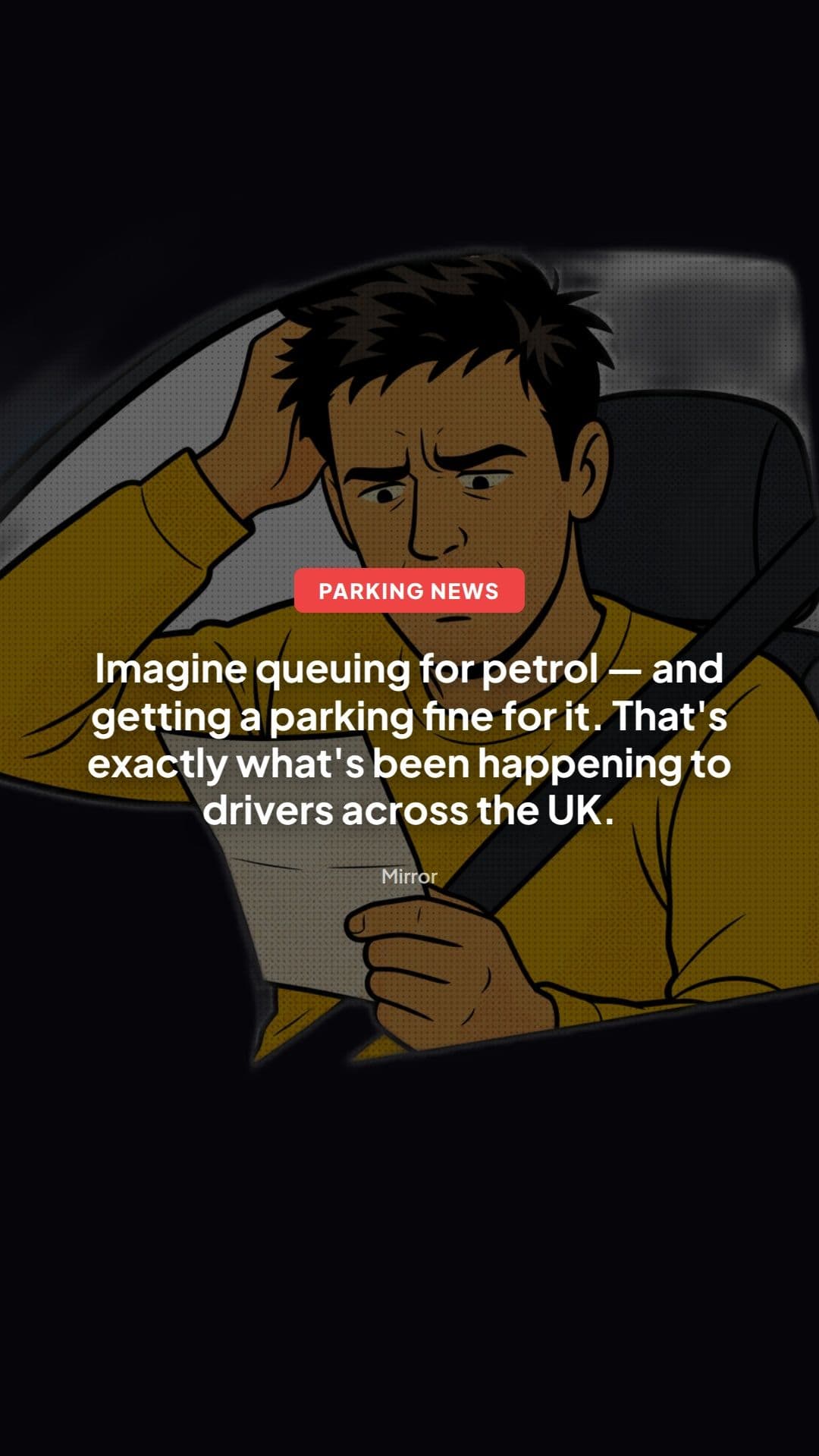
Parking Fines While Queuing for Petrol: What the CMA Investigation Means for UK Drivers
Picture this: you've been sitting in a slow-moving queue for twenty minutes, engine idling, inching forward towards a petrol station forecourt. Your fuel light has been on since yesterday. You finally make it to the pump, fill up, and drive away relieved. Then, a week later, a parking charge notice drops through your letterbox. You've been fined for the very act of waiting to buy fuel.
It sounds absurd. Yet this is precisely the situation that has prompted the Competition and Markets Authority to open a formal investigation into private parking enforcement at and around petrol station sites. The Mirror has reported a surge in complaints from drivers hit with parking charges while queuing to refuel, with enforcement companies accused of issuing tickets in circumstances where any reasonable person would consider the vehicle to be in entirely legitimate use of the space.
This is not a minor administrative curiosity. It goes to the heart of how private parking enforcement operates in the UK, who it serves, and whether the rules as currently applied are fit for purpose.
What Is Actually Happening?
The CMA investigation follows a wave of complaints from motorists who found themselves fined while waiting in queues to access petrol station forecourts. In many cases, drivers were not parked in the traditional sense at all. They were stationary in a moving queue, with no choice about where their vehicle sat at any given moment.
The complaints centre on two recurring problems. First, unclear or inadequate signage that fails to properly communicate the terms and conditions of the site to drivers. Second, aggressive enforcement by private operators using Automatic Number Plate Recognition cameras, which log a vehicle's entry and exit time without any human judgement about what the driver was actually doing during that period.
The ANPR system is the crux of the problem. A camera records your plate as you enter a car park or forecourt zone. Another camera records your departure. If the time between those two events exceeds the permitted period, a charge notice is generated automatically. The camera does not know, and does not care, whether you spent that time actively queuing, waiting for a pump, or parked up doing your weekly shop. The system treats every minute the same.
Why This Matters Beyond the Forecourt
The CMA's decision to investigate is significant because it signals that regulators are paying close attention to the gap between how private parking enforcement is presented to the public and how it actually functions in practice.
Private parking operators in the UK are not public bodies. They are commercial companies, and the charges they issue are not fines in the legal sense. They are contractual claims, based on the argument that by entering a site you have accepted the posted terms and conditions. This distinction matters enormously, because it means the entire system rests on the quality of the signage and the reasonableness of the terms being enforced.
The British Parking Association and the International Parking Community are the two main trade bodies that accredit private operators and run the alternative dispute resolution schemes through which drivers can appeal. Both bodies require their members to follow codes of practice, and both have faced criticism over whether those codes are robust enough to protect consumers.
The Parking (Code of Practice) Act 2019 was passed with the explicit intention of creating a single, statutory code of practice for the private parking industry. Progress has been slow, but the code, when fully implemented, is intended to set minimum standards for signage, grace periods, and appeals processes. The investigation by the CMA sits within this broader context of an industry that has expanded rapidly but has not always kept pace with the consumer protections that expansion demands.
The Legal Angle: What Are Your Rights?
When a private parking company issues a charge notice, it is making a civil claim against you. It is not a criminal matter, and it does not carry the same legal weight as a penalty charge notice issued by a local authority. This is a distinction that many drivers do not fully appreciate, and one that private operators have not always been transparent about.
For a private parking charge to be enforceable, several conditions generally need to be met. The signage on the site must be clear, prominent, and legible, so that a driver entering the site could reasonably be expected to understand the terms they are accepting. The charge itself must represent a genuine pre-estimate of loss, or a deterrent that is not so disproportionate as to be considered a penalty under contract law. And the operator must be able to demonstrate that the vehicle was genuinely in breach of the stated conditions.
In the queuing scenario, this last point is where many charge notices may be vulnerable. If a driver was stationary in a queue to access a pump, and had no realistic ability to move their vehicle or to exit the site, it is difficult to see how they can be said to have breached any reasonable parking condition. A queue is not a parking event. It is a temporary obstruction caused by demand, and in many cases it is demand that the petrol station itself has created or encouraged.
Drivers who receive a charge notice in these circumstances would be well advised to document everything they can remember about the visit, including the approximate time they arrived, how long they waited in the queue, and whether any signage was visible from their position in the queue. Photographs of the site, particularly of any signs, can be invaluable in an appeal. For guidance on how to frame a challenge based on signage failures, our guide to using unclear parking signs as a defence sets out the key arguments in detail.
What Drivers Should Know: Practical Takeaways
If you have received, or are worried about receiving, a parking charge notice after queuing for petrol, here is what is worth understanding.
Do not ignore the notice. Even though a private parking charge is a civil matter rather than a criminal one, ignoring it can lead to the debt being passed to a collections agency and potentially escalating in cost. The time to challenge it is early in the process.
Check the operator's accreditation. Private parking companies must be members of either the BPA or the IPC to access DVLA data and obtain your registered keeper details. If the company issuing the charge is not accredited by one of these bodies, that is itself a significant issue.
Look carefully at the signage evidence. When you appeal, the operator will typically provide photographs of their signs. Scrutinise these carefully. Were the signs visible from the queue? Were they legible? Did they specifically address the situation of drivers waiting to access a pump?
Use the appeals process. Every accredited operator must offer an internal appeals stage, followed by access to an independent appeals service. For BPA members this is POPLA, and for IPC members it is the Independent Appeals Service. These are free to use and provide a genuine check on operator behaviour. Our step-by-step guide to the POPLA appeals process walks you through what to expect.
Keep records of everything. Dates, times, fuel receipts, and any photographs you took at the time are all potentially useful evidence. A fuel receipt from the same site on the same day is a particularly strong piece of supporting documentation.
Consider whether the charge is proportionate. The courts have previously found that private parking charges can be unenforceable if they amount to a penalty rather than a genuine pre-estimate of loss. This is a nuanced area of contract law, and anyone facing a significant charge who is unsure of their position should seek independent legal advice rather than relying on general information.
Looking Ahead: What This Investigation Could Change
The CMA investigation is unlikely to produce overnight results. Regulatory inquiries of this nature take time, and any formal recommendations or enforcement action would need to work through established processes. However, the investigation sends an important signal to the private parking industry that the current model of automated, blanket enforcement is under scrutiny.
There is a reasonable argument that ANPR technology, while efficient, is being deployed in ways that its original purpose did not anticipate. Petrol stations are not car parks. They are transactional spaces where a degree of queuing and waiting is inherent to the service being provided. Applying rigid time-based enforcement to those spaces, without any mechanism for distinguishing between a driver who has abandoned their car and walked to a nearby shop and a driver who has been sitting in a queue for twenty minutes trying to buy fuel, is a failure of proportionality.
The broader reform of private parking law, driven by the Parking (Code of Practice) Act 2019 and ongoing pressure from consumer groups and parliamentarians, is moving in a direction that should provide better protections for drivers. But reform takes time, and in the meantime, drivers caught in situations like this need to know their rights and be prepared to use them.
The CMA's willingness to look at this specific issue suggests that the regulator considers the current situation to be genuinely problematic. Whether that leads to binding guidance, enforcement action against specific operators, or recommendations for legislative change remains to be seen. For now, the most important thing any driver in this position can do is to challenge the charge, document their case carefully, and not assume that because a notice has arrived it must be valid.
If you are unsure where to start, our guide to crafting an effective informal PCN appeal provides a free template and practical advice on making your case as clearly and persuasively as possible.
Written by
James Wilson
Legal Counsel
Ready to Challenge Your Ticket?
Let our AI analyse your PCN and generate a professional appeal letter in minutes.
Start Free Appeal