Cheap fuel hunt: £100 fine and 3 points risk for drivers
Searching for cheaper petrol or diesel? Risky manoeuvres and phone use can trigger a £100 fixed penalty and 3 points under UK driving laws.

Lisa Rodriguez
5 May 2026
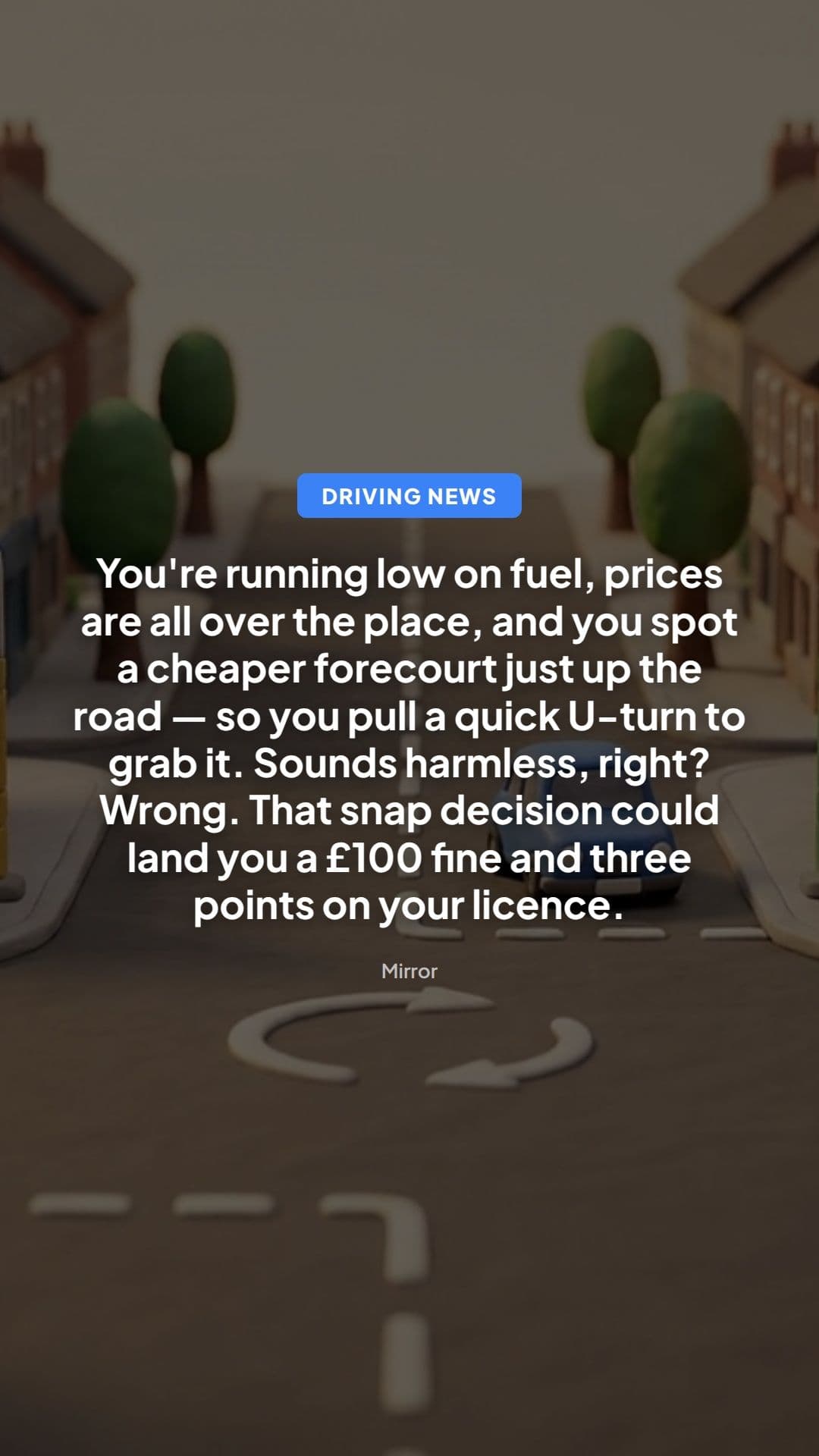
Hunting for Cheap Fuel Could Cost You £100 and Three Penalty Points — Here's What UK Drivers Need to Know
The scramble to save a few pence per litre is entirely understandable — but the legal risks hiding in that decision could cost you far more than you'd ever save at the pump.
The Lure of the Cheaper Forecourt
Cast your mind back to the last time fuel prices crept upward. Perhaps you noticed the sign at your usual petrol station and thought: "There's a cheaper one two miles away — I'll head there instead." Maybe you spotted a price comparison on an app, did a sharp U-turn, or cut across a lane of traffic to catch a forecourt before the lights changed.
It feels instinctive. Rational, even. With petrol regularly topping 130p per litre and diesel not far behind, the difference between an expensive BP on a high street and a budget supermarket forecourt a short distance away can amount to several pounds on a full tank. Over the course of a year, for a typical driver covering around 7,400 miles, those savings genuinely add up.
But here's the uncomfortable truth that a recent Mirror report has brought sharply into focus: the driving behaviours that fuel-hunting tends to trigger — the sudden lane changes, the illegal U-turns, the nipping across junctions, the stopping in restricted zones — carry their own very real financial penalties. And those penalties don't just hit the wallet. They go on your licence.
What the Story Is Really About
The Mirror's report flags something that motoring organisations have quietly worried about for some time: as fuel prices fluctuate and price differentials between forecourts widen, drivers are increasingly making impulsive, and sometimes illegal, manoeuvres to access cheaper petrol or diesel.
The specific risks highlighted include fixed-penalty notices of £100 and three penalty points — the standard sanction for a range of moving traffic offences. But the story, as reported, only scratches the surface. The reality is that the legal exposure for a driver hunting cheap fuel spans a surprisingly wide range of offences, each carrying its own consequences. And in certain circumstances, those consequences extend well beyond a fixed penalty.
Why This Matters Right Now
Context is everything here. UK fuel prices have been on a turbulent trajectory. Global oil market pressures, refinery capacity constraints, and the weak pound have all contributed to a pricing environment where forecourt costs can vary significantly — not just between supermarkets and branded stations, but between streets in the same town.
Apps like Petrol Prices and Confused.com's fuel finder have made it easier than ever to identify the cheapest litre within a given radius. That's genuinely useful. But it also means drivers are increasingly making real-time routing decisions based on price data — decisions that weren't part of their original journey plan, and which can lead to sudden, unplanned manoeuvres on roads that weren't designed to accommodate them.
Meanwhile, local authorities and Transport for London have been expanding their networks of ANPR cameras and moving traffic enforcement cameras. Offences that might once have gone undetected are now far more likely to result in a Penalty Charge Notice landing on your doormat.
The Legal Angle: What Offences Are Actually at Stake?
This is where things get genuinely important, and where the Mirror's headline only tells part of the story.
Illegal U-Turns
Under the Highway Code Rule 188, U-turns are prohibited where signs indicate, on motorways, and where they would endanger other road users. A U-turn made to catch a cheaper forecourt — across a solid white line, near a junction, or on a road with a no U-turn sign — can attract a £100 fixed penalty and three points under Section 36 of the Road Traffic Act 1988 (failing to comply with a traffic sign).
Careless or Inconsiderate Driving
This is the big one that many drivers overlook. Under the Road Traffic Act 1988, Section 3, careless driving — defined as driving below the standard expected of a competent and careful driver — carries a fixed penalty of £100 and three points. However, if a case goes to court, the fine can rise to £2,500 and the points can increase to nine. A sudden lane change to reach a forecourt, cutting across traffic, or braking sharply without warning could all fall into this category.
Stopping in Prohibited Zones
Attempting to enter a forecourt across a yellow box junction, stopping on a red route, or pulling up where stopping is prohibited can each generate a Penalty Charge Notice from the local authority or TfL — typically £70 to £130 in London, and £50 to £70 outside the capital (with a 50% discount for early payment). These are civil penalties rather than criminal ones, meaning no points, but they're still a significant financial hit.
Dangerous Driving
In the most serious cases — where a manoeuvre creates a genuine risk of injury — police have the power to charge under Section 2 of the Road Traffic Act 1988. Dangerous driving carries an unlimited fine, a mandatory disqualification of at least 12 months, and up to two years' imprisonment. This is an extreme outcome, but not an impossible one if a fuel-hunting manoeuvre causes a collision.
Failing to Comply with Traffic Signs
Prohibited turns, one-way street violations, and no-entry infractions — all of which can occur when a driver diverts unexpectedly to reach a forecourt — attract £100 and three points under the same Section 36 provisions mentioned above.
What Drivers Should Know: Practical Advice
The good news is that with a little forward planning, you can hunt for cheap fuel without putting yourself at legal risk. Here's how:
1. Plan your route before you drive, not during it Check fuel prices on an app before you set off, not while you're already on the road. Making routing decisions in advance means you won't be tempted to make impulsive manoeuvres mid-journey.
2. Never make a manoeuvre you haven't planned Sudden U-turns, sharp lane changes, and unexpected stops are precisely the behaviours that attract police attention and camera enforcement. If you've missed your turning for a cheaper forecourt, accept it and find a safe place to turn around legally.
3. Know where ANPR and moving traffic cameras are active Local authority enforcement camera networks have expanded significantly in recent years. Box junction cameras, no-turn cameras, and bus lane cameras are increasingly common in urban areas. A snap decision to cut through a junction could be captured and result in a PCN.
4. Use supermarket forecourts wisely Supermarket petrol stations consistently offer among the cheapest fuel in the UK. If you're doing a weekly shop anyway, filling up at the same time requires no special detour and no risky driving behaviour.
5. Consider the maths honestly The average car has a 50-litre tank. A 5p-per-litre saving — which is on the generous side — amounts to £2.50. If reaching that cheaper forecourt requires a significant detour or a risky manoeuvre, the potential cost of a £100 fine makes the economics look very different indeed.
6. If you receive a fixed penalty, consider your options carefully A fixed penalty notice for a moving traffic offence gives you the option to pay the reduced fine and accept the points, or to request a court hearing. If you genuinely believe the penalty was issued incorrectly — for example, if signage was unclear or the camera evidence is ambiguous — it is worth examining the evidence carefully before simply paying up.
Looking Ahead: A Structural Problem That Isn't Going Away
The underlying tension here is unlikely to resolve itself quickly. Fuel prices remain volatile, forecourt price differentials continue to attract attention, and the expansion of traffic camera networks means that impulsive driving decisions carry greater enforcement risk than ever before.
There is also a broader conversation to be had about how fuel pricing information is presented to drivers. The more granular and real-time that information becomes, the more likely drivers are to make on-the-fly decisions — and the greater the risk that those decisions lead to the kind of driving behaviour described above.
What's needed, arguably, is better driver education about the specific legal risks attached to common fuel-hunting behaviours. The three-points-and-£100 combination is well known in the abstract, but many drivers genuinely don't connect it to the kind of routine manoeuvres they might make without thinking twice.
The message is simple: the cheapest fuel in your area isn't cheap at all if getting to it costs you a fine, three points, and a potential insurance premium hike. Plan ahead, drive calmly, and let the app do the work before you leave home — not while you're behind the wheel.
Sources: Mirror, Road Traffic Act 1988, Highway Code Rules 185–188, Department for Transport fixed penalty schedule.
Written by
Lisa Rodriguez
Automotive Journalist
Ready to Challenge Your Ticket?
Let our AI analyse your PCN and generate a professional appeal letter in minutes.
Start Free Appeal