Car insurance typo leads to conviction: what UK drivers must check
An 86-year-old was convicted after a single wrong letter on her car insurance policy. We explain UK rules on uninsured driving and how to avoid errors.

Emma Thompson
20 April 2026
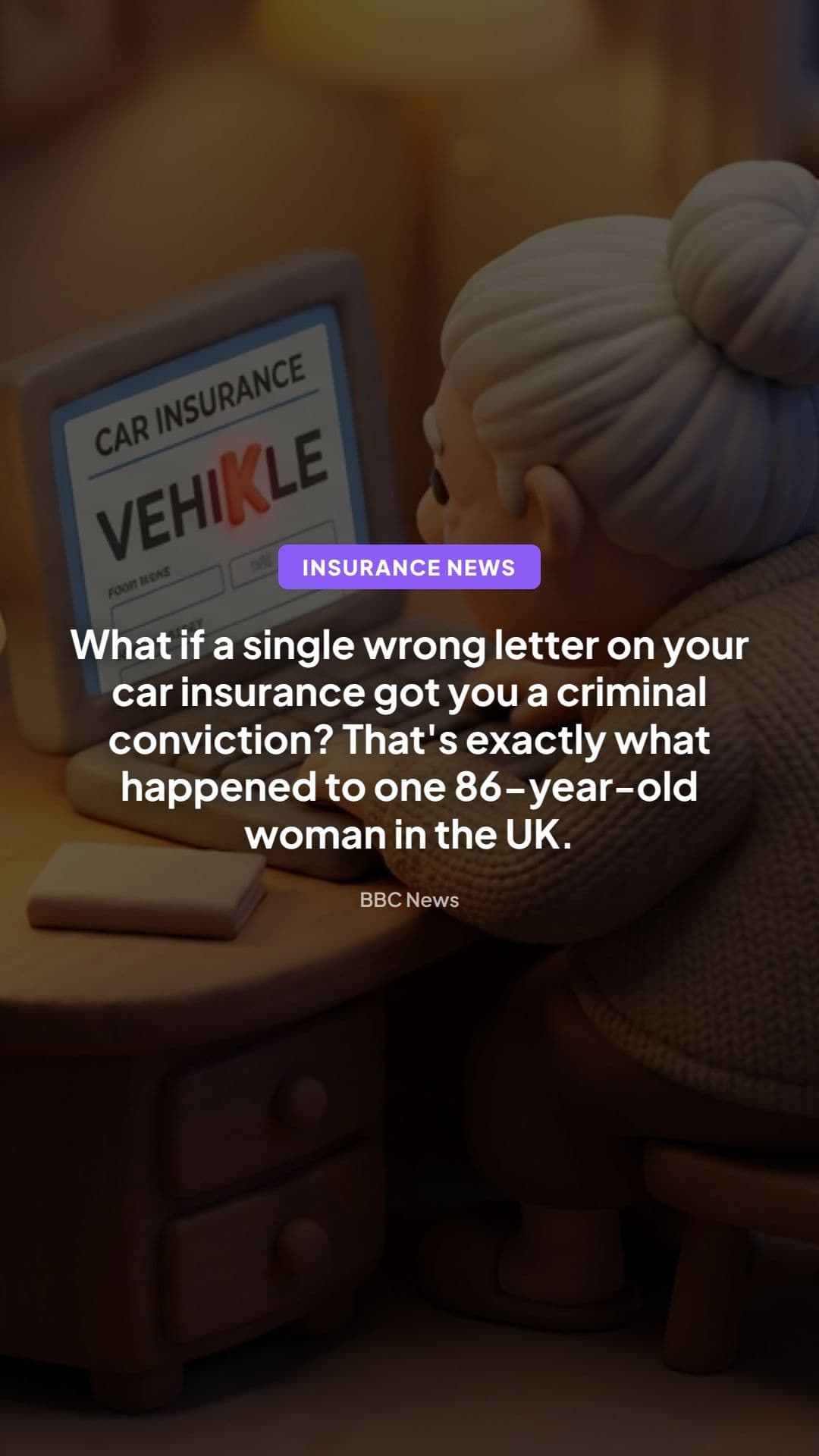
One Wrong Letter, One Criminal Conviction: The Shocking Case That Every UK Driver Must Read
Imagine spending decades as a careful, law-abiding driver. You've never had a serious accident, never deliberately broken the law, and you dutifully renew your car insurance every year without fail. Then, at 86 years old, you find yourself with a criminal conviction — not because you drove dangerously, not because you defrauded anyone, but because you mistyped a single letter of your vehicle registration number.
This isn't a hypothetical. It happened. And it could happen to you.
What Happened
As reported by BBC News, an 86-year-old woman was criminally prosecuted and subsequently convicted for keeping a vehicle without insurance — despite having a valid insurance policy in place. The problem? When entering her vehicle registration number during the insurance application process, she made a one-character typographical error.
That single wrong letter meant that the Motor Insurance Database (MID) — the central register that police, the DVLA, and enforcement cameras use to verify whether a vehicle is insured — showed her actual car as uninsured. As far as the automated systems were concerned, her vehicle had no valid cover attached to it.
The consequences were devastating. Rather than receiving a Fixed Penalty Notice or a warning, she was criminally prosecuted under the Road Traffic Act 1988. She was convicted of the offence of using a vehicle without insurance — a criminal offence in the UK, not merely a civil matter.
The case has provoked widespread outrage, and rightly so. Here was an elderly woman, clearly not acting dishonestly or recklessly, caught in a bureaucratic and legal trap that showed precious little room for common sense or proportionality.
Why It Matters
This case is not simply a human-interest story about one unfortunate pensioner. It exposes a systemic problem at the intersection of automated enforcement, rigid legal frameworks, and the very real fallibility of human data entry.
The Motor Insurance Database is updated by insurers and is the backbone of the UK's insurance enforcement regime. Automated Number Plate Recognition (ANPR) cameras cross-reference plates against this database in real time. If your plate isn't on the MID, the system flags you as uninsured — regardless of the reason why.
The database holds records for over 40 million vehicles and processes vast quantities of data. Errors, whether made by drivers, insurers, or administrators, are not merely theoretical. They happen. And as this case demonstrates, when they do, the consequences can be catastrophic.
What makes this case particularly troubling is the question of intent. Criminal law in the UK generally distinguishes between offences that require mens rea (a guilty mind) and those that are "strict liability" — meaning guilt is established simply by proving the act occurred, regardless of intent or knowledge. Driving without insurance is a strict liability offence. You either have valid insurance attached to your vehicle, or you don't. The courts are not required to consider whether you meant to be uninsured.
In theory, the existence of a valid insurance policy — just with a mistyped registration — could be raised as a mitigating factor, or in some circumstances a defence of honest and reasonable belief might be explored. In practice, as this case shows, it does not always prevent a conviction.
The Legal Angle
Under Section 143 of the Road Traffic Act 1988, it is an offence to use, cause, or permit the use of a motor vehicle on a road or public place without a valid policy of insurance in respect of third-party risks. This is one of the most fundamental obligations placed on UK drivers.
The penalties for conviction can include:
- A fine of up to £1,000
- 6–8 penalty points on your driving licence
- Discretionary disqualification from driving
- A criminal record
Crucially, the offence is one of strict liability. The prosecution does not need to prove you knew you were uninsured. They simply need to prove that, at the relevant time, the vehicle in question was not covered by a valid policy.
There is a statutory defence available under Section 143(3) of the Road Traffic Act 1988, which allows a person to escape liability if they can prove they were not the owner of the vehicle, did not know it was uninsured, and had no reasonable cause to believe it was uninsured. However, this defence is specifically designed for employees or those using a vehicle belonging to someone else — not for the registered keeper who took out the policy themselves.
This means that a driver who genuinely believed they were insured, had paid their premium in full, and simply made a clerical error has very limited statutory protection. The law, as it stands, does not adequately account for this scenario.
What Drivers Should Know
This case is a wake-up call. Here are the practical steps every UK driver should take to protect themselves:
1. Double-check your registration number immediately When you take out or renew any insurance policy — whether online, over the phone, or through a broker — verify that the vehicle registration number on your policy documents is exactly correct. Check it against your V5C logbook, not from memory.
2. Check the Motor Insurance Database yourself You can verify whether your vehicle appears correctly on the MID by visiting askmid.com. This free tool allows you to check your own vehicle's insurance status. Make this part of your routine every time you renew.
3. Notify your insurer immediately if you spot an error If you notice a mistake on your policy documents, contact your insurer straight away and request a written correction. Keep a record of all correspondence. Most insurers can issue a corrected certificate of insurance promptly.
4. Keep copies of everything Store digital and physical copies of your certificate of insurance, policy schedule, and any correspondence with your insurer. If you are ever stopped by police or face enforcement action, having documentary evidence of your intent to be insured — and of a valid policy existing — may assist in any subsequent proceedings or mitigation.
5. Be especially careful with personalised plates If you have a private or personalised registration, double-check that your insurer has recorded it correctly. Transfers between vehicles are a common source of errors, and the MID may not always update instantly.
6. Allow time for MID updates When you take out a new policy or change vehicles, the MID is not always updated instantaneously. Insurers are required to update the database promptly, but there can be short delays. If you are driving a newly insured vehicle, carry your insurance documents with you until you have confirmed the MID shows the correct information.
Looking Ahead
This case should serve as a catalyst for urgent reform. The idea that an 86-year-old woman — or indeed anyone acting in good faith — can receive a criminal conviction for a typographical error is a profound failure of proportionality and justice.
There are legitimate questions that Parliament and the relevant authorities should now be asking. Should strict liability for insurance offences be revisited to include a genuine "honest and reasonable mistake" defence? Should insurers bear greater responsibility for verifying registration numbers at the point of sale, particularly given that they have access to DVLA data? Should the MID system include automated cross-referencing tools that flag potential typos — for example, where a policy is taken out for a plate that differs by only one character from a registered vehicle?
The technology exists to make these improvements. What is lacking is the political and regulatory will to implement them.
In the meantime, the burden falls on individual drivers to be meticulous. The law will not protect you simply because your mistake was innocent. That is a deeply uncomfortable truth — but it is the reality of the current legal framework, as this case so starkly illustrates.
For now, take five minutes today to check your insurance documents and verify your vehicle on the MID. It is a small action that could save you from a very large and life-altering problem.
Based on reporting by BBC News. Original analysis and legal commentary by Parking Ticket Pal.
Written by
Emma Thompson
Traffic Law Specialist
Ready to Challenge Your Ticket?
Let our AI analyse your PCN and generate a professional appeal letter in minutes.
Start Free Appeal