Car finance compensation delayed to 2027: what now?
Car finance redress for mis-sold deals (2007–2024) is delayed until at least 2027 amid legal challenges. What UK drivers can do now to prepare.

Raj Patel
3 July 2026
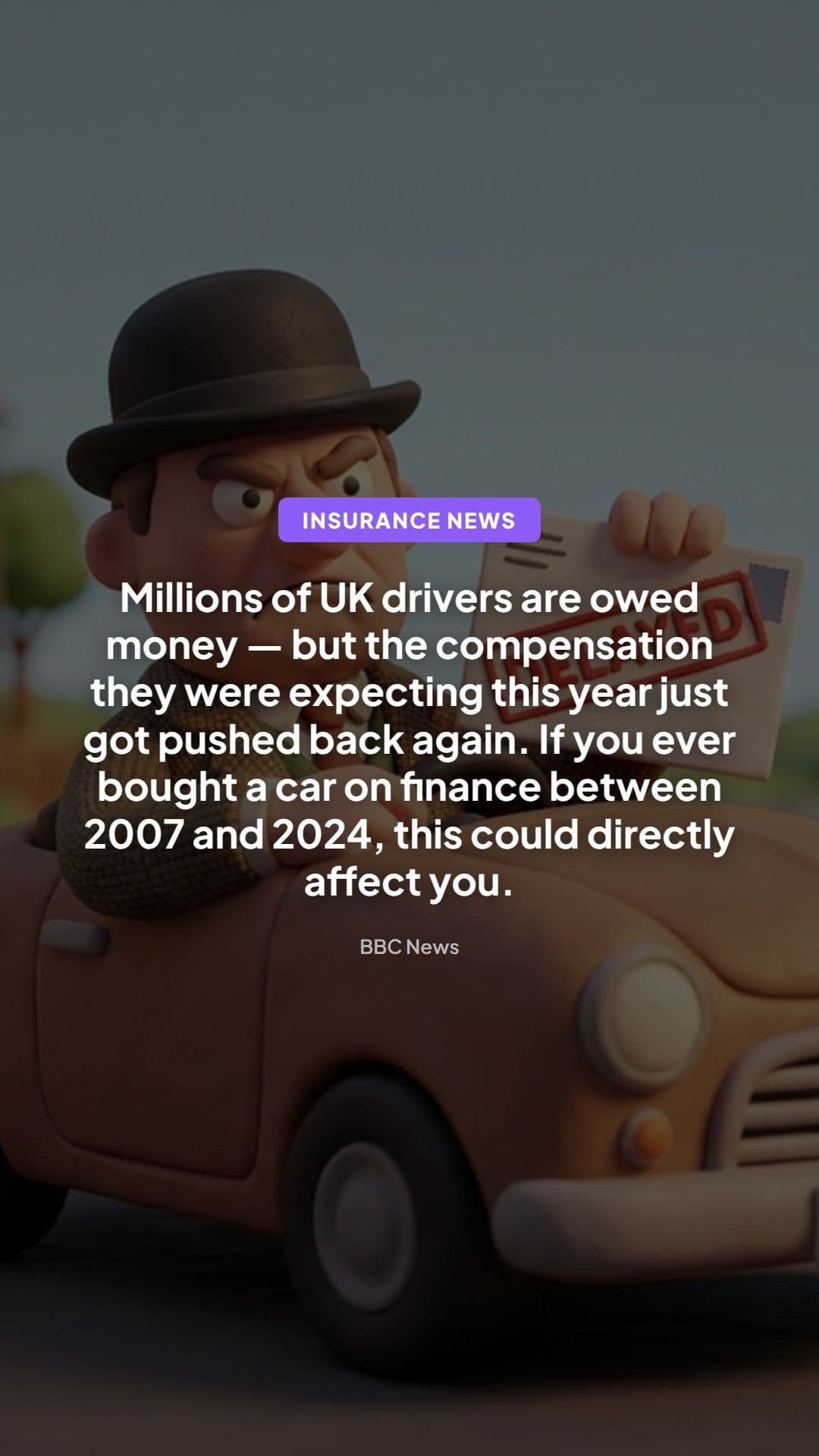
Car Finance Mis-Selling: Why Millions of Drivers Are Still Waiting — and What to Do Now
Imagine discovering that a financial product you trusted to help you buy your car was sold to you dishonestly — that a dealer quietly pocketed a hidden commission, inflating your repayments without your knowledge. Now imagine being told you'll have to wait until at least 2027 to see a penny of compensation. That's the reality facing millions of UK drivers today, and the story behind it is one of the most significant consumer finance scandals in British history.
What's Actually Happening
The Financial Conduct Authority (FCA) has confirmed that compensation payments to drivers mis-sold car finance agreements will not begin until at minimum 2027. The delay stems from ongoing legal challenges that have complicated what was already a sprawling regulatory investigation.
The numbers involved are staggering. Average expected payouts sit at around £829 per mis-sold agreement, and the total potential bill across the industry could reach approximately £9.1 billion — a figure that rivals the infamous Payment Protection Insurance (PPI) scandal, which ultimately cost lenders over £38 billion and took more than a decade to resolve fully.
The agreements in question span a lengthy period: 2007 to 2024. That's 17 years of car finance deals that may have been tainted by a practice known as discretionary commission arrangements (DCAs) — a mechanism that allowed car dealers and brokers to set, or influence, the interest rate on a customer's finance agreement, and to earn a higher commission the more they inflated that rate.
In short: the more you paid, the more the dealer earned. And you were never told.
Why This Matters So Much
This isn't a niche issue affecting a handful of unlucky buyers. Car finance is the most common way Britons purchase vehicles. According to the Finance & Leasing Association, around 90% of new cars bought through dealerships in the UK are financed, with personal contract purchase (PCP) and hire purchase (HP) agreements dominating the market. Millions of households are potentially affected.
The FCA banned DCAs in January 2021 after its own review found that the practice was widespread and caused real consumer harm. But banning the practice going forward did nothing to address the harm already done to those who had taken out agreements in the preceding years.
What prompted the current wave of claims and legal action was a landmark Court of Appeal ruling in October 2024, in which judges found that it was unlawful for car dealers to receive hidden commissions from lenders without the customer's informed consent. The ruling went further than many in the industry expected, opening the door to claims based not just on DCAs but on any undisclosed commission arrangement — a much broader category.
That ruling is now subject to a Supreme Court challenge, which is one of the primary reasons the FCA's redress scheme has been pushed back. Until the Supreme Court delivers its verdict, the full legal landscape — and therefore the precise scope of who qualifies for compensation — remains uncertain.
The Legal Framework Driving This
Several pieces of legislation and regulation are relevant here.
The Consumer Credit Act 1974 requires that credit agreements are transparent and fair. Hidden commissions that influenced the terms of a loan arguably breach the principle that a credit broker must act in the customer's best interests.
FCA Conduct of Business rules (specifically CONC — Consumer Credit sourcebook) require that firms treat customers fairly and disclose material conflicts of interest. A dealer earning a higher commission by charging you a higher rate of interest is precisely the kind of conflict that should have been disclosed but rarely was.
The Financial Services and Markets Act 2000 (FSMA) also comes into play, as it governs the authorisation and conduct of financial services firms. Lenders and brokers operating under FCA authorisation are bound by its requirements around fair treatment and transparency.
The Court of Appeal's October 2024 ruling drew on common law principles around secret commissions and fiduciary duty — specifically, the idea that a broker acting as your agent cannot secretly profit at your expense. This is a well-established principle in English law, and its application to car finance is what caught the industry off guard.
The Supreme Court is expected to clarify the extent of these obligations. If it upholds the Court of Appeal's broader interpretation, the potential compensation pool expands dramatically.
What Drivers Should Know Right Now
If you bought or financed a car between 2007 and 2024 using a PCP, HP, or conditional sale agreement arranged through a dealership, you may be entitled to compensation. Here's what you should be doing now:
1. Don't assume you're excluded. Even if your agreement didn't involve a DCA, the broader ruling on undisclosed commissions may still apply to your deal. The Supreme Court ruling will clarify this, but it's worth preserving your position.
2. Gather your paperwork. Locate your original finance agreement, any correspondence from the lender, and records of payments made. If you no longer have these, your lender is legally obliged to provide them on request under the Consumer Credit Act 1974 (Section 77/78).
3. Submit a complaint to your lender now. The FCA has encouraged consumers to complain directly to their lender. While complaints are currently being paused pending the Supreme Court ruling, submitting one formally establishes your claim and preserves your position in any future redress scheme. Keep a copy of everything.
4. Be cautious about claims management companies. Dozens of CMCs have emerged offering to handle your claim for a fee — sometimes 25–30% of any payout. Given that the FCA is working towards an industry-wide redress scheme, you may not need one. Check whether your lender is part of the scheme before paying anyone a percentage of your potential compensation.
5. Check the Financial Ombudsman Service (FOS) position. The FOS is currently handling car finance complaints and has been working through a significant backlog. If your lender rejects your complaint, you have the right to escalate to the FOS — and this route is free.
6. Note the time limits. Normally, FCA complaints must be raised within six years of the event, or three years from when you became aware of the issue. The FCA has signalled it may extend these limits given the complexity of the situation, but don't bank on indefinite extensions.
Looking Ahead: A Long Road to Resolution
The Supreme Court is expected to deliver its ruling in 2025, with the FCA's formal redress scheme likely to follow in 2026 at the earliest — and actual payments unlikely before 2027. For many drivers, that's a frustrating wait.
But the scale of potential redress is genuinely significant. At £829 per agreement, a household that financed two or three cars over the affected period could be looking at well over £2,000. Some claims — particularly those involving longer agreements or higher-value vehicles — could be considerably larger.
The parallels with PPI are instructive, but also cautionary. PPI compensation took years to reach consumers, spawned an entire industry of dubious claims firms, and ultimately cost far more than early estimates suggested. The FCA appears determined to avoid a repeat of that chaos by establishing a structured, industry-wide scheme — but the legal delays are making that harder.
What's clear is that this is not a scandal that will quietly disappear. The Court of Appeal ruling, the Supreme Court challenge, and the FCA's active involvement all but guarantee that car finance mis-selling will remain one of the dominant consumer finance stories of the next several years.
If you think you might be affected, the time to act — or at least to prepare — is now. Gather your documents, submit your complaint, and avoid handing over a slice of your payout to a CMC before you understand what the FCA scheme will offer. The money may be slow in coming, but for millions of drivers, it is coming.
Source: BBC News. This article provides general information and analysis only.
Written by
Raj Patel
Transport Policy Analyst
Ready to Challenge Your Ticket?
Let our AI analyse your PCN and generate a professional appeal letter in minutes.
Start Free Appeal