Can traffic wardens park on double yellow lines in UK?
A council says a traffic warden can park on double yellow lines for enforcement. We explain UK exemption rules, what’s allowed, and when to complain.

Hannah MacLeod
4 June 2026
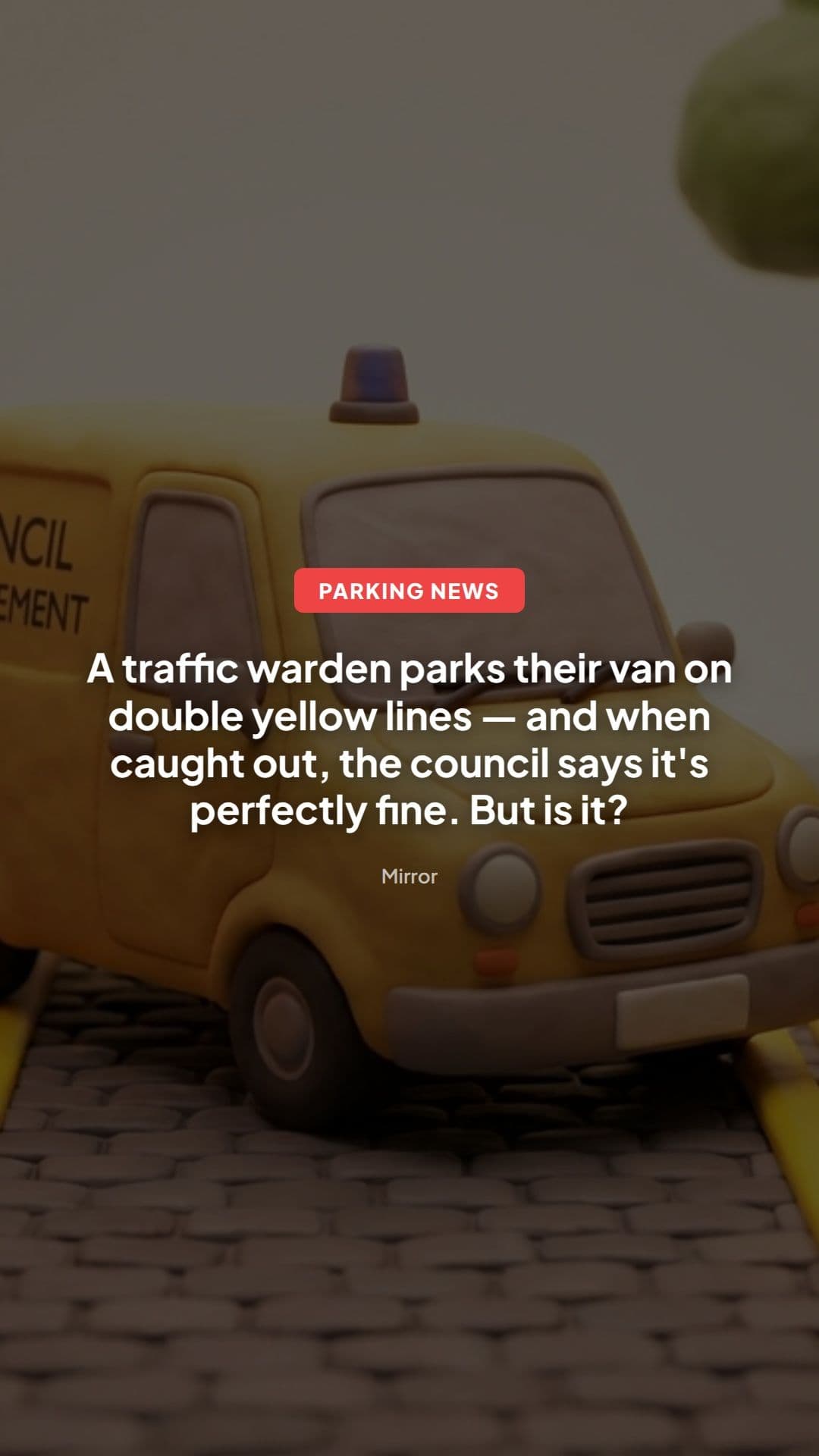
When the Warden Parks on Yellow Lines: Who Polices the Enforcers?
There's a particular kind of frustration that comes from watching someone hand out parking tickets while their own vehicle sits squarely on a double yellow line. It feels like the punchline to a joke that isn't funny — especially if you've ever received a fine for doing exactly the same thing. But when a council defends this practice as entirely lawful, the question becomes more interesting: are they right, and what does it tell us about how parking enforcement actually works in Britain?
What Happened
A traffic warden's van was photographed parked on double yellow lines, and the image — as these things do — made its way online and into the press. The Mirror reported that the local council, rather than apologising or distancing itself from the optics, stood its ground. Their position was straightforward: parking enforcement vehicles are permitted to stop on restrictions in certain circumstances when carrying out operational duties.
The council's defence wasn't bluster. It was, broadly speaking, legally accurate. And that's precisely what makes this story worth unpacking properly.
Why It Matters
At face value, this looks like hypocrisy in a hi-vis jacket. But the reality is more nuanced — and understanding it matters for every driver who has ever questioned whether the rules are applied fairly.
The frustration here isn't irrational. Double yellow lines exist to keep roads clear, maintain sightlines, and prevent obstruction. When a council vehicle parks on them, it creates the very hazard the restriction was designed to prevent. The fact that it's technically permitted doesn't automatically make it operationally sensible or publicly acceptable.
There's also a broader trust issue at play. Parking enforcement is already one of the most contentious areas of local government activity in the UK. Councils rely on PCN revenue to fund enforcement operations, and drivers are acutely aware of that financial relationship. When wardens appear to operate above the rules they enforce, it deepens public scepticism — and that scepticism can undermine the legitimacy of the entire system.
The Legal Angle
So what does the law actually say? Let's get specific.
The Traffic Signs Regulations and General Directions 2016
Double yellow lines are a waiting restriction, not an absolute prohibition on all vehicle movement. Under the Traffic Management Act 2004 and associated regulations, local authorities have the power to enforce waiting and loading restrictions. But enforcement vehicles — including those operated by civil enforcement officers (CEOs) — do benefit from certain statutory exemptions.
The key instrument here is the Traffic Signs Regulations and General Directions 2016 (TSRGD), which governs what road markings and signs mean in law. Double yellow lines prohibit waiting — defined as a vehicle remaining stationary other than to allow passengers to board or alight, or to load or unload. Critically, vehicles that are loading or unloading, or making a brief stop for operational necessity, may not technically be "waiting" in the legal sense.
Operational Necessity and Exemptions
Beyond the definitional nuance, there are specific statutory exemptions that apply to certain vehicles. Under the Road Traffic Regulation Act 1984, Section 87, vehicles used for fire brigade, ambulance, or police purposes are exempt from most traffic restrictions when responding to emergencies. However, civil enforcement vehicles — council-operated warden vans — do not automatically fall under this blanket exemption.
Instead, councils typically rely on a combination of:
- Local Traffic Orders, which can include specific provisions exempting enforcement vehicles from waiting restrictions in their operational area
- The "operational necessity" principle, which is not a formal statutory exemption but is widely applied in practice
- Schedule 1 exemptions within individual Traffic Regulation Orders (TROs), which some councils build in to cover their own enforcement activity
This means the legality of a warden parking on double yellows is not uniform across the country. It depends on the specific wording of the local TRO. Some councils have explicitly written in exemptions for enforcement vehicles; others haven't — and in those areas, a warden's van on double yellows may actually be unlawful, regardless of what the council claims.
The Irony of Enforcement
Here's the genuinely awkward legal reality: a civil enforcement officer cannot issue themselves a PCN, and councils cannot fine their own vehicles. The enforcement mechanism simply doesn't apply upward. There is no independent body that routinely audits whether council enforcement vehicles are themselves complying with restrictions — which creates an accountability gap that this story illustrates rather neatly.
What Drivers Should Know
This story has practical implications beyond the immediate outrage.
1. Check whether a local TRO covers enforcement vehicles
If you believe a council vehicle was unlawfully parked — particularly if it caused an obstruction that affected you — you can request a copy of the relevant Traffic Regulation Order under the Freedom of Information Act 2000. Ask specifically whether enforcement vehicles are exempted from waiting restrictions in that zone. If they're not, you have grounds for a formal complaint.
2. Exemptions are not a free pass
Even where exemptions exist, they typically apply only when the vehicle is actively engaged in enforcement. A warden van parked on double yellows while the officer is inside eating lunch would not qualify. The exemption is operational, not general. If you photograph a council vehicle parked on restrictions with no apparent enforcement activity nearby, that's worth noting.
3. Complaining about council vehicles
If you believe a council enforcement vehicle was parked unlawfully or caused an obstruction:
- Write to the council's parking services department formally, referencing the location, date, time, and any photographs
- Escalate to the Local Government Ombudsman (now the Local Government and Social Care Ombudsman) if the council fails to respond adequately
- Contact your local councillor, particularly if the issue is part of a pattern — elected members can raise operational concerns through scrutiny committees
4. Don't use it as a defence for your own PCN
It's tempting to think: "if the warden can park there, so can I." That logic won't hold up. Any appeal based on the argument that a council vehicle was also parked on restrictions will be dismissed — the exemptions, where they exist, are specific to enforcement operations. The adjudicators at the Traffic Penalty Tribunal are well-versed in this argument and it carries no weight.
5. Know the difference between a restriction and a prohibition
Double yellow lines prohibit waiting, not stopping entirely. You are permitted to stop briefly to drop off or pick up a passenger, or to load and unload (unless kerb marks indicate otherwise). This is a distinction many drivers don't realise — and it's also part of why enforcement vehicles can legitimately stop there briefly without necessarily breaching the restriction.
Looking Ahead
This story is unlikely to prompt immediate legislative change, but it touches on something that deserves serious policy attention: the accountability gap in civil parking enforcement.
Since parking enforcement was decriminalised in the 1990s and progressively handed to local authorities, the system has grown enormously. Millions of PCNs are issued every year, generating hundreds of millions of pounds in revenue. Yet the oversight mechanisms for the enforcers themselves remain relatively thin.
The British Parking Association (BPA) and International Parking Community (IPC) set codes of practice for private operators, but local authority enforcement is largely self-regulated, with complaints handled internally before escalating to the Ombudsman. There is no independent inspectorate that monitors whether council enforcement vehicles comply with the same rules they enforce.
As public trust in parking enforcement continues to erode — fuelled by stories exactly like this one — there is a growing case for greater transparency. That might mean councils publishing operational exemptions clearly and proactively, rather than defending them after the fact. It might mean independent auditing of enforcement vehicle activity. Or it might simply mean that when a warden parks on double yellows, there's a visible, publicly accessible reason attached to it.
The rules may well allow it. But in an era when every parking ticket feels like a revenue exercise rather than a safety measure, the optics of enforcing restrictions you don't follow yourself are corrosive — and councils would do well to understand that.
The law gives enforcement vehicles a degree of latitude. Public confidence doesn't.
Source: Mirror — "Council says 'it's allowed' as traffic warden parks on double yellow lines"
Written by
Hannah MacLeod
Traffic Law Specialist
Ready to Challenge Your Ticket?
Let our AI analyse your PCN and generate a professional appeal letter in minutes.
Start Free Appeal