Can EVs ease UK fuel reserves? What drivers should know
EV uptake and two-way charging could help the UK manage fuel reserve risks during supply shocks—cutting reliance on petrol and diesel. What it means for drivers.

Yuki Tanaka
28 March 2026
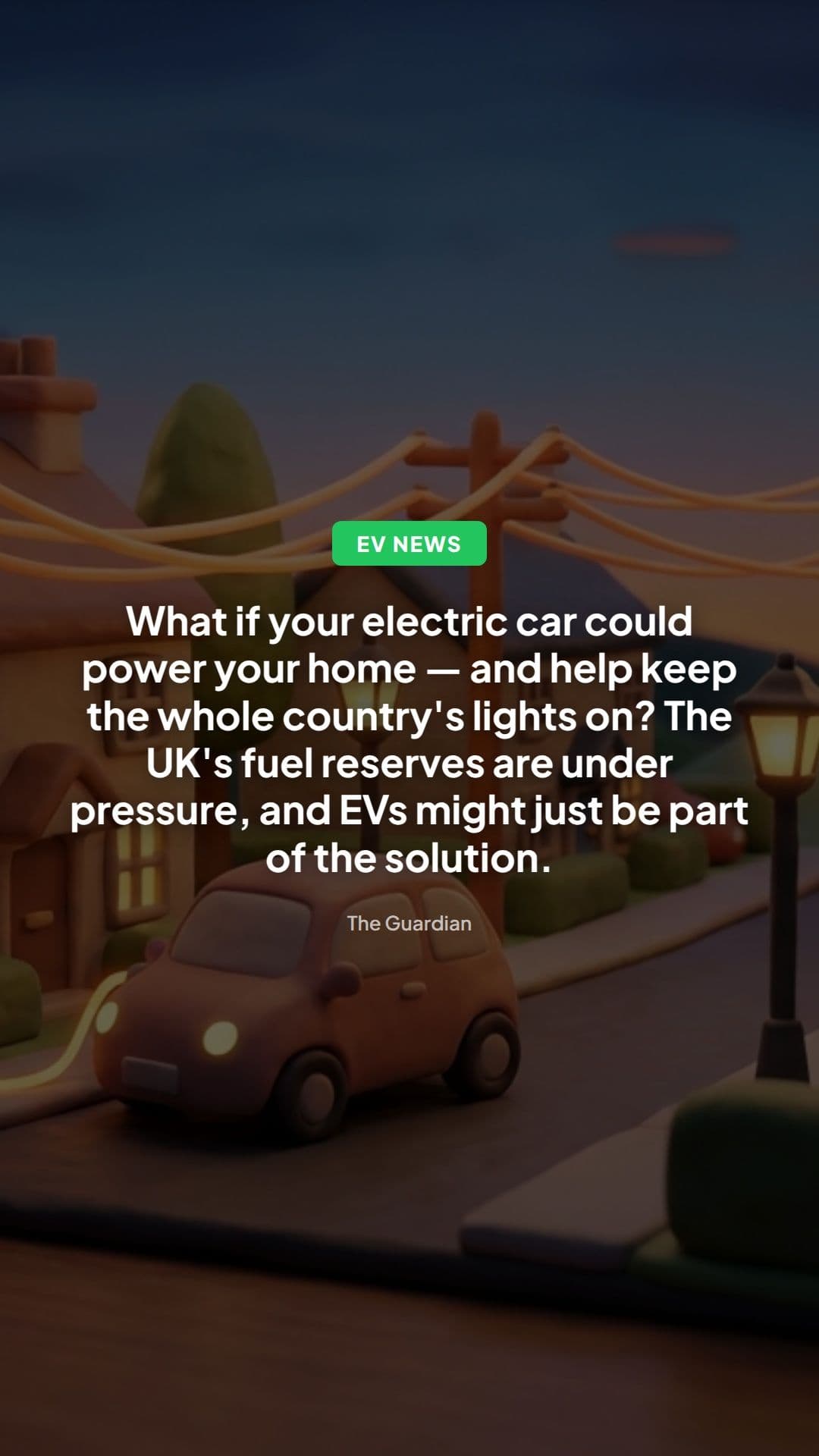
Could Your Electric Car Help Power Britain Through an Energy Crisis?
Imagine a future where, during a global fuel supply shock, the government doesn't scramble to release emergency oil reserves or beg foreign suppliers for more crude — instead, it simply asks millions of British EV owners to plug in. Not to charge their cars, but to feed electricity back into the grid. That future is closer than most drivers realise, and it raises some genuinely fascinating questions about what it means to own a vehicle in the 21st century.
A recent piece in The Guardian explored how the widespread adoption of electric vehicles, combined with so-called "vehicle-to-grid" (V2G) technology, could play a meaningful role in addressing the UK's fuel reserve vulnerabilities. But the story goes considerably deeper than a feel-good headline about green cars saving the day. This is about national energy security, the changing relationship between drivers and the state, and some very real practical decisions facing anyone thinking about going electric right now.
What's Actually Going On: The Fuel Reserve Problem
Britain has long maintained strategic fuel reserves — stocks of petrol, diesel, and other petroleum products held to buffer against supply disruptions. The UK is legally obliged under International Energy Agency (IEA) membership rules to hold oil stocks equivalent to at least 90 days of net imports. In practice, a combination of government-held reserves and obligations placed on industry keeps the lights on when global supply chains wobble.
But wobble they do. The past few years have demonstrated just how fragile fossil fuel supply chains can be — from the post-pandemic logistics crunch to the energy price shock triggered by Russia's invasion of Ukraine. Each disruption has renewed questions about whether the UK's reserve system is truly fit for purpose, and whether an economy still heavily dependent on imported hydrocarbons can adequately protect itself.
The answer The Guardian explores is genuinely novel: what if a fleet of millions of electric vehicles, each carrying a substantial battery pack, could collectively act as a distributed energy reserve? Not a replacement for strategic oil stocks, obviously, but a meaningful buffer — one that could smooth out demand spikes, reduce grid pressure during crises, and lessen the country's appetite for fossil fuels in the first place.
Why This Matters More Than You Might Think
The UK currently has around 1.3 million fully electric cars on the road, a figure that is growing rapidly as the government's Zero Emission Vehicle (ZEV) mandate pushes manufacturers to ensure that an increasing proportion of their new car sales are electric — rising to 100% by 2035.
A typical modern EV carries a battery of between 50 and 100 kilowatt-hours (kWh). Even conservatively, if a million EVs each stored an average of 40 kWh of usable energy, that's 40 gigawatt-hours of distributed storage. For context, the UK's peak electricity demand on a cold winter evening runs to around 50–55 gigawatts. That's not a solution on its own, but it's far from trivial.
The technology that makes this useful is Vehicle-to-Grid (V2G) charging — two-way chargers that allow electricity to flow not just into your car, but back out of it and into the grid. Your car, plugged in overnight, could discharge energy during the evening peak, earn you money through smart energy tariffs, and recharge itself at 2am when demand — and prices — are lowest.
Crucially, this isn't science fiction. V2G trials have been running in the UK for several years. Octopus Energy's Powerloop scheme and Ovo Energy's partnerships with Nissan (whose Leaf has supported V2G for some time) have demonstrated that the technology works at a consumer level. The question is no longer whether it's possible, but how fast we can scale it.
The Legal and Regulatory Landscape
This is where it gets genuinely interesting for drivers. The legal framework around V2G and smart charging in the UK is evolving rapidly, and there are several important regulations already in place — or coming — that every EV owner should understand.
The Electric Vehicles (Smart Charge Points) Regulations 2021 came into force in June 2022 and represent a significant piece of legislation. They require that any new private EV charge point sold or installed in the UK must be a "smart" charger — one capable of communicating with the grid and responding to signals to shift charging to off-peak periods. This isn't optional; it's a legal requirement for manufacturers and installers.
These regulations also set requirements around randomised delay — chargers must not all start charging simultaneously when plugged in, which would cause dangerous demand spikes on the grid. Instead, they must spread load intelligently.
The regulations don't yet mandate V2G capability, but the groundwork is clearly being laid. The government's Smart Systems and Flexibility Plan, updated in recent years by Ofgem and DESNZ (the Department for Energy Security and Net Zero), explicitly identifies V2G as a priority technology and commits to removing regulatory barriers to its rollout.
One significant barrier has been VAT. For some time, energy exported from a vehicle back to the grid attracted a different VAT treatment than energy imported, creating accounting headaches for energy suppliers and dampening commercial interest in V2G tariffs. HMRC has been working through the implications, and clarity on this point is essential before V2G can go truly mainstream.
There are also grid connection and Distribution Network Operator (DNO) considerations. Homes with V2G chargers are, in effect, becoming micro-generators. The rules around what you can export, at what rate, and how this interacts with your energy contract are still being standardised. Ofgem's ongoing work on flexible demand and the development of a proper half-hourly settlement system for domestic consumers will be critical to making V2G commercially attractive at scale.
What Drivers Should Know Right Now
If you're an EV owner, or seriously considering becoming one, here's what's practically relevant today:
- Check your charger's smart credentials. If you've had a home charger installed since June 2022, it should already be a smart charger. If it was installed before that date, it may not be — and you could be missing out on cheaper off-peak charging rates.
- Look at smart EV tariffs. Energy suppliers including Octopus (with its Intelligent Octopus Go tariff) and OVO offer tariffs specifically designed for EV drivers that charge your car at significantly cheaper overnight rates — sometimes as low as 7–8p per kWh versus 25p+ during the day. This can save hundreds of pounds annually.
- Investigate V2G compatibility before buying. Not all EVs support V2G. The Nissan Leaf (with a CHAdeMO port), certain Mitsubishi models, and increasingly vehicles from brands like Volkswagen and Hyundai (with CCS connectors and appropriate firmware) support bidirectional charging. If V2G matters to you, check compatibility before committing to a vehicle.
- Don't assume your installer knows about V2G. Many domestic EV charger installers are not yet fully across the V2G landscape. If you want to future-proof your home setup, ask specifically about bidirectional charger options and ensure your home's electrical setup can support export as well as import.
- Understand the financial opportunity. Early V2G trial participants have reported meaningful earnings — in some cases over £500 per year — from selling electricity back to the grid during peak periods. As these tariffs become more widely available, this could become a genuine income stream for EV owners.
Looking Ahead: A New Kind of Driver
The broader implication of all this is profound. For most of motoring history, drivers have been purely consumers of energy — you pull up, you fill up, you drive away. The relationship between a vehicle and the energy system has been entirely one-directional.
V2G changes that fundamentally. EV owners could become active participants in the energy market — storing cheap electricity, selling it back at peak times, and collectively providing a buffer that reduces the country's dependence on imported fossil fuels. In the context of the energy security concerns raised by The Guardian, this isn't just environmentally interesting; it's strategically significant.
The government clearly recognises this. The ZEV mandate, the Smart Charge Points Regulations, and ongoing Ofgem reforms are all pieces of a larger puzzle. But the pace of regulatory change will need to match the pace of EV adoption if Britain is to capture the full potential of its growing electric fleet.
For drivers, the message is clear: going electric is no longer just about saving money on fuel or reducing your carbon footprint. It's about becoming part of a smarter, more resilient energy system — one that could, in the not-too-distant future, help the UK weather the next global supply shock rather than scramble to survive it.
The car on your driveway might just be the most useful piece of national infrastructure you've never thought about.
Written by
Yuki Tanaka
Urban Planning Researcher
Ready to Challenge Your Ticket?
Let our AI analyse your PCN and generate a professional appeal letter in minutes.
Start Free Appeal