
Camden Traffic Warden Strike: What It Means for Parking
Over 100 Camden traffic wardens are set to strike for eight weeks. Find out how reduced parking enforcement could affect drivers and local streets.

The Parking Ticket Pal Editorial Team
9 October 2026
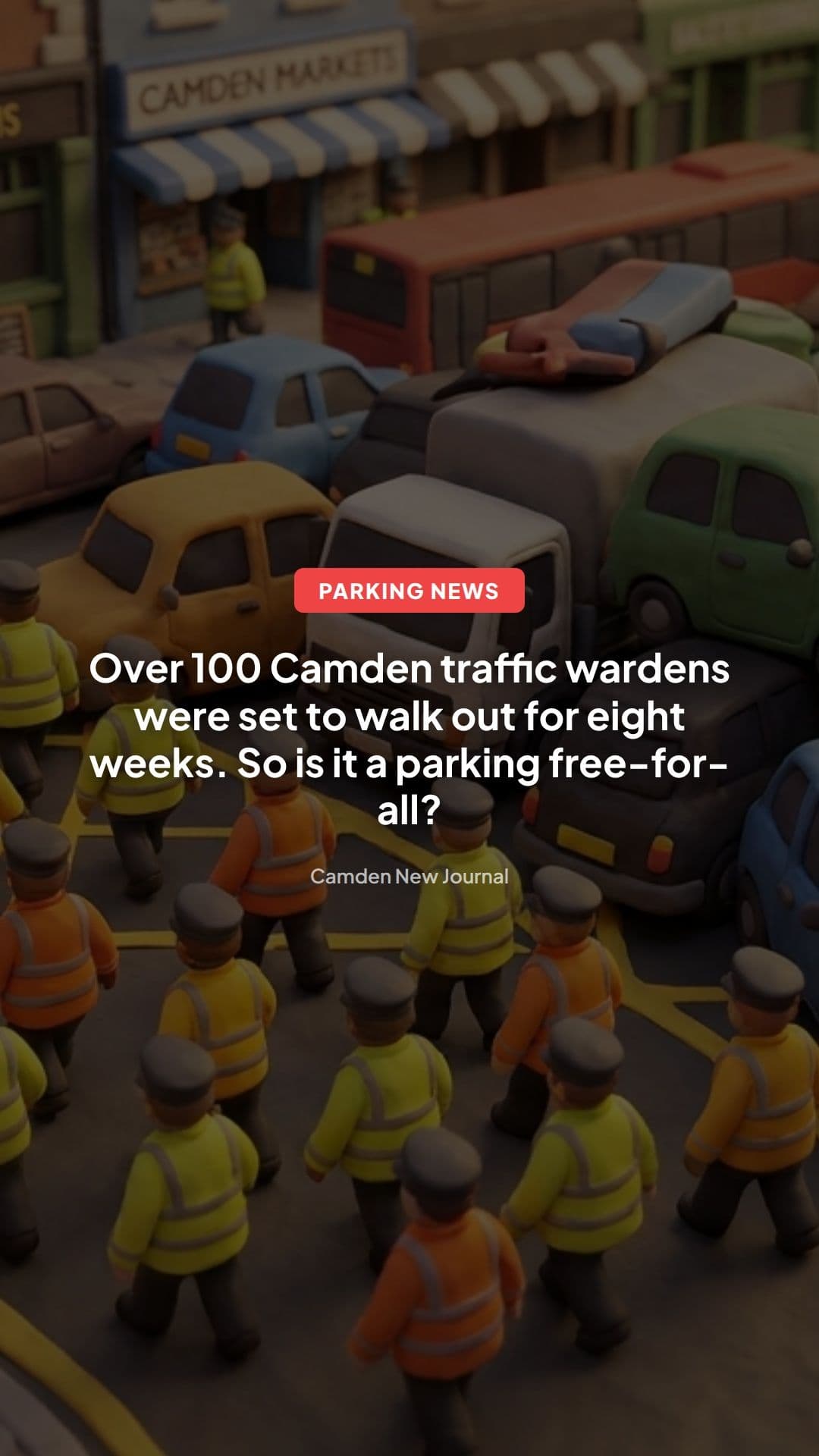
Camden Parking Wardens Plan an Eight-Week Strike: What It Means for Drivers
Few headlines make a motorist's ears prick up like "parking free-for-all". The Camden New Journal's report that more than 100 of the borough's traffic wardens are preparing an eight-week strike has people wondering whether the yellow lines are about to become decorative.
They are not. A strike by enforcement staff changes who is likely to catch you, not what the rules are. For drivers in and around Camden, the gap between those two things is where the risk sits. Here is what is being reported, what the law says, and how to avoid getting caught out.
What has been reported
According to the Camden New Journal, more than 100 Camden traffic wardens are reportedly preparing an eight-week strike. The paper's framing is that the action could sharply reduce local parking enforcement and lead to more illegal or obstructive parking across the borough.
Treat this as a developing story. The headline and summary use cautious language ("reportedly preparing"), and I am not going to guess at details the report does not give. For the latest on the grounds for the dispute, who is involved, and whether any dates are fixed, read the original coverage and any council or union statements. What matters for drivers is the practical effect if the action goes ahead: for a sustained period, far fewer officers on foot and in vehicles.
Eight weeks is a long time. A one-day walkout is a blip. Two months is long enough for habits to shift, for delivery drivers, commuters and visitors to notice that nobody is checking, and for problems such as blocked junctions and bays to build up.
Why this matters more than it first appears
Camden is a dense inner-London borough with a heavy mix of residents, commuters, visitors, hospitals, universities, markets, shops and through traffic. Much of the borough is covered by controlled parking zones, and kerb space is under constant pressure. Enforcement is what makes that system work. Without it, restrictions rely on goodwill, and goodwill is thin on a busy street.
Parking enforcement is often thought of as revenue collection, and councils do raise money from it. But the underlying purpose, set out in the Traffic Management Act 2004, is managing road space: keeping traffic moving, keeping bus stops and crossings clear, giving residents a realistic chance of finding a space, and keeping loading bays usable for the businesses that depend on them.
When enforcement thins out, the effects tend to show up in predictable places:
- Junctions and corners, where a single car parked too close can block sightlines and make turns difficult for buses and larger vehicles.
- Dropped kerbs and crossings, where parking creates real problems for wheelchair users, people with pushchairs and visually impaired pedestrians.
- Disabled bays and loading bays, which are quickly taken by anyone prepared to gamble.
- Residents' bays and pay and display bays, where turnover collapses if people overstay.
- Bus stops and clearways, where delays ripple through the network.
Residents who rely on those bays and kerbs will bear most of the inconvenience. If you live in the borough and have been counting on a particular bay, expect it to be harder to find a space.
What the law actually says
Restrictions do not pause
This is the central point. Yellow lines, red routes, resident bays, loading restrictions, pay and display rules and the rest are created by traffic orders. They stay in force whether or not a warden is on the street. A strike by civil enforcement officers does not suspend a traffic order, and the council does not announce an amnesty by default. Unless the council formally says otherwise, the rules apply as normal.
Parking in England (outside private land) is civil enforcement
Under Part 6 of the Traffic Management Act 2004, councils with civil enforcement powers issue penalty charge notices (PCNs) for parking contraventions. A PCN can be served in different ways. The most familiar is a ticket on the windscreen or one handed over by a civil enforcement officer. In other circumstances, such as when the vehicle drives off, or when the contravention is captured on an approved camera device, the notice can be sent by post to the registered keeper.
For that reason, a quiet street is not the same as a safe street. Camera enforcement does not depend on wardens being on the pavement. Councils use approved devices for certain contraventions, such as bus lanes and some moving traffic restrictions, and in some places for specific parking restrictions such as stopping on school entrance markings or in certain bus stop areas. If you are in the habit of treating those as a warden-only risk, think again.
Late enforcement is possible
PCNs have to be issued within time limits set out in regulations, and the postal route is tightly defined. It is not a general licence for the council to send a bundle of notices weeks later for things a warden did not see. But it also means you should not assume that no warden today equals no consequence. Whether a particular notice is valid depends on how and when it was served, and it is the sort of thing worth checking if you ever receive one.
Police and other powers still exist
Councils are not the only ones who can act. Obstruction is a matter for the police under separate law, including the "unnecessary obstruction" rules in the Road Vehicles (Construction and Use) Regulations 1986 and the offence of wilfully obstructing the highway under the Highways Act 1980. Police can also deal with some dangerous or inconsiderate parking, and vehicles can be removed in certain circumstances. If a car is blocking a driveway, a pavement or a junction in a way that creates danger, the police are an option for reporting it, particularly where emergency access is affected.
Private land is a different system
Supermarket car parks, retail parks and hospital sites operate under a different regime. Private parking companies issue parking charges under contract law, and keeper liability is governed by Schedule 4 of the Protection of Freedoms Act 2012. A council warden strike does not touch that. If you park in a private car park, the same operators and cameras will carry on as before.
Practical advice for drivers
None of this is legal advice, and what suits one driver will not suit another. But these are sensible points to keep in mind.
If you drive in Camden
- Do not treat the strike as a green light. The restrictions remain, cameras keep working, and any enforcement that does happen will be applied to those who are caught.
- Keep paying where payment is required. If you pay by app, keep the confirmation. Payment records and photographs are the usual evidence in a dispute.
- Check the signs every time. Restrictions vary from street to street, and some apply only at certain hours or on certain days. A habit that works on one road may not work on the next.
- Think about the people behind the rules. A bay marked for disabled drivers, a dropped kerb or a junction is there for a reason. If enforcement is light, the burden falls on drivers to act sensibly.
If you are a resident
- Expect more competition for spaces. Visitors and commuters who would normally avoid your street may be tempted to try their luck.
- Document problems rather than confronting people. If a vehicle is blocking your driveway or causing a safety issue, photographs with date, time and location are useful when you report it to the council or, where there is danger, the police. Confrontation tends to make things worse.
- Report through proper channels. Councils usually have an online reporting route for illegal parking, and these reports may still be used to direct whatever enforcement resources are available.
- Know that you can still challenge a PCN you receive. If you get a ticket in the coming weeks, whether in Camden or elsewhere, the normal process applies. In London, you can usually pay at a reduced rate within 14 days, or challenge the notice through the council's informal and formal stages and, if rejected, appeal to London Tribunals. Check the notice itself, which sets out your options and deadlines.
If you are a visitor or commuter
- A lack of wardens is not a defence. If you are caught by a camera or a late-arriving officer, "I never saw anyone" does not help.
- Consider alternatives. If your destination is hard to park near, public transport or a car park may be safer than hoping for the best.
- Mind the traps. Red routes, bus stops, loading bays and pedestrian zones are risky places to gamble, particularly if you are unfamiliar with the area.
If you are running a business
Deliveries and loading are particularly exposed. If bays are blocked, your drivers may struggle to find legal places to stop. Plan routes and timings with that in mind, and make sure drivers know the rules on loading and permitted stopping rather than assuming they can stop anywhere.
The wider picture
The dispute raises a question that goes beyond Camden. Enforcement is a visible public service, and when it is reduced, people discover quickly how much the rules rely on being applied. Councils across the country have faced debates about parking enforcement staffing, outsourcing and the balance between traffic management and revenue. Whatever the specific grievances in Camden, which the source article is the best place to follow, a long strike will put those arguments in front of the public.
It also raises practical questions for the council. If compliance drops, the borough may face complaints from residents, pressure from businesses and concern from transport bodies about blocked buses and emergency access. If the strike is resolved or called off, there may be a catch-up period with more visible enforcement, and some drivers who have got used to a quieter regime may be surprised.
For drivers, the safest assumption is simple: the rules are exactly the same, only the odds of being caught on any given day may change, and cameras do not go on strike. If you would not park somewhere with a warden standing next to you, think twice before parking there when no one is watching.
Key takeaways
- A strike changes who might catch you, not what is legal. Traffic orders stay in force.
- Cameras and approved devices continue to operate, and PCNs can still arrive by post where the law allows.
- Police can act on obstruction and dangerous parking regardless of council enforcement levels.
- Private car parks are unaffected, because they follow a different legal regime.
- Keep evidence, check signs, and use the normal challenge process if you receive a notice you believe is wrong.
- Follow the Camden New Journal and official council announcements for confirmed dates and details, as the story is still developing.
Written by
The Parking Ticket Pal Editorial Team
Source-checked parking guidance
Ready to Challenge Your Ticket?
Let our AI analyse your PCN and generate a professional appeal letter in minutes.
Start Free Appeal