Britain’s pothole roads: why drivers still love them
Britain’s pothole crisis is worsening, yet drivers still seek out the best B-roads. We explore road maintenance failures, liability and what it means for car culture.

Priya Sharma
17 May 2026
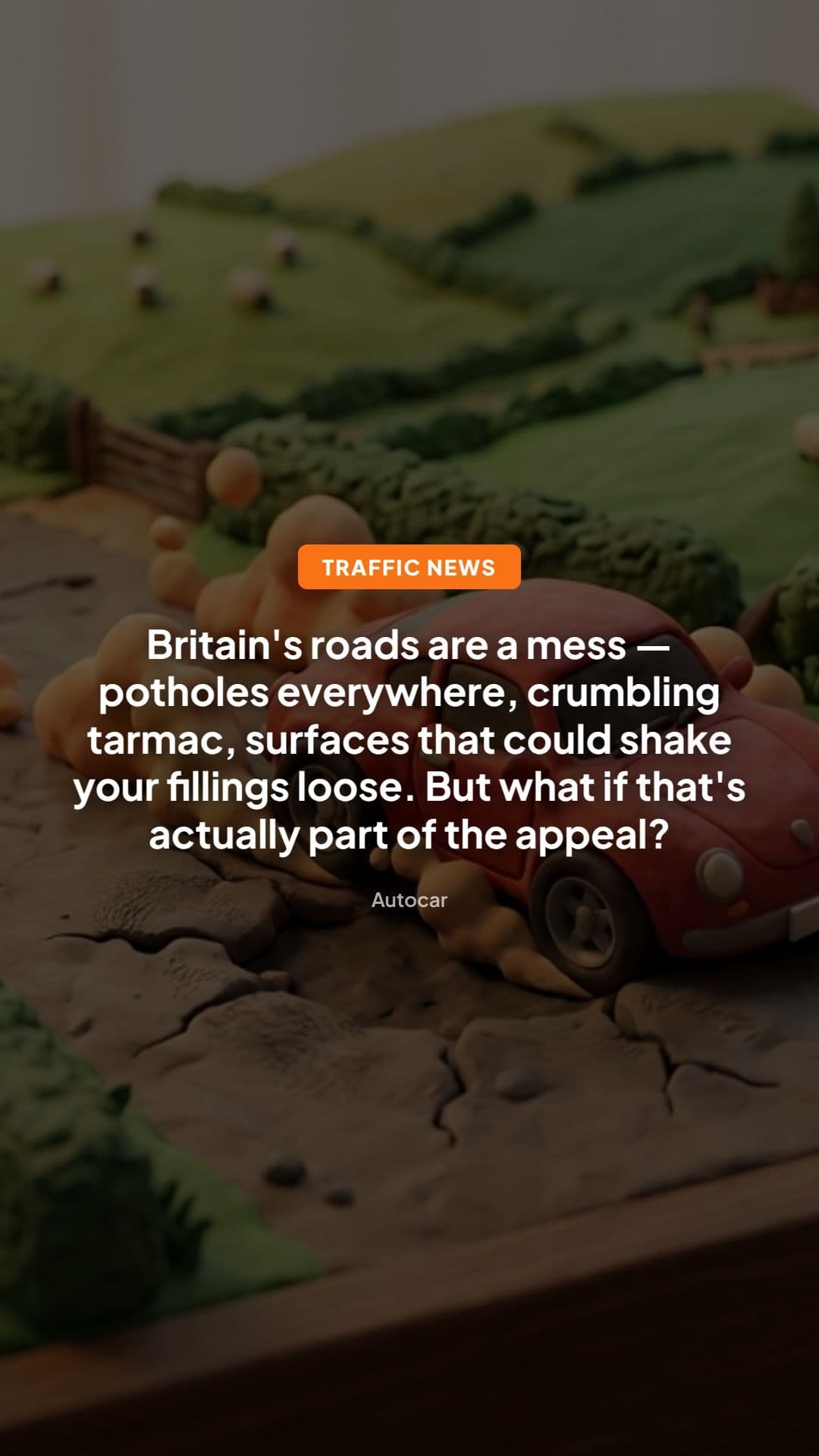
Britain's Roads Are Falling Apart — And Somehow, That's Part of the Charm
There's a particular kind of masochism that defines the British motoring experience. You set off on a Sunday drive through some gloriously winding B-road in the Cotswolds or the Brecon Beacons, heart full of optimism, and within three miles you've navigated a pothole the size of a small paddling pool, a crumbling verge that's swallowed half the lane, and a stretch of tarmac so patchwork it resembles a bad quilt. And yet — somehow — you wouldn't have it any other way.
That, in essence, is the argument Autocar puts forward in their recent opinion piece "Holey Land: Britain's Knackered Roads Are Still a Haven for Car Lovers." It's a provocative take, and one that deserves far more unpacking than a single column allows. Because behind the romantic notion of driving Britain's battered backroads lies a deeply uncomfortable reality: our road network is in a genuine state of crisis, with real legal, financial, and safety consequences for every driver on the tarmac.
The Story: Celebrating the Unlovable
Autocar's piece takes a glass-half-full view of something most drivers would consider a glass-completely-smashed situation. Yes, British roads are rough. Yes, the surfaces are crumbling. But the argument goes that this very imperfection — the narrow lanes, the unexpected cambers, the roads that demand your full attention — creates a driving environment that rewards skill and engagement in a way that smooth, wide, continental motorways simply don't.
It's a view many enthusiasts will recognise. There's a reason car journalists consistently rave about driving in Wales, Scotland, or the Yorkshire Dales. The roads there haven't been engineered into submission. They're organic, challenging, alive. But the piece also implicitly acknowledges the elephant in the room: these roads aren't rough because of some charming design philosophy. They're rough because they haven't been properly maintained in years.
Why It Matters: The Scale of the Problem
Britain's road maintenance crisis is not new, but it is worsening. According to the Asphalt Industry Alliance's Annual Local Authority Road Maintenance (ALARM) survey, the backlog of repairs needed on local roads in England and Wales has reached staggering proportions — councils themselves estimate it would take over a decade to clear the backlog even with current funding levels.
The reasons are structural. Local authority road budgets have been squeezed for years. Central government funding for local roads is fragmented and often short-term, making long-term maintenance planning nearly impossible. Winter weather accelerates surface deterioration, and the increasing weight of modern vehicles — particularly larger SUVs and electric cars with heavy battery packs — places greater stress on road surfaces that were built for lighter traffic.
The result is a network that looks, in places, like it belongs to a country that hasn't invested in infrastructure since the 1970s. Which, in fairness, some of it hasn't.
The Legal Angle: What Rights Do Drivers Actually Have?
Here's where the romantic notion of "character-filled roads" collides with hard legal reality. If a pothole damages your vehicle, you are not simply expected to absorb the cost. You have legal recourse — though exercising it requires understanding how the law works.
The Highways Act 1980 places a statutory duty on highway authorities (typically local councils) to maintain roads in their area. Under Section 41, councils must ensure that roads are safe for ordinary traffic. Crucially, however, Section 58 provides councils with a complete defence if they can show they took "reasonable care" to maintain the road — which in practice means they can escape liability if they followed a regular inspection schedule, even if the pothole was already dangerous.
This creates a frustrating paradox. A council that inspects a road every six months and misses a pothole that develops in week two may face no liability, even if that pothole destroys your suspension. The law essentially rewards process over outcome.
Key legal points for pothole damage claims:
- You must be able to prove the pothole caused the damage (photographs with a coin or ruler for scale are essential)
- You must report the pothole to the council — ideally before making a claim, and certainly as part of the process
- Check whether the pothole was already reported using the council's own records (obtainable via a Freedom of Information request)
- Claims are made directly to the local highway authority, not through the courts initially
- If rejected, you can escalate to the Local Government Ombudsman or pursue a civil claim in the small claims court for amounts under £10,000
There is no automatic right to compensation. But there is a clear legal pathway — and councils do pay out. Many quietly settle claims to avoid the cost of litigation.
What Drivers Should Know: Protecting Yourself on Britain's Battered Roads
Whether you're an enthusiast embracing the challenge of a demanding B-road or simply trying to get to work without losing a wheel, there are practical steps every driver should take.
Before you drive:
- Check your tyre pressures regularly. Under-inflated tyres are far more vulnerable to pothole damage, particularly sidewall impact. The correct pressure is in your vehicle handbook — not the tyre sidewall, which shows the maximum.
- Know your suspension. Lowered vehicles and performance cars with stiff suspension setups are disproportionately affected by poor road surfaces. If you've modified your car, factor that into route planning.
- Consider your insurance excess. Many drivers don't realise that pothole damage claims can be made directly against the council rather than through their own insurer — meaning no excess, no loss of no-claims bonus.
If you hit a pothole:
- Stop safely and assess — check for tyre damage, unusual handling, or visible wheel damage before driving further
- Photograph everything — the pothole (with something for scale), your vehicle, the road name, and any damage
- Report it immediately — use the council's online reporting tool or Fix My Street (fixmystreet.com), which logs and timestamps your report
- Keep all receipts — garage invoices, hire car costs, and any consequential expenses strengthen your claim
- Submit a formal claim to the relevant highway authority — most councils have an online claims process
If your claim is rejected:
- Request the council's inspection records for that road under the Freedom of Information Act 2000
- If the pothole had already been reported and not repaired, this significantly strengthens your position
- Consider the small claims court for amounts up to £10,000 — the process is designed to be accessible without a solicitor
The Enthusiast's Dilemma: Passion Versus Practicality
There's something genuinely worth preserving in Autocar's argument. Britain's roads, for all their faults, do create a driving culture that values skill, attention, and the physical connection between driver and machine. The narrow lanes of Dartmoor, the switchbacks of the Pass of the Cattle in Scotland, the undulating B-roads of mid-Wales — these are genuinely world-class driving roads, precisely because they haven't been smoothed into irrelevance.
But there's a difference between roads that are challenging and roads that are dangerous. A tight, well-surfaced country lane demands concentration and rewards skill. A cratered urban road or a pothole-riddled A-road that blows out tyres and cracks alloy wheels is simply a failure of governance. Conflating the two does a disservice to both the driving experience and the legitimate grievances of motorists who face real costs every day.
The romantic view is best enjoyed in a well-maintained performance car on a genuinely scenic route. For the millions of drivers navigating crumbling urban streets in everyday vehicles, the poetry wears thin rather quickly.
Looking Ahead: Will It Get Better?
The honest answer is: not quickly. Road maintenance funding remains politically unglamorous. Councils are under pressure from multiple directions, and resurfacing a B-road rarely wins votes in the way that a new leisure centre or school might. The shift towards electric vehicles — heavier than their petrol equivalents — will likely accelerate surface degradation on roads that were never designed for their weight.
There are some grounds for cautious optimism. The government has made periodic commitments to increase local road funding, and technology is beginning to play a role — AI-assisted pothole detection systems are being trialled by several councils, enabling faster identification and prioritisation of repairs.
But systemic improvement requires sustained investment over years, not one-off announcements. Until that happens, Britain's roads will remain both a source of motoring romance and a genuine hazard — and drivers will need to stay informed, stay prepared, and know their legal rights when the inevitable happens.
The roads may be knackered. But at least now you know what to do about it.
Written by
Priya Sharma
Legal Aid Coordinator
Ready to Challenge Your Ticket?
Let our AI analyse your PCN and generate a professional appeal letter in minutes.
Start Free Appeal