Bexley PCN Appeal Allowed: Restricted Street Lessons
A Bexley PCN appeal for parking in a restricted street was allowed. Learn how to check restrictions, evidence and council paperwork before paying a charge.

Lisa Rodriguez
30 July 2026
When Three Parking Tickets in a Row Turned Out to Be Bexley's Mistake, Not the Driver's
Imagine parking your car in a perfectly ordinary bay, leaving it there for a few days, and coming back to find three penalty charge notices stacked up against you, one for each day. That is exactly what happened to a driver in the London Borough of Bexley, and it led to a tribunal case that offers a genuinely useful lesson about who has to prove what when a council paints new road markings.
This case is a reminder that councils cannot simply assume their yellow lines are correctly placed. If a driver challenges the legality of the line itself, the burden shifts firmly onto the authority to prove it got the details right.
The Case: Three Tickets, One Parked Car
The driver had left his car parked at a spot in Bexley before 24 April. According to his account, when he parked, he was inside a marked bay and there was no yellow line restricting that spot. He then received three separate penalty charge notices on consecutive days, all for the same parked vehicle, all alleging the same contravention: parking in a restricted street.
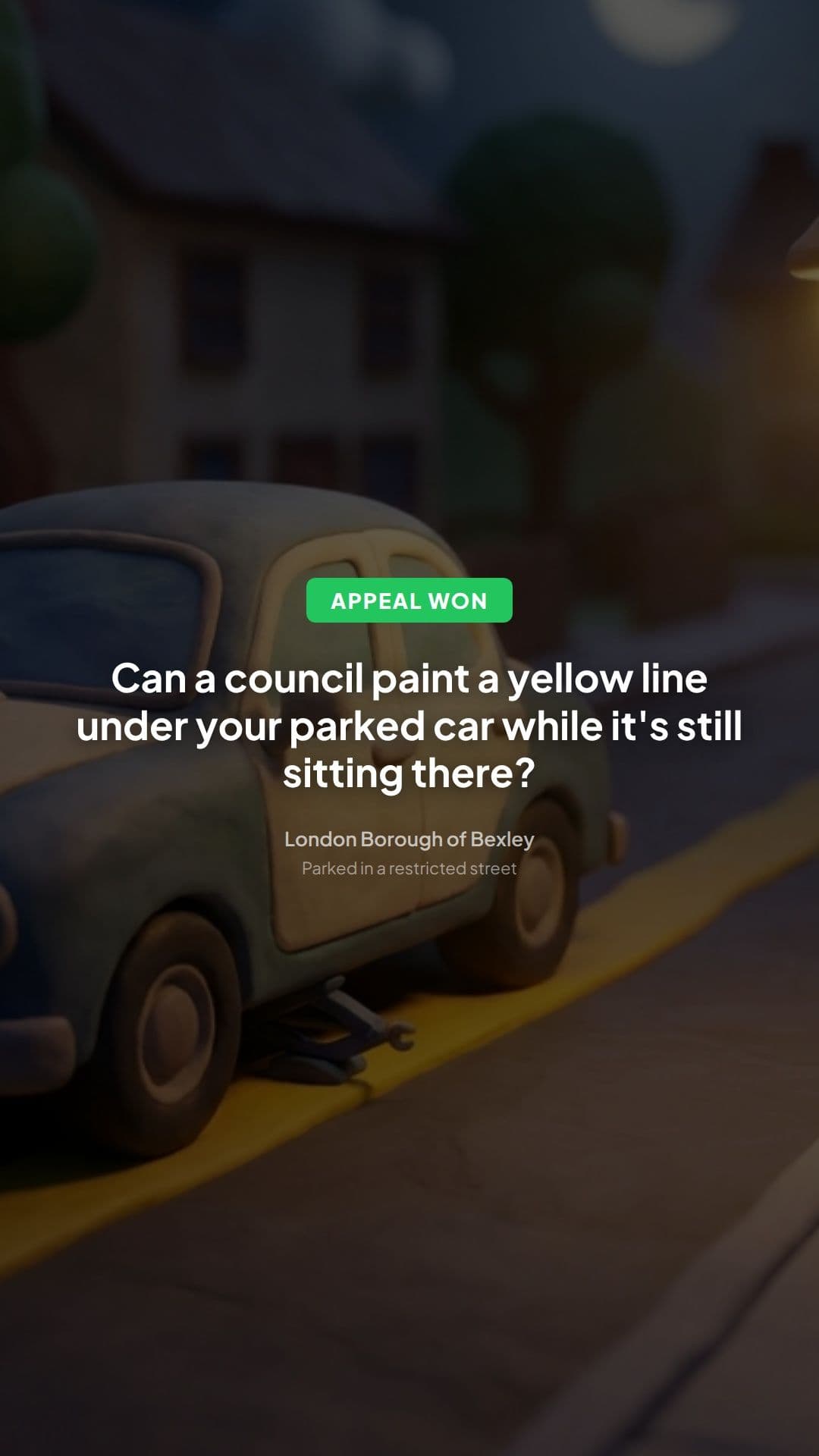
His explanation for what had happened was unusual, to say the least. He suggested that at some point after he parked, his car had been lifted, perhaps with a jack, so that a new yellow line could be painted underneath it before the vehicle was lowered back down. It sounds like a stretch, but he backed it up with photographic evidence: a tyre print visible on the yellow line, and yellow paint transferred onto his own tyre. Whatever the exact mechanics, something had clearly caused paint to end up where his tyre had been.
He also raised a second, arguably more important point. He said the yellow line encroached into the parking bay itself, rather than staying on the carriageway edge where you would normally expect it.
The Arguments: Driver vs Council
The council's response was straightforward on the surface. Bexley said the bay had been repainted around two weeks before the penalty charge notices were issued. It also accepted the driver's observation that the yellow line did stray into the bay, but argued this did not matter because that particular section of the bay was on a sloped part of the kerb.
In other words, the council's position was: yes, the line is in an odd place, but it is not a problem because of where exactly it sits.
The driver's position was simpler and more fundamental: if the yellow line should not have been painted where it was, or was the wrong length, then he could not be in contravention for parking near it, regardless of how or when the paint appeared.
The Decision: Appeal Allowed
The adjudicator sided with the driver and allowed all three appeals. The reasoning did not dwell on the jack-and-paint theory, nor did it need to resolve exactly how the tyre print got onto the line. Instead, the adjudicator focused on a much more basic question: was the yellow line actually authorised to be there, in that position, at that length?
The adjudicator found that once the driver had raised a genuine question about whether the line encroached into the bay without proper authority, it became the council's job to prove otherwise. Bexley did submit an extract from the Traffic Management Order, which is the legal document that gives a council the power to impose restrictions like yellow lines in the first place. But an extract from the order only shows what restriction was legally created. It does not show whether the physical paint on the road accurately matches that legal restriction.
The adjudicator's conclusion was clear: there was no evidence that the length of the restriction had been accurately reflected in the painted line. Without that evidence, the council could not prove the contravention had actually occurred. The appeal was allowed.
The Legal Reasoning, Explained Simply
This case turns on a principle that is easy to state but often overlooked: a parking restriction only exists where it has been properly authorised, and it must be marked in a way that matches that authorisation.
Every yellow line, every restricted bay, every no-waiting zone, is only legally binding because it was created through a document called a Traffic Management Order (TMO). This is the paperwork trail that gives a council the legal power to say "no parking here." The TMO will specify things such as the exact length of the restriction, its location, and the hours it applies.
Painting a yellow line on the road is meant to be a physical, visible representation of what the TMO says. Usually, drivers and adjudicators simply accept that the paint on the ground reflects the paperwork behind it. But when a driver raises a specific, credible challenge (in this case, that the line clearly ran into the bay itself, which is not where you would expect a restriction to sit), the council cannot just wave the TMO extract and expect that to settle things.
The adjudicator's phrase captures it well: the authority "must prove that the line was the correct length and it had authority from the TMO to paint the line into the bay." Producing the TMO alone proves the restriction exists somewhere. It does not prove the restriction was painted correctly, in the right place, at the right length. That is a evidential gap, and in this case, Bexley did not fill it.
This links to a wider theme that comes up again and again in parking appeals: a driver cannot be found guilty of a contravention that, strictly speaking, does not exist because the underlying marking was flawed or unauthorised. If the paint on the road does not match the legal authority behind it, the paint has no power to create a penalty.
Lessons for Drivers
Photograph everything, including things that seem odd. The driver's evidence, tyre prints on paint, yellow paint transferred onto a tyre, was unusual, but it supported a wider and more persuasive argument about the legitimacy of the line itself. If you notice something strange about new road markings, take clear photographs straight away, including wide shots that show the line's position relative to the bay, kerb, and any nearby signs.
Question markings that look out of place. A yellow line running into a parking bay, rather than along its edge, is exactly the kind of anomaly worth challenging. You do not need to be a traffic engineer to spot that something looks wrong. If a restriction seems to sit in an unusual spot, it is worth asking the council to justify it.
Understand that councils carry the burden once you raise a genuine challenge. You are not expected to produce the Traffic Management Order yourself or prove a negative. Once you raise a specific, reasonable doubt about whether a restriction was correctly authorised or accurately painted, it becomes the authority's job to produce clear evidence resolving that doubt.
A TMO extract is not automatically enough. Councils will often submit an extract from their Traffic Management Order as if that settles any dispute. This case shows that adjudicators can and do look further, asking whether the physical marking on the ground actually matches what the order describes.
Multiple tickets for the same spot can point to a systemic issue. Receiving several penalty charge notices for the same parked car in quick succession, rather than one, can be a sign that something changed around the vehicle rather than the vehicle itself doing anything different. That pattern is worth highlighting clearly in any appeal.
If you are dealing with a live penalty charge notice and believe a road marking is wrong, unauthorised, or unclear, it is worth looking at official guidance on how to challenge unclear parking signs and markings, and seeking independent advice if the financial stakes are significant.
Key Takeaway
A yellow line is only as powerful as the paperwork behind it. If a council cannot show that the paint on the road matches the restriction it was legally authorised to create, a driver cannot be found to have broken a rule that, in law, was never properly put in place.
Written by
Lisa Rodriguez
Automotive Journalist
Ready to Challenge Your Ticket?
Let our AI analyse your PCN and generate a professional appeal letter in minutes.
Start Free Appeal