
Barnet Resident Permit Appeal: Key Win for Drivers
Learn why a Barnet resident permit PCN appeal was allowed, and what drivers should check about permit display, signage and council evidence before paying.

The Parking Ticket Pal Editorial Team
20 September 2026
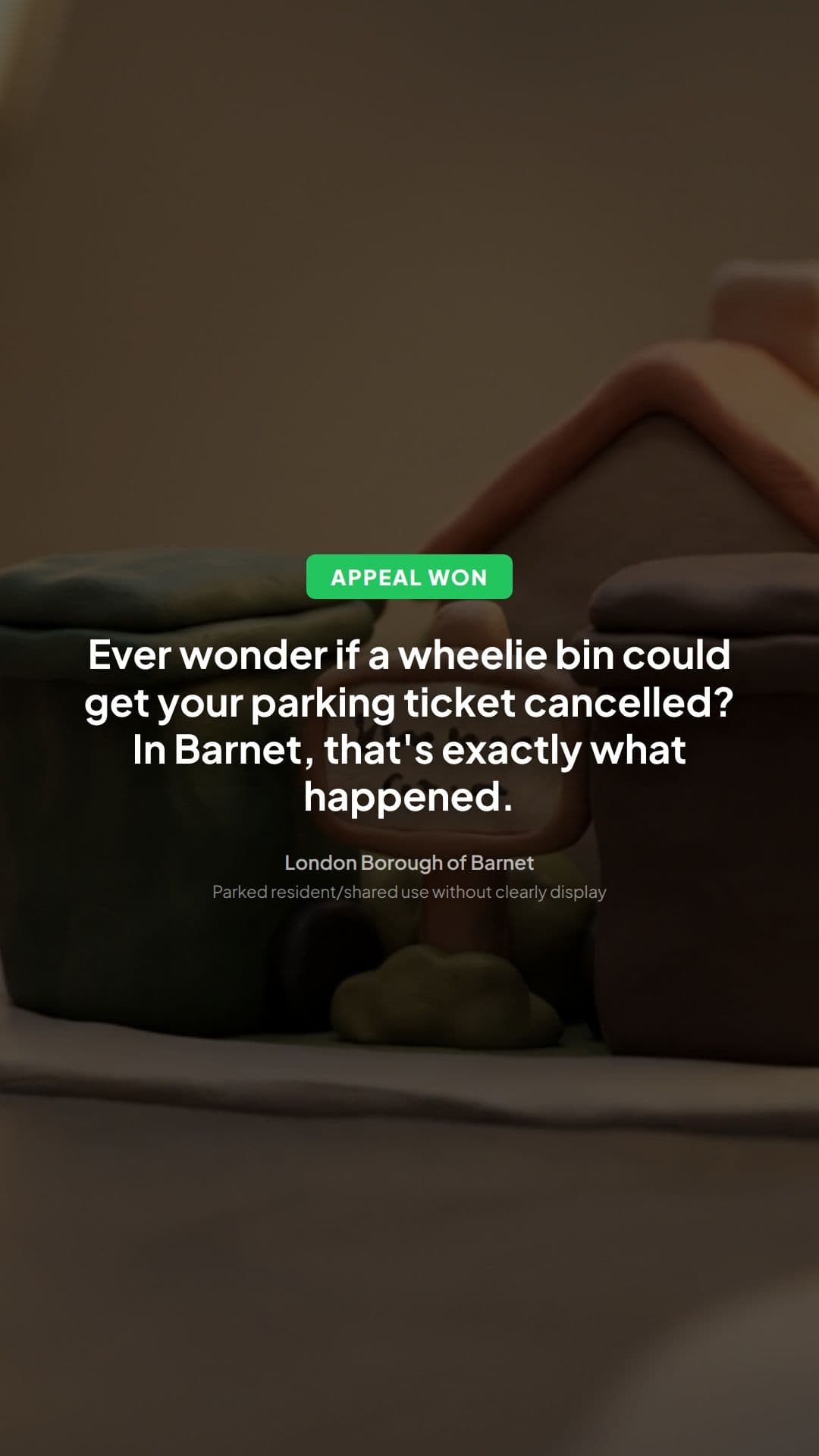
When a Wheelie Bin Beat a Parking Ticket: The Barnet Bay Case Explained
Why This Case Matters
Picture this: you park in a residents' bay, do everything you think is right, and still come back to find a parking ticket tucked under your wiper. Then you discover the sign explaining the rules was hidden behind next door's rubbish bins the entire time. Sounds unfair? A London tribunal agreed.
This Barnet case is a brilliant example of a principle that trips up councils more often than you'd think: a parking restriction is only enforceable if drivers can actually see the sign telling them about it. If the signage is blocked, faded, or otherwise not "readable," the whole penalty can collapse, no matter how clearly the bay is marked on the tarmac.
For drivers who've ever squinted at a barely visible sign or wondered whether that permit-holder plate applied to them, this case is worth understanding properly.
What Happened
The story is straightforward. Miss Diamond parked her car in a residents' parking bay on Glebe Crescent in Barnet, at around 10.24am on 19 June 2018. A civil enforcement officer (CEO) came along, checked the bay, and issued a Penalty Charge Notice (PCN) because no valid parking permit was on display.
On the face of it, this looked like an open-and-shut case. The CEO's own photographs showed Miss Diamond's car sitting in a marked bay, alongside a sign stating "permit holders only" with controlled hours of 10am to 5pm, Monday to Friday. The car was parked squarely within those controlled hours. So far, so simple, until you look more closely at where that sign actually was.
The Arguments
The council's position rested on the CEO's photographic evidence. The bay was clearly marked, the sign was present, and no permit was displayed on Miss Diamond's dashboard. As far as Barnet was concerned, the contravention was straightforward: wrong bay, no permit, PCN issued correctly.
Miss Diamond's defence was more interesting. She didn't dispute that a sign existed, or even that she'd parked in a permit bay. Her argument was that the sign was practically invisible when she parked. She said that when she returned to find the ticket, she noticed the sign was wedged behind two wheelie bins, and she submitted her own photographs to prove it. Crucially, she also stated that she'd actively checked for signage before parking and simply couldn't see any, because it was obscured.
This is where the CEO's own evidence became a problem for the council. Their photograph, taken at the time of enforcement, showed the sign at wall height, lodged between the two bins. In other words, the council's own paperwork inadvertently backed up the driver's account.
The Decision
The adjudicator sided with Miss Diamond and allowed the appeal, cancelling the PCN entirely.
The reasoning was refreshingly common-sense. The adjudicator looked at both sets of photographs, the CEO's and Miss Diamond's, and concluded that the sign genuinely was concealed behind the wheelie bins at the relevant time. Because the sign wasn't visible, the adjudicator found that the parking restrictions were "not adequately signed," and therefore Miss Diamond couldn't be expected to have known that a permit was required.
The Legal Reasoning, Explained Simply
At the heart of this case is a principle that runs through UK parking law: restrictions must be clearly communicated to drivers before they can be lawfully enforced. This isn't just a technicality. It's a matter of basic fairness, and it's backed up by the Traffic Signs Regulations and General Directions (TSRGD), which set out detailed rules on how, where, and how visibly signs must be placed for parking restrictions to be valid.
If a sign is present but not reasonably visible to a driver approaching or parking in a bay, the legal position is that the restriction hasn't been properly communicated. It doesn't matter that the sign technically exists somewhere nearby. What matters is whether a reasonable, attentive driver checking for signage would actually have been able to see and understand it.
In this case, two things worked in Miss Diamond's favour:
- The CEO's own photograph undermined the council's case. Enforcement officers' images are usually the council's strongest evidence, showing the contravention in black and white. Here, the same photograph that was meant to prove the offence also proved the defence, because it showed the sign obscured by bins.
- The driver provided her own corroborating evidence. Miss Diamond didn't just assert that the sign was hidden. She took her own photographs and described specifically checking for signage before parking. That combination of proactive behaviour and supporting evidence gave the adjudicator a clear, credible account to weigh against the council's version.
Adjudicators at parking tribunals are required to weigh evidence on the balance of probabilities, essentially, what's most likely to be true. When a driver's photographic evidence lines up with inconsistencies in the council's own material, that tends to tip the scales.
Lessons for Drivers
This case offers some genuinely useful takeaways, whether you're dealing with a residents' bay, a shared-use bay, or any other permit-controlled space.
1. Photograph the scene the moment you spot a problem. Miss Diamond's case worked because she had her own images showing the sign's position. If you ever return to your car and something about the signage looks off, obscured, faded, missing, take photos immediately, from the angle you'd have seen when parking.
2. Councils' own evidence can work in your favour. It's easy to assume that a CEO's photograph is only ever going to help the council's case. Not true. Look closely at any photographic evidence submitted against you. Does it show the sign clearly? Does it inadvertently reveal an obstruction, a wheelie bin, an overgrown hedge, a parked van, that would have blocked your view at the time?
3. "Present" isn't the same as "visible." A sign existing somewhere on the street doesn't automatically mean the restriction is enforceable. If you genuinely couldn't see or read a sign due to obstruction, that's a legitimate ground for appeal, not just an excuse.
4. Describe what you actually did, not just what went wrong. Miss Diamond's evidence wasn't just "the sign was hidden," it was "I checked for signage and couldn't see any." That detail matters. It shows the adjudicator that reasonable care was taken, which strengthens the credibility of the whole account. If you're appealing on similar grounds, our guide on how to use unclear parking signs as a defence against UK parking fines walks through this kind of argument in more detail.
5. Don't assume a PCN is unbeatable just because the bay markings are correct. Many drivers give up on appeals because they assume the physical parking situation, right bay, right restriction, right time, means they have no case. This decision shows that signage visibility is a separate, and equally important, legal requirement.
Key Takeaway
A parking restriction is only fair, and only enforceable, if a driver could reasonably have seen and understood it at the time. If your view of a sign was blocked, whether by a wheelie bin, a badly parked van, or overgrown foliage, that's not a minor inconvenience. It could be the difference between a valid PCN and one that gets cancelled on appeal. Always photograph the scene as you found it, because sometimes the strongest evidence in your favour is hiding in plain sight, quite literally, behind a bin.
Written by
The Parking Ticket Pal Editorial Team
Source-checked parking guidance
Ready to Challenge Your Ticket?
Let our AI analyse your PCN and generate a professional appeal letter in minutes.
Start Free Appeal