
Barnet Parking Charge Appeal Refused: What Drivers Learn
A London Borough of Barnet tribunal refused a parking charge appeal. Learn how to evidence payment, check signs and avoid common PCN appeal errors in time.

The Parking Ticket Pal Editorial Team
5 October 2026
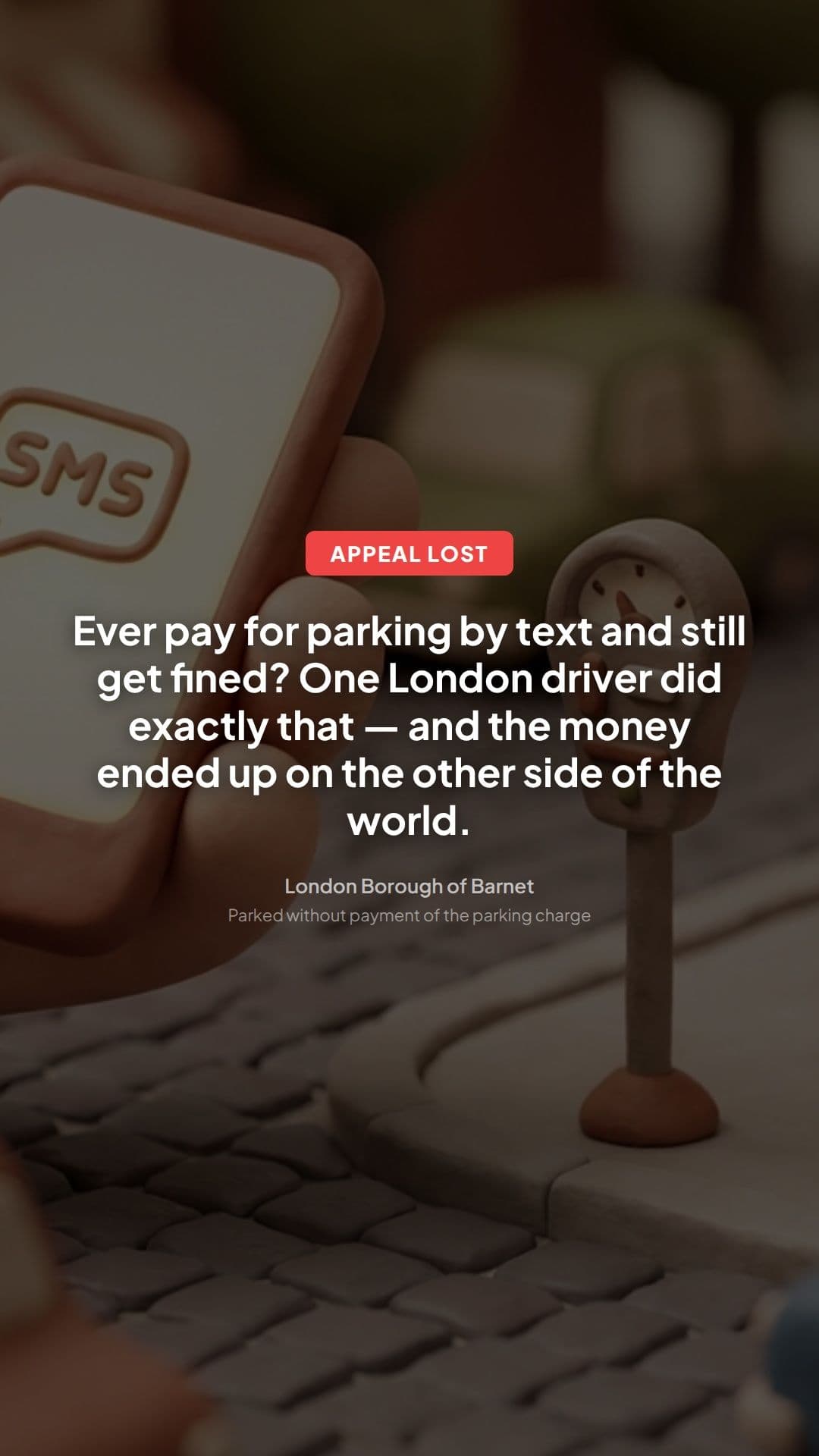
When One Digit Costs You a Parking Fine: The Barnet "Wrong Location Code" Case
Why This Case Matters
Picture this: you park your car, whip out your phone, dial the parking payment line, and tap in the location code from the sign. Job done, you think, as you walk off to your meeting or your shopping trip. Weeks later, a penalty charge notice lands on your doormat. You paid. You have the text message to prove it. Surely that's the end of the matter?
Not necessarily. A case from the London Borough of Barnet shows exactly how a single mistyped or mis-spoken digit in a location code can undo an otherwise perfectly genuine payment, and leave a driver on the hook for a parking charge despite having clearly tried to do the right thing. For anyone who relies on mobile phone parking apps or cashless payment lines, this case is a cautionary tale worth understanding.
The Case
The appellant, Mr Bordon, was issued a penalty charge notice for "parked without payment of the parking charge" after leaving his car on Golders Green Road in the London Borough of Barnet. Mr Bordon's position was straightforward: he had paid. He produced an SMS record confirming that a mobile phone payment had gone through at the time he was parked.
The case was first heard in December 2012, but the adjudicator adjourned it rather than make an immediate decision. Why? Because something didn't quite add up. The SMS confirmation that Mr Bordon submitted referred to a location number that didn't match what Barnet Council said the location number for that stretch of Golders Green Road actually was. The adjudicator needed clarification from the council before reaching a conclusion, so the hearing was paused to get to the bottom of the discrepancy.
The Arguments
Mr Bordon's case rested on the simple fact that he had made a payment by mobile phone for the location where he was parked, Golders Green Road. He believed the payment had gone through correctly, and the text message he held as evidence seemed to back this up. His argument, in essence, was that the money had been wrongly credited to a completely different location in Canada, through no fault of his own, and that he should not be penalised for what looked like a processing or system error.
The council's position was equally simple: it disputed that any valid payment had been made for the vehicle at the location in question. From Barnet's perspective, the records showed no payment registered against the correct location code for Golders Green Road, and that meant the parking charge had not been paid, regardless of what the SMS appeared to show.
The Decision
When the hearing resumed, the adjudicator compared the two location numbers directly. Mr Bordon's SMS referred to location number "9698". Barnet Council, however, confirmed that the actual location number for the relevant stretch of Golders Green Road was "5698".
Two numbers, remarkably close, but not the same.
The adjudicator concluded that it was likely the wrong location number had been entered, either typed or spoken, by whoever made the call to pay for parking. Because of this, the payment was logged against an entirely different location (seemingly one associated with a code used in Canada within the same mobile payment system) rather than against the Golders Green Road bay where Mr Bordon's car was actually parked.
The result: no valid payment was recorded for the vehicle at the location where the contravention occurred. The appeal was refused.
The Legal Reasoning, Explained Simply
This case hinges on a point that trips up more drivers than you might expect: a genuine attempt to pay is not the same thing as a valid payment for the correct location.
Mobile phone and app-based parking payment systems work by matching a location code (usually displayed on signs or in the bay itself) to a specific parking zone. When you dial in or enter that code, the system doesn't know where your car physically is. It only knows what code you gave it. If that code is wrong, even by a single digit, the system has no way of knowing you meant somewhere else entirely. It simply processes the payment for whatever location the code corresponds to.
From a legal standpoint, the adjudicator's job here wasn't to decide whether Mr Bordon was honest or had made an innocent mistake. The adjudicator clearly accepted that a payment had been made and that Mr Bordon likely believed he was paying correctly. But the legal test for whether a contravention occurred is not about intention, it's about whether a valid payment was actually made for the correct location at the correct time. Since the evidence showed the payment was logged against a different location code than the one that matched where the car was parked, the legal requirement to pay for that specific bay had not been satisfied.
This is why the council's side of the evidence, confirming the correct location number for Golders Green Road, was so decisive. Once the adjudicator had that confirmation, the mismatch between "9698" and "5698" spoke for itself. It didn't matter that the numbers were strikingly similar, or that the mistake seemed like an honest slip. The system doesn't deal in near enough. It deals in exact matches.
It's also worth noting the adjudicator's careful, methodical approach here. Rather than deciding the case on the first hearing date, the adjournment to seek confirmation of the correct location number shows how seriously these small details are treated in parking tribunals. A single digit was enough to warrant pausing proceedings and seeking further evidence before a final decision was reached.
Lessons for Drivers
This case offers several practical takeaways for anyone who uses mobile phone or app-based parking payment:
Double check the location code before you pay. Location codes are often displayed on signs, kerbside posts, or ticket machines near the bay. Before dialling or entering the code into an app, read it carefully and compare it against what's actually printed. A quick second glance could save you a significant headache later.
Keep your payment confirmation, but check it matches. An SMS or app confirmation is valuable evidence, but only if it clearly shows the correct location number for where you were parked. If you're unsure, compare the confirmation message against the signage at the location as soon as you receive it, not weeks later when a penalty notice arrives.
Act quickly if something looks wrong. If you notice after parking that your confirmation references an unfamiliar code or location, it's worth contacting your payment provider or the council straight away to flag the issue, rather than waiting to see if a penalty notice turns up.
Understand that honesty isn't the legal test. It's easy to assume that because you genuinely tried to pay and made no attempt to avoid charges, you'll automatically be in the clear. As this case shows, tribunals look at whether a valid payment was made for the specific location, not simply whether the driver acted in good faith.
Know that adjudicators do dig into the detail. This case demonstrates that tribunal adjudicators don't simply take the council's word for it, or dismiss a driver's evidence out of hand. The adjournment to clarify the correct location number shows a genuine effort to get to the truth. If you're appealing a penalty charge notice and believe there's a discrepancy in the location details, it's worth raising this clearly and asking the council to confirm the correct reference numbers in writing.
If you find yourself in a dispute involving a payment made to the wrong location code, it's sensible to gather all your evidence, including screenshots, confirmation texts, and photographs of any signage, and seek advice on the formal appeals process if you're not sure how to present your case effectively.
Key Takeaway
A payment attempt is only as good as the code behind it. If the location number is even slightly wrong, the system has no way of knowing where your car actually is, and you could end up fined despite having genuinely tried and believed you'd paid. Before you tap in that code, take an extra five seconds to check it against the signage. It's a small habit that could save you a very frustrating dispute.
Written by
The Parking Ticket Pal Editorial Team
Source-checked parking guidance
Ready to Challenge Your Ticket?
Let our AI analyse your PCN and generate a professional appeal letter in minutes.
Start Free Appeal