Barnet box junction PCN appeal won: key lesson
London Borough of Barnet box junction PCN cancelled on appeal. Learn what evidence and Traffic Signs Regulations points can overturn “entering and stopping” claims.

Grace O'Sullivan
17 March 2026
How a Motorbike Saved a Driver £130: The Box Junction Case That Every Driver Should Read
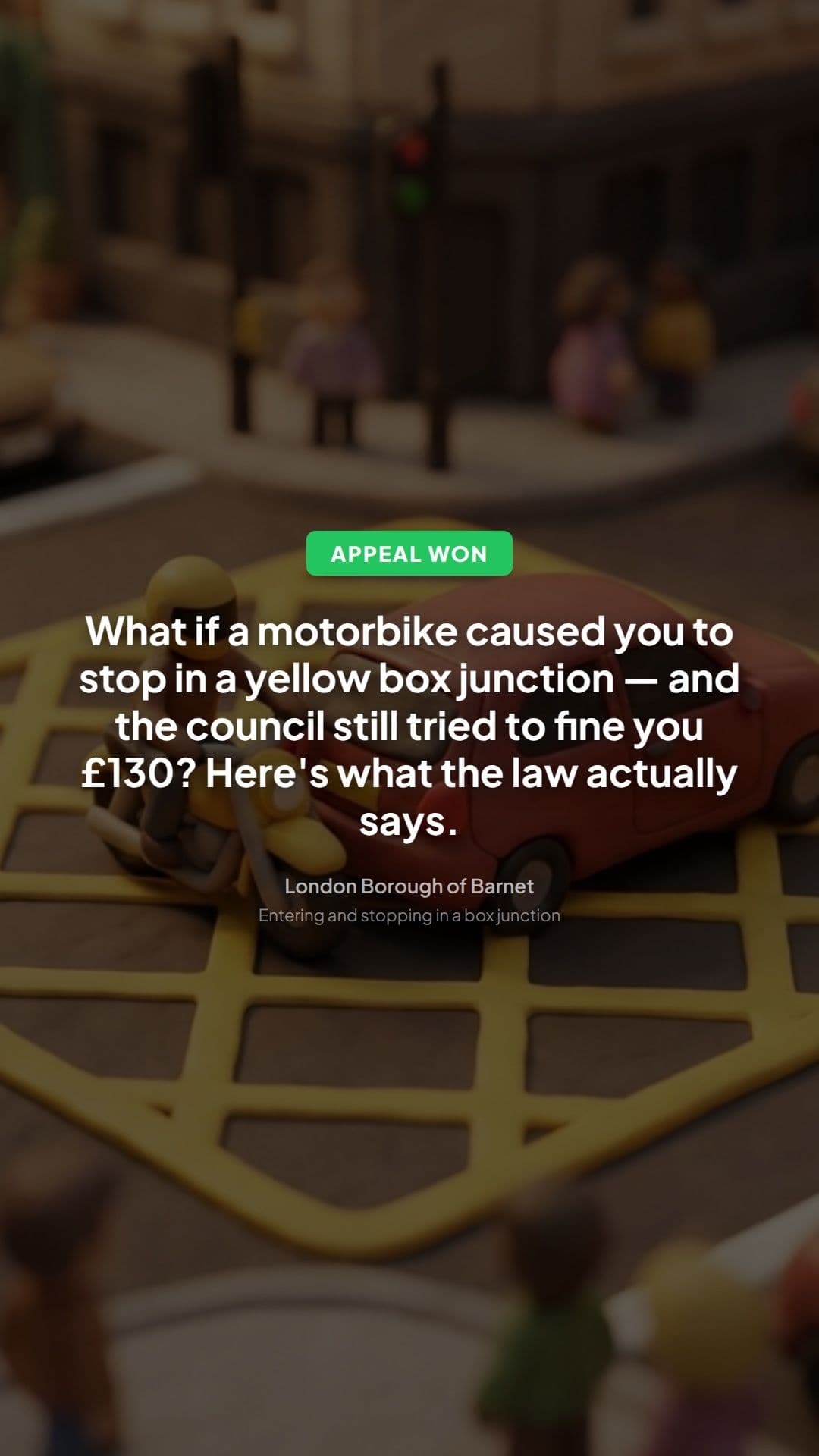
Imagine this: you check the road ahead, the exit is clear, you pull forward into the yellow box — and then, out of nowhere, a motorbike cuts across your path and takes the very space you were heading for. You're stuck, half in the junction, and a few days later a Penalty Charge Notice drops through your letterbox. Sound unfair? A London tribunal agreed — and the legal reasoning behind the decision is genuinely fascinating.
This is the story of Mr Brook versus the London Borough of Barnet, and it's one of those cases that reveals a crucial gap between what most drivers think the rules say and what the law actually says.
The Case: A Box Junction, a Motorbike, and a PCN
The incident took place at 15:50 on a day when Mr Brook was driving his vehicle, registered NL17 UBU, through a yellow box junction in the London Borough of Barnet. The council's own CCTV footage captured exactly what happened.
Mr Brook drove into the box junction at a moment when his exit route was clear — there was enough space ahead for his car to pass through without stopping. That's the critical detail. He didn't jump in recklessly or gamble on a gap that wasn't there. The space existed.
But then a motorbike moved into the gap in front of him, occupying precisely the space his car had been heading for. The rear of Mr Brook's car came to rest inside the box junction. The adjudicator noted that the portion of the car left in the box was roughly equivalent to the length of the motorbike. In other words: no motorbike, no problem. Mr Brook's car would have cleared the junction entirely.
Barnet issued a PCN for "entering and stopping in a box junction." Mr Brook appealed.
The Arguments: Highway Code vs. The Actual Law
This is where the case gets genuinely interesting — and where Mr Brook deserves real credit for the quality of his appeal.
Most drivers, if they think about box junctions at all, think of Rule 174 of the Highway Code. That rule tells us not to enter a box junction unless our exit road is clear. It's the guidance almost everyone has seen. But Mr Brook's appeal notice made a pointed and legally sharp argument: the Highway Code is not the law.
He argued that Barnet had based its enforcement on Rule 174, when the actual legal prohibition comes from a completely different document — paragraph 11 of Part 7 of Schedule 9 to the Traffic Signs Regulations and General Directions 2016 (mercifully abbreviated to the TSRGD 2016). When you apply that legislation — rather than the Highway Code — to the facts on the video, Mr Brook contended, no contravention had actually taken place.
The council, notably, did not attend the video hearing to defend their position. That silence spoke volumes.
The Decision: Appeal Allowed
The adjudicator allowed the appeal in full.
Having reviewed the council's own video evidence, the adjudicator found the facts clearly supported Mr Brook's account. The exit was clear when he entered the junction. A motorbike then moved into that space, blocking his path. His car stopped with its rear portion inside the box — but only because of what the motorbike did after he had already committed to entering.
The PCN was cancelled. Mr Brook owed nothing.
The Legal Reasoning: What the Law Actually Says
Let's unpack the legal point at the heart of this case, because it matters enormously for any driver who receives a similar ticket.
The TSRGD 2016 sets out the legal prohibition for box junctions in precise terms. Under paragraph 11(1), a driver must not cause a vehicle to enter a box junction so that the vehicle has to stop within it due to the presence of stationary vehicles.
Read that carefully. The prohibition isn't simply "don't stop in the box." It's more nuanced than that. The question is: why did the vehicle stop? The law focuses on the reason for stopping — and specifically, it asks whether the driver caused the vehicle to enter the junction in circumstances where stationary vehicles would force a stop.
Here's the crucial distinction the adjudicator applied:
- What the Highway Code says: Don't enter unless your exit is clear.
- What the law says: Don't enter if doing so means you'll be forced to stop because of stationary vehicles already present.
When Mr Brook entered the junction, there were no stationary vehicles blocking his path. The exit was clear. He did not enter the box knowing or in circumstances where stationary vehicles would trap him. The motorbike that subsequently moved into his path was an intervening event — something that happened after he had lawfully committed to crossing the junction.
The law, as written, simply did not catch what happened to Mr Brook. He didn't cause his vehicle to enter in a way that required it to stop due to stationary vehicles. He entered when the coast was clear, and another road user's unexpected movement created the problem. That's a fundamentally different situation from the driver who edges into a box on a busy junction and hopes the traffic will clear — which is precisely the behaviour the law is designed to prevent.
Lessons for Drivers: What This Case Teaches Us
This case is a masterclass in the difference between common assumptions and legal reality. Here are the key takeaways:
1. The Highway Code and the law are not the same thing The Highway Code is guidance. It can be used as evidence in civil and criminal proceedings, but the legal prohibition for box junctions comes from the TSRGD 2016. If a council issues a PCN, it must prove a breach of the actual legislation — not just a departure from the Highway Code.
2. The reason you stopped matters enormously The law asks why your vehicle stopped in the box. If you entered when the exit was clear and were then blocked by an unexpected third party, that is legally different from entering when the exit was already obstructed. Document everything if this happens to you — dashcam footage is invaluable.
3. A council's failure to attend a hearing is significant Barnet did not attend the video hearing. Councils that fail to support their case in person risk having appeals allowed by default, particularly where the legal arguments are strong. If you've made a solid legal argument and the council doesn't show up to rebut it, that works in your favour.
4. Read the legislation, not just the signage guidance When challenging any PCN, it's worth looking up the specific legal provision the contravention is based on. In many cases — as here — the precise wording of the law contains important nuances that a council's standard enforcement approach may overlook. The TSRGD 2016 is publicly available online.
5. Dashcam footage is your best friend In this case, the council's own video actually supported Mr Brook's account. Imagine if he'd had dashcam footage too — the case would have been even clearer. If you drive regularly through busy junctions in London or any major city, a forward-facing dashcam is a worthwhile investment.
The Key Takeaway
You can only break the box junction rule if you caused the problem yourself.
If you entered the yellow box when your exit was genuinely clear, and another driver's unexpected action then blocked you, the legal prohibition was never triggered in the first place. The law targets the decision to enter — not the unfortunate result of someone else's behaviour. Mr Brook understood this, argued it clearly, and won.
The next time you receive a PCN and instinctively think "well, the Highway Code says…" — stop. Ask yourself what the actual legislation says. You might be surprised how different those two things can be.
Written by
Grace O'Sullivan
Municipal Enforcement Expert
Ready to Challenge Your Ticket?
Let our AI analyse your PCN and generate a professional appeal letter in minutes.
Start Free Appeal