Bank holiday traffic: 19m drivers, border-check delays
Britain faces long bank holiday traffic queues as 19m drivers hit the roads. Extra border checks and hot weather could trigger severe delays Friday and Saturday.

Isabella Romano
23 May 2026
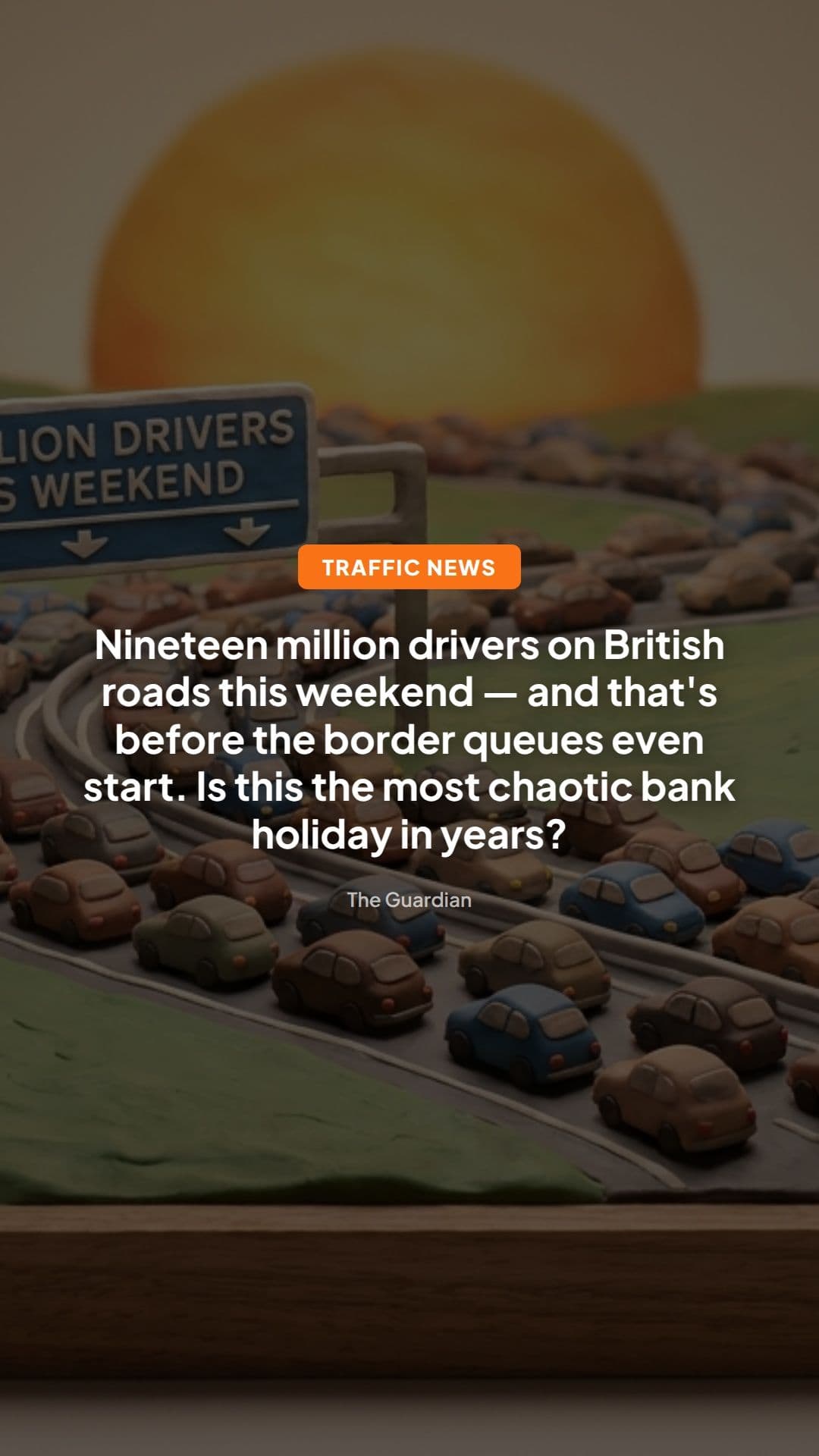
Britain's Bank Holiday Road Chaos: What 19 Million Drivers Need to Know Before They Set Off
Imagine this: it's Friday afternoon, the sun is blazing, the kids are restless in the back seat, and you're sitting completely stationary on the M25 — not because of an accident, not because of roadworks, but simply because nearly a fifth of Britain's entire driving population has decided to head somewhere at exactly the same moment as you. Welcome to the May bank holiday weekend.
According to reporting by The Guardian, forecasts suggest almost 19 million drivers will take to Britain's roads over the upcoming bank holiday weekend, with severe delays expected across major routes. Add in extra border checks at key crossing points, temperatures pushing into the high twenties, and the predictable collision of school holiday travel patterns — and you have a recipe for some of the most challenging driving conditions of the year.
But beyond the frustration of gridlock, there are genuine legal, safety, and financial implications that millions of motorists simply aren't prepared for. Here's what you need to know before you turn that key.
What's Actually Happening on Britain's Roads
The bank holiday weekend — running from Friday 22 May through to Monday 25 May — is shaping up to be one of the busiest road travel periods of 2026. The RAC and traffic analysis firms have consistently flagged May bank holidays as among the top five most congested travel weekends of the year, and this one carries additional pressure points.
Friday afternoon and Saturday morning are expected to bear the brunt of outbound traffic, particularly on:
- The M25 and all major arterial routes out of London
- The M5 southbound towards Devon and Cornwall
- The A303 near Stonehenge
- The M6 northbound through the Midlands
- Cross-channel routes into Kent, including the M20 and the approaches to the Channel Tunnel terminal at Folkestone
Extra border checks — a consequence of tightened post-Brexit entry controls and heightened security protocols — are adding considerable time to journeys at Dover and Folkestone. Travellers heading to Europe should factor in delays of several hours beyond normal processing times.
Compound this with the heat. When temperatures climb above 25°C, tyre blowouts increase, engines overheat, and — critically — driver concentration deteriorates. Research from the Transport Research Laboratory has shown that reaction times can slow significantly in hot vehicles, with impairment beginning at cabin temperatures that are surprisingly easy to reach on a sunny UK motorway.
Why This Matters Beyond the Inconvenience
It would be easy to dismiss bank holiday traffic as an annual nuisance — an accepted British rite of passage alongside warm beer and queuing. But the reality is more serious.
Road safety statistics show that bank holiday weekends consistently see elevated casualty figures. The combination of increased traffic volume, fatigued drivers, higher speeds on motorways, and impaired judgement from heat creates conditions that claim lives every year. The Department for Transport's road safety data regularly highlights May bank holidays as high-risk periods.
There's also a significant economic dimension. Businesses lose productivity, haulage companies face penalties for missed delivery windows, and the cumulative fuel cost of idling traffic runs into tens of millions of pounds nationally. For individual families, an unplanned extra tank of fuel — or a breakdown callout — can add hundreds of pounds to what was supposed to be an affordable break.
And then there's the border dimension. The introduction of the EU Entry/Exit System (EES), combined with existing post-Brexit passport checks, has fundamentally changed the flow of traffic through Kent. What used to take minutes can now take hours. The knock-on effect doesn't stay at the port — it ripples back along the M20, through Operation Stack territory, and into communities that have been fighting for years to keep their roads clear.
The Legal Angle: What Drivers Must Know
When roads are congested and tempers are fraying, the likelihood of traffic violations — and the penalties attached to them — increases substantially.
Contraflow and smart motorway compliance is a significant concern. Under the Road Traffic Regulation Act 1984 and the Traffic Signs Regulations and General Directions 2016, temporary traffic management signs carry the same legal force as permanent ones. Ignoring a contraflow instruction, a lane closure signal, or a variable speed limit displayed on a matrix sign is a criminal offence, not merely a civil matter. Fines start at £100 with three penalty points, and for more serious contraventions, prosecution under the Road Traffic Act 1988 can follow.
Mobile phone use in slow-moving or stationary traffic is still illegal. A persistent misconception holds that because you're not moving, you're not "driving" in the legal sense. This is wrong. The courts have consistently held that a driver sitting in a queue with the engine running is driving for the purposes of the Road Traffic Act 1988 (section 163) and the Road Vehicles (Construction and Use) Regulations 1986. The penalty is a £200 fixed penalty notice and six points — enough to lose a licence for a new driver.
Stopping on the hard shoulder without a genuine breakdown or emergency is illegal under the Motorways Traffic (England and Wales) Regulations 1982. During bank holiday congestion, drivers sometimes pull onto the hard shoulder to "let someone out for a comfort break" or to check a map. This is not a defence. The fine is up to £100, and the safety risk is considerable — hard shoulders are among the most dangerous places on the road network.
Fuel shortages and "jerry can" carrying occasionally become relevant during high-demand periods. Legally, you may carry petrol in a container in your vehicle, but the Petroleum (Consolidation) Regulations 2014 limit this to 10 litres in a plastic container or 20 litres in a metal one, and the container must be properly sealed and stored safely. Carrying more than this, or carrying fuel in an unapproved container, is a legal offence.
What Drivers Should Know: Practical Advice for This Weekend
Here's how to navigate the weekend without adding a fine, a breakdown, or worse to your bank holiday memories:
Before you leave:
- Check your tyres. Hot tarmac and underinflated tyres are a dangerous combination. The legal minimum tread depth is 1.6mm across the central three-quarters of the tyre, but safety organisations recommend replacing at 3mm. Check pressure cold before any long journey.
- Check your coolant and oil. Engines work harder in heat and in stop-start traffic. A low coolant level in a traffic jam is a recipe for an expensive breakdown.
- Download offline maps. Mobile signal in rural areas — particularly in the South West and parts of Wales — can be unreliable. Don't rely on live navigation in areas with poor coverage.
- Plan your departure time strategically. Traffic modelling consistently shows that leaving before 7am or after 7pm on a Friday avoids the worst of the congestion. Saturday morning departures between 8am and 11am are typically the worst window of the weekend.
On the road:
- Take regular breaks. The Highway Code recommends a break of at least 15 minutes every two hours. In hot weather, this should be more frequent. Fatigue is a factor in roughly 20% of serious road accidents.
- Keep water in the car. Dehydration impairs cognitive function in ways that are legally comparable to mild intoxication. Keep passengers — and yourself — hydrated.
- Don't tailgate in slow traffic. The most common collision type in bank holiday queues is the low-speed rear-end shunt. Keep your distance and stay alert.
- If you break down on a motorway, get to the left-hand lane, exit at the nearest junction or emergency refuge area if possible, switch on hazard lights, and call for assistance. Do not stand behind your vehicle.
At the border (if travelling to Europe):
- Arrive with significantly more time than you think you need — at least three hours before your crossing time.
- Ensure all passports are valid for the duration of your trip. Post-Brexit rules require passports to be less than 10 years old on the day of entry and valid for the duration of your stay.
- Pet owners must carry the correct animal health documentation. The rules changed post-Brexit and a missing stamp or incorrect certificate can mean your pet cannot travel.
Looking Ahead: The Bigger Picture
This weekend's congestion is a symptom of deeper, structural problems in Britain's transport infrastructure. The road network was largely designed in the 1960s and 1970s for a population and vehicle ownership level that has since roughly doubled. Motorway expansion has been politically contentious, funding for road maintenance has been inconsistent, and the promised transformation of public transport as an alternative has been slow to materialise outside major cities.
The border delay problem is unlikely to resolve quickly. The EES, when fully operational, will require biometric data collection for every non-EU traveller — a process that takes time regardless of how efficiently it is managed. Until infrastructure at Dover and Folkestone is significantly expanded, bank holiday weekends will continue to generate the kind of gridlock that ripples across the entire South East.
For drivers, the lesson is the same one that every bank holiday teaches and too many ignore: the road will be busy, the weather will be warm, and the unexpected will happen. The difference between a memorable trip and a miserable one — or worse — often comes down to preparation, patience, and knowing your rights and responsibilities before you set off.
Drive carefully, leave early, and enjoy the weekend.
Written by
Isabella Romano
Civil Enforcement Officer
Ready to Challenge Your Ticket?
Let our AI analyse your PCN and generate a professional appeal letter in minutes.
Start Free Appeal