£700m UK road schemes axed for drones: driver impact
Ministers cancel £700m of UK road infrastructure schemes, including the A46 Newark bypass, to fund drones. What it means for drivers, traffic and local plans.

Sarah Mitchell
30 June 2026
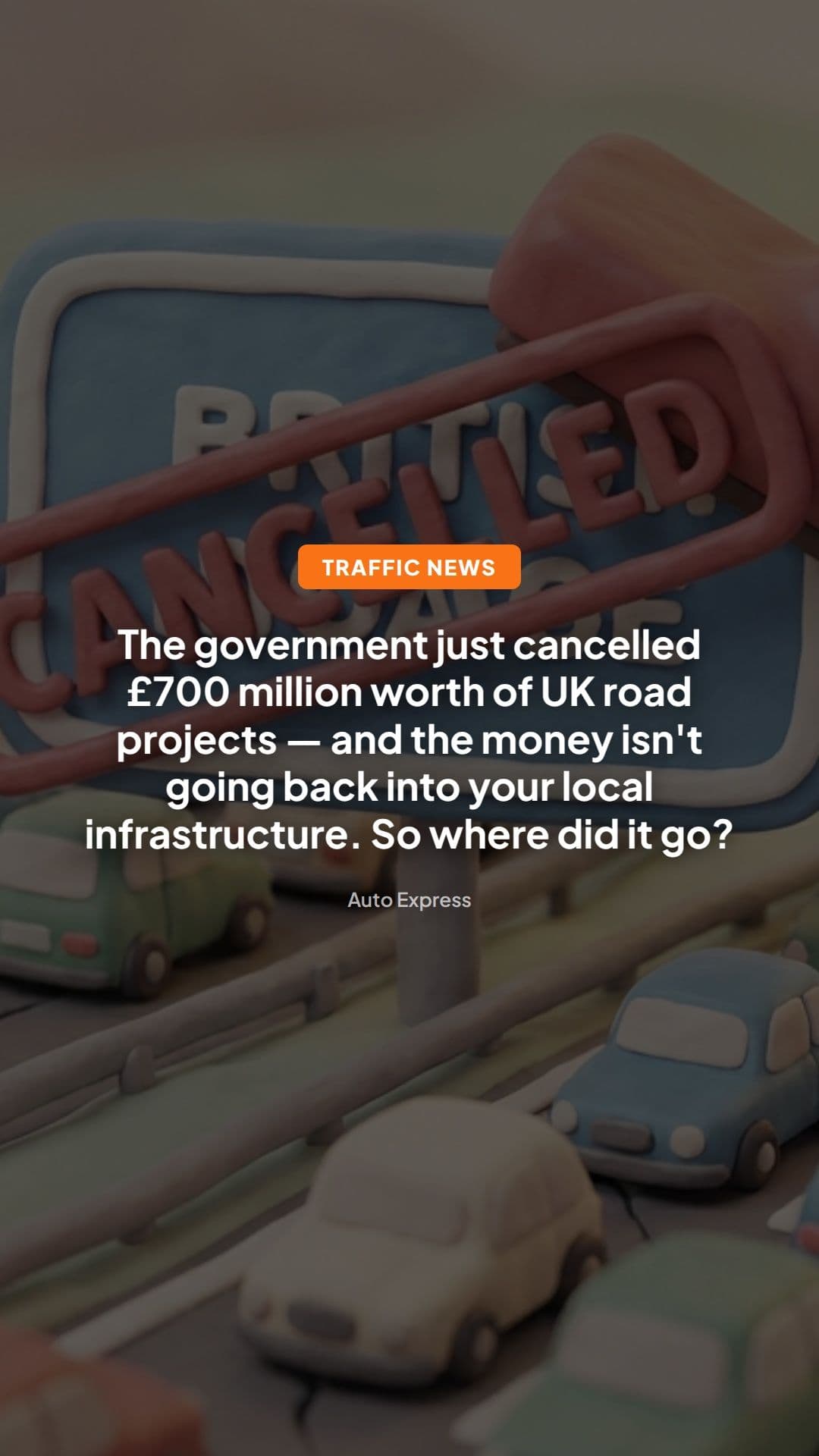
£700 Million Road Projects Axed for Drones: What It Really Means for Britain's Drivers
The government has quietly cancelled nearly three-quarters of a billion pounds' worth of road improvements. Here's the full story — and what you should actually be doing about it.
There's a particular kind of frustration that builds slowly, like a pothole that starts as a hairline crack and ends up swallowing a wheel. Britain's drivers have been living with that frustration for years — watching promised road improvements get delayed, downgraded, or quietly shelved. But this week, the government did something that moved the goalposts entirely: it cancelled £700 million worth of road infrastructure projects outright, redirecting the money towards military and security drone procurement.
The A46 Newark bypass — one of the most high-profile schemes on the list — is gone. So are a raft of other local and regional road improvements that communities had been counting on. Ministers have called the decision "necessary." Drivers, understandably, are calling it something else entirely.
What Actually Happened
According to reporting by Auto Express, the UK government has cancelled road infrastructure projects totalling approximately £700 million. The funding, which had been earmarked through the Road Investment Strategy (RIS) framework, has been reallocated to cover the cost of military and security drone purchases — a decision framed by ministers as a response to evolving national security priorities.
The A46 Newark bypass is perhaps the most tangible loss here. This was a scheme with genuine local support and a clear economic rationale: the existing A46 corridor through Newark-on-Trent has long been a bottleneck for freight and commuter traffic, with HGVs routinely clogging residential streets. The bypass would have relieved that pressure substantially. Now it won't be built — at least not in the near term.
The cancellations don't exist in isolation. They follow a turbulent few years for road investment in England, during which the government has already scaled back its ambitions significantly. The third Road Investment Strategy (RIS3), covering 2025 to 2030, was already trimmed before these latest cuts. What we're now seeing is not a minor adjustment — it's a structural retreat from committed infrastructure spending.
Why This Matters Far Beyond the Headlines
To understand why this decision stings so much, you need to understand how road investment in England actually works — and how deeply the current system is failing drivers.
National Highways (formerly Highways England) is the government-owned company responsible for operating, maintaining, and improving England's strategic road network: motorways and major A-roads. Its funding comes directly from central government, ring-fenced through the Road Investment Strategy process. In theory, this ring-fencing was supposed to protect road budgets from exactly this kind of raid. In practice, it hasn't.
The RIS framework was introduced in 2015 precisely because successive governments had a habit of treating the roads budget as a rainy-day fund — dipping into it whenever other priorities demanded cash. The ring-fencing was meant to give Highways England and local authorities the certainty they needed to plan, design, and deliver major schemes. Cancelling £700 million of committed projects undermines that certainty entirely.
There's also a cascading economic cost that rarely makes it into ministerial statements. Road congestion costs the UK economy an estimated £8 billion per year in lost productivity, according to the Centre for Economics and Business Research. Every delayed or cancelled bypass, junction improvement, or capacity upgrade compounds that figure. The A46 Newark bypass alone would have unlocked significant freight efficiency gains for businesses operating across the East Midlands.
And then there's the road condition crisis running in parallel. The local road network — maintained by councils rather than National Highways — is in a state of chronic disrepair. The Asphalt Industry Alliance's 2024 Annual Local Authority Road Maintenance (ALARM) survey estimated the backlog of pothole repairs across England and Wales at £16.3 billion. Councils are already stretched beyond capacity. Strategic road cancellations don't directly affect local roads, but they signal a broader political environment in which transport infrastructure is perpetually deprioritised.
The Legal Angle: What Rights Do Affected Communities Actually Have?
This is where things get complicated — and where drivers and local communities need to be clear-eyed about their position.
When road schemes are included in the Road Investment Strategy, they go through a statutory process under the Planning Act 2008 for nationally significant infrastructure projects (NSIPs). Major road schemes above a certain threshold require a Development Consent Order (DCO), which involves public consultation, environmental impact assessments, and formal examination by the Planning Inspectorate.
If a scheme has already received a DCO — or is mid-examination — cancellation raises genuine legal questions. Affected parties, including local authorities, businesses, and residents who participated in the formal process, may have grounds to challenge a cancellation decision through judicial review, arguing that the government has acted irrationally or failed to follow proper procedure.
For schemes that hadn't yet reached DCO stage, the legal position is weaker. Government commitments in policy documents like the RIS are not legally binding contracts in the way a commercial agreement would be. Courts have generally been reluctant to treat political commitments as enforceable obligations unless a very specific legitimate expectation has been created.
Under the Infrastructure (Wales) Act and equivalent English provisions, communities also have rights to be consulted on major planning decisions — but consultation rights are procedural, not substantive. Being consulted doesn't mean the government must proceed.
What affected communities can do is use the Freedom of Information Act 2000 to request the internal assessments, cost-benefit analyses, and ministerial advice that informed these cancellation decisions. If the government cannot demonstrate that it properly weighed the transport and economic impacts against the security benefits of drone procurement, that could form the basis of a legal challenge.
What Drivers Should Know Right Now
The immediate practical consequences of these cancellations will vary depending on where you live and drive. Here's what to bear in mind:
If you use the A46 Newark corridor:
- Expect no meaningful congestion relief in the foreseeable future. Plan your routes accordingly, particularly for freight-dependent journeys.
- Local authority traffic management schemes may attempt to mitigate the worst pinch points, but these are sticking-plaster solutions.
If you're in a region with a cancelled scheme:
- Contact your local MP directly. Parliamentary pressure remains one of the most effective tools for reversing or reinstating infrastructure decisions. Use the TheyWorkForYou website to find your representative and track their voting record on transport issues.
- Engage with your local authority's transport consultation processes. Many councils are now developing Local Transport Plans under the Transport Act 2000 framework, and cancelled national schemes create pressure to find local alternatives.
For all drivers:
- Be aware that road conditions on affected corridors are unlikely to improve — and may deteriorate — as deferred investment compounds existing wear. Check your tyre condition and suspension components more regularly if you regularly use heavily trafficked A-roads.
- Consider whether your journey insurance adequately covers damage caused by road defects. Under the Highways Act 1980, local authorities have a duty to maintain roads to a reasonable standard. If your vehicle is damaged by a pothole on a road where maintenance has been demonstrably neglected, you may have grounds to claim compensation from the relevant authority.
Looking Ahead: A Dangerous Precedent
The deeper concern here isn't just about £700 million or a handful of cancelled bypasses. It's about what this decision signals for the future of transport infrastructure in Britain.
The Road Investment Strategy was built on a promise: that road funding would be treated with the same long-term seriousness as, say, defence procurement. The irony of that funding now being redirected to defence procurement is not lost on anyone paying attention.
If the RIS ring-fence can be broken whenever a competing priority emerges, it ceases to function as a planning tool. Contractors, designers, and local authorities cannot make long-term commitments on the basis of promises that evaporate with the next spending review. The result is a chilling effect on infrastructure delivery that extends well beyond the specific schemes cancelled this week.
There is also a broader political question about priorities. Britain's road network carries 84% of all passenger journeys and 76% of freight by tonne-kilometres, according to the Department for Transport's own statistics. Roads are not a luxury — they are the circulatory system of the economy. Treating road investment as a discretionary line item, available for reallocation whenever security or other pressures mount, is a choice with real consequences for real people.
Drivers can and should push back. Write to your MP. Respond to local transport consultations. Support organisations like the RAC Foundation and the AA, which consistently advocate for evidence-based road investment. And if you use a road that's been promised an improvement that now won't materialise, document the conditions — because the legal and political case for reinstatement is built on exactly that kind of evidence.
The drones may be necessary. But so are the roads. Britain shouldn't have to choose between them.
Source: Auto Express, "[UK road infrastructure projects worth £700 million cancelled to pay for drones](https://www.autoexpress.co.uk/news/369930/uk-road-infrastructure-projects-worth-ps700-million-cancelled-pay-drones)"
Written by
Sarah Mitchell
Parking Rights Advocate
Ready to Challenge Your Ticket?
Let our AI analyse your PCN and generate a professional appeal letter in minutes.
Start Free Appeal