£60 Parking Charge Notice Could Harm Your Mortgage Score
A £60 parking charge can spiral into debt collection or a CCJ, harming your credit file and mortgage chances. What UK drivers should do to avoid it.

Carlos Mendoza
4 July 2026
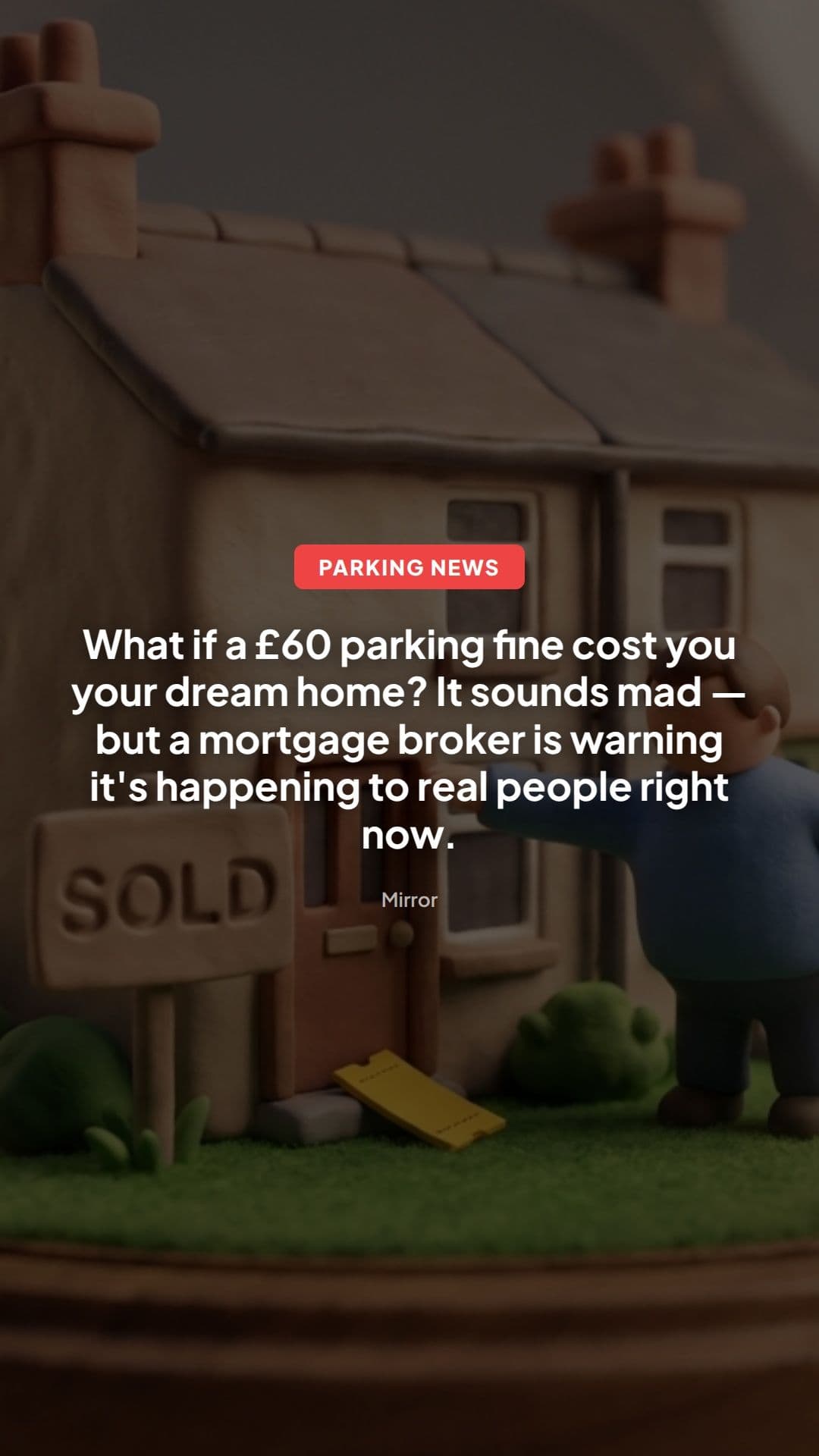
That £60 Parking Fine Could Cost You Your Mortgage: Here's What Every Driver Needs to Know
Imagine you're sitting across the desk from a mortgage adviser, documents in order, deposit saved, salary healthy. Everything looks good — until the adviser spots something on your credit file. A county court judgment. The reason? A £60 parking fine you forgot about three years ago.
It sounds far-fetched. It isn't.
A warning from a mortgage broker, reported by the Mirror, has thrown a spotlight on a financial risk that most drivers simply don't know exists: that a small, unpaid parking charge can quietly snowball into a credit-damaging judgment that follows you for six years — potentially derailing a mortgage application, a car finance agreement, or even a rental tenancy.
What the Warning Actually Said
The broker's concern, as reported by the Mirror, centres on the journey a parking charge can take when it goes unpaid. What begins as a modest notice — often as little as £60 — doesn't simply disappear if you ignore it. Instead, it enters a well-established escalation process that can, at its endpoint, land on your credit record in the form of a County Court Judgment (CCJ).
And here's the part that catches people off guard: a CCJ doesn't just mean you owe money. It means a court has formally ruled against you, and that ruling is registered on the Register of Judgments, Orders and Fines — a publicly accessible database that credit reference agencies including Experian, Equifax, and TransUnion routinely check. That single entry can drag down your credit score significantly and remain visible to lenders for six years from the date of the judgment.
For anyone applying for a mortgage, that's potentially catastrophic. Lenders conducting affordability and risk assessments will see the CCJ, and many — particularly high-street banks — will either decline the application outright or offer substantially worse terms.
Why This Matters More Than You Might Think
The UK parking enforcement landscape has changed dramatically over the past decade. Private parking operators — companies managing supermarket car parks, retail sites, hospital grounds, and residential estates — now issue tens of millions of parking charge notices (PCNs) every year. Recent data suggests the figure exceeds 13 million private parking tickets annually across the country.
Unlike council-issued PCNs, which are governed by the Traffic Management Act 2004 and enforced by local authorities, private parking charges are civil debts — essentially a contractual claim between the landowner (or their agent) and the driver. This distinction matters enormously.
Because private charges are civil matters, operators can pursue them through the civil courts. And they do. Debt collection agencies are routinely employed to chase unpaid charges, and if those efforts fail, the operator can apply for a County Court Judgment through the small claims process — often without the driver even being aware proceedings have begun.
This is partly because court documents are sent to the registered keeper's address on record with the DVLA. If you've moved house, or simply missed the post, you may receive a CCJ without ever having had the chance to contest the original charge.
The Legal Framework: What Operators Can and Cannot Do
It's worth understanding exactly what legal standing private parking operators have — because it's not unlimited.
The Parking (Code of Practice) Act 2019
This legislation, which came fully into force with the Private Parking Code of Practice, establishes a framework for how private operators must behave. The Code — overseen by the government and administered through two accreditation bodies, the British Parking Association (BPA) and the International Parking Community (IPC) — sets out rules on signage, grace periods, charge caps, and appeals processes.
Crucially, the Code introduced a mandatory 10-minute grace period at the end of paid or permitted parking time, meaning operators cannot issue a charge the moment a ticket expires. It also set a cap of £100 on parking charges in England, Scotland, and Wales (with a lower cap for some contravention types).
However, the Code does not prevent operators from pursuing unpaid charges through the courts. Once a charge has been legitimately issued and ignored, the civil debt route remains open to them.
The Keeper Liability Provisions
Under Schedule 4 of the Protection of Freedoms Act 2012, private operators gained the right to pursue the registered keeper of a vehicle — not just the driver — provided they follow a strict procedural process. This includes issuing a Notice to Keeper within specific timeframes and complying with requirements around signage and notice content.
If an operator fails to comply with these procedural requirements, their ability to pursue the keeper (as opposed to the driver) falls away. This is one of the most powerful defences available to drivers — and one that is frequently overlooked.
What Drivers Should Know: Practical Steps
If you've received a private parking charge, here's what you need to understand:
1. Don't automatically ignore it — but don't automatically pay it either
The instinct to bin a private parking ticket is understandable, but dangerous. Equally, paying without question rewards operators who may have issued charges unlawfully. Read the notice carefully.
2. Check the operator's accreditation
Only operators accredited with the BPA or IPC can access DVLA keeper data. If the notice comes from an unaccredited operator, they may have no legal basis to pursue you as the keeper.
3. Look for procedural errors
Was the Notice to Keeper issued within 14 days (if no windscreen ticket was left) or 28 days (if a windscreen ticket was issued)? Were the signs at the location clear, prominent, and compliant? Did the operator follow the correct appeals process? Any of these failures can invalidate the charge.
4. Use the formal appeals process
Both the BPA and IPC operate independent appeals services — POPLA (for BPA members) and the IAS (for IPC members). These are free to use and provide a genuine opportunity to contest charges without going to court. Use them.
5. Monitor your credit file
If you suspect an old parking charge may have progressed further than you realised, check your credit file with all three main reference agencies. You're entitled to a free statutory report. If you find a CCJ you weren't aware of, you may be able to apply to have it set aside — particularly if you weren't notified of the court proceedings.
6. Pay promptly if the charge is valid
If you've checked the notice, confirmed the operator is compliant, and concluded the charge is legitimate — pay within the reduced-rate window (usually 14 days from issue) to minimise the amount owed and close the matter down.
Looking Ahead: A System That Needs Greater Transparency
The broker's warning is timely, but it also points to a broader problem: most drivers have no idea that a parking dispute can end up affecting their financial life in such a significant way. The gap between "I'll just ignore this" and "CCJ on my credit file" is narrower than almost anyone realises.
There is growing pressure on the government to improve transparency around how private parking charges escalate, and to require operators to more clearly communicate the potential consequences of non-payment — including the credit implications. At present, many notices bury this information in small print, if they include it at all.
The Digital Markets, Competition and Consumers Act 2024 has given the Competition and Markets Authority (CMA) new powers in consumer protection, and there is an argument that the opacity of parking charge escalation falls squarely within its remit. The CMA has already fined at least one major parking operator for failing to comply with information requests — a sign that regulatory appetite in this space is sharpening.
For drivers, the message is straightforward: treat every parking charge notice as the legally significant document it is. A £60 fine left unaddressed doesn't disappear — it grows, escalates, and can ultimately cost you far more than the original sum. At the extreme end, it could cost you your home.
That's not scaremongering. That's the law as it currently stands.
Written by
Carlos Mendoza
Parking Technology Analyst
Ready to Challenge Your Ticket?
Let our AI analyse your PCN and generate a professional appeal letter in minutes.
Start Free Appeal